Top 12 Best AIO Cooler for 13900K You Can’t Miss!
When running a high-performance CPU like the 13900k, heat can quickly become a serious headache. A cheap or ill-fitting cooler often struggles to keep temperatures down, leading to throttling and shorter hardware lifespan.
Finding the best aio cooler for 13900k is crucial because this processor can easily surpass 125 watts under load, demanding effective heat dissipation to maintain stability during intense tasks.
The difference between a good and a poor aio cooler often comes down to radiator size, pump quality, and compatibility with your case and motherboard. Radiators of at least 240mm are common for the 13900k to handle its thermal output, while a reliable pump ensures consistent coolant flow to prevent hotspots.
Proper mounting and a secure fit are essential to avoid leaks and ensure full contact with the CPU’s heat spreader for efficient cooling.
Need a Quick Check?
| Image | Product | Price |
|---|---|---|
Our Top Picks 1  | ARCTIC Liquid Freezer III 360 | Check Price |
Our Top Picks 2  | ARCTIC Liquid Freezer III Pro | Check Price |
Our Top Picks 3  | Cooler Master 360 Atmos | Check Price |
Our Selected Top 12 Aio Cooler for 13900k for Different Needs
This list features a variety of all-in-one coolers designed to efficiently manage the 13900k processor’s heat output. Each review covers performance, suitability for different setups, and highlights key strengths and potential drawbacks to help you find the best match for your needs.
1. ARCTIC Liquid Freezer III Pro 360 CPU Cooler
77 cfm airflow capacity makes the ARCTIC Liquid Freezer III Pro 360 a powerful choice for anyone running an Intel 13900K. It’s built to keep high-performance CPUs cool by focusing on optimized pressure distribution and efficient heat dissipation, well-suited for gamers and heavy multitaskers.
Installation is straightforward, especially with the native offset mounting targeting the CPU hotspot, which should simplify setup without guesswork. The integrated VRM fan quietly manages voltage converter temperatures, so daily operation runs smoothly without loud fan noise.
The P12 PRO fan delivers improved performance at both low and high speeds, making routine use stable even under heavy load.
Cooling results meet expectations, with the liquid setup and fan combination maintaining low temperatures under pressure. The build feels solid, and the shifted cold plate improves heat transfer noticeably. Most praise highlights quiet operation and stable performance.
On the downside, some find the maximum rotational speed of 3000 rpm a bit on the higher noise side during intense workloads.
Quiet performance and effective cooling receive strong praise, with many appreciating the smart cold plate design and VRM fan. The main complaint revolves around higher noise levels at the fan’s top speed and the physical size of the cooler which needs ample case space.
Users with roomy cases and a focus on efficient thermal management will benefit from this cooler. Those with smaller builds or who require ultra-quiet operation at maximum load might consider alternatives with smaller radiators or quieter fans.
Pros
- Quiet operation, especially at low fan speeds
- Efficient cooling with high airflow
- Integrated VRM fan lowers voltage converter temperature
- Optimized cold plate placement for better heat transfer
Cons
- Maximum fan speed can get noisy under load
- Large 360mm radiator may not fit all cases
| Specification | Details |
|---|---|
| Air Flow Capacity | 77 cfm |
| Maximum Rotational Speed | 3000 rpm |
| Power Connector Type | 4-Pin |
| Voltage | 12 volts |
| Wattage | 3.96 watts |
| Cooling Method | Liquid |
2. ARCTIC Liquid Freezer III Pro 360 A-RGB CPU Cooler
People building high-performance rigs or overclocking with an Intel 13900K will appreciate this cooler’s focused design on efficient heat transfer and VRM cooling. Its standout feature is the integrated VRM fan paired with a large 360mm radiator to keep temperatures low consistently, even under heavy CPU loads.
Setup involves mounting the cold plate off-center, targeting the CPU hotspot directly, which improves heat conduction. Installation is straightforward for Intel sockets like LGA1851 and LGA1700 due to the optimized contact frame.
The ARCTIC P12 PRO fans offer quiet airflow with better performance at low speeds, so day-to-day use is quieter while still ready to spin up at up to 3000 rpm when your CPU demands more cooling.
Cooling power holds up well against the 13900K’s heat output, helped by a strong airflow capacity of 77 cfm. The build quality is solid, with careful pressure distribution on the CPU for long-term reliability. Praise often highlights the quiet operation, while some note the integrated VRM fan can be heard during peak loads.
Quiet daily operation receives strong praise, with the integrated VRM fan being a key benefit for system stability. Common complaints mention that the VRM fan noise becomes apparent when the system is under very heavy load, slightly detracting from the otherwise quiet profile.
Those wanting excellent cooling paired with quiet fans during typical use will be satisfied. Anyone extremely sensitive to noise under max load or wanting a completely silent VRM solution might look toward alternatives without an active VRM cooler.
Pros
- Optimized contact frame for better heat dissipation
- Integrated VRM fan lowers voltage converter temperature
- Quiet operation even at higher fan speeds
- Higher maximum speed for intense cooling demands
Cons
- VRM fan noise noticeable under heavy load
- Relatively high maximum fan speed may increase noise
| Specification | Details |
|---|---|
| Power Connector Type | 4-Pin |
| Voltage | 12 volts |
| Wattage | 3.96 watts |
| Maximum Rotational Speed | 3000 rpm |
| Air Flow Capacity | 77 cfm |
| Cooling Method | Liquid |
3. Cooler Master 360 Atmos AIO Liquid Cooler
Cooling high-performance chips like the Intel i9 13900k requires focused design, and the Cooler Master 360 Atmos AIO Liquid Cooler stands out by using a patented Next Gen Dual Chamber to boost water pressure directly at the CPU hotspot. It’s particularly suited for desktop users wanting efficient heat dissipation combined with some visual customization options.
Installation is pretty straightforward, thanks to the redesigned brackets that fit AM5 and LGA 1851|1700 sockets without much fuss. The ultra-thin spade fins inside the radiator concentrate on cooling the CPU where it matters most. Along with the pre-installed SickleFlow 120 Edge fans, the setup offers enough airflow while staying relatively quiet at 25 dB noise level.
Performance-wise, it handles heat from processors like the i9 with ease, thanks to optimized microchannels and strong, focused water flow. The build quality feels solid, with durable fans and a customizable pump top cover to personalize the look using your own 3D designs. The loudest complaint tends to be about the fan speed reaching up to 2500 rpm, which can come with some noticeable noise at full load.
The patented dual chamber system effectively directs water flow to cool critical CPU areas, keeping temperatures low during heavy loads. Some users find the increased fan speed necessary for maximum cooling introduces noticeable noise, which may impact desk noise levels.
Gamers and content creators pushing their Intel i9 13900k will appreciate this cooler’s focused performance and easy fit on newer sockets. Anyone needing extremely quiet operation or limited by case size might want to explore smaller or quieter alternatives.
Pros
- Targeted heat dissipation for CPU hotspot
- Easy installation on AM5 and LGA sockets
- Customizable pump top cover with 3D designs
- Quiet operation at typical speeds (25 dB)
Cons
- Fan noise can be loud at full speed
- Requires some space for 360mm radiator
| Specification | Details |
|---|---|
| Cooling Method | Water |
| Power Connector Type | 4-Pin |
| Noise Level | 25 db |
| Maximum Rotational Speed | 2500 rpm |
| Air Flow Capacity | 70.7 cfm |
4. Thermalright Peerless Vision 360 ARGB CPU Cooler

Thermalright Peerless Vision 360 ARGB is a water cooler designed for the Intel 13900k, excelling in keeping temps down with a 360mm radiator and strong airflow. Its standout feature is the 3.95-inch magnetic screen on the pump head, which adds a cool customizable visual flair for users who like a personalized build.
Setup involves attaching the pump head magnetically, which is quick and easy to swap out or adjust. The three TL-M12Q fans spin up to 2000 rpm and include RGB infinity mirror lighting.
They’re designed to be quiet thanks to the S-FDB bearing that cuts down on vibration and noise. Day-to-day, it works silently in the background, moving heat away fast without needing frequent cleanup.
Performance is solid with reliable heat dissipation from the large radiator and high airflow fans, making it capable of handling the heat output of a 13900k. Build quality feels sturdy, with a narrow bezel screen that shows animations smoothly at 60Hz. Praise often mentions the ease of installation and quiet fan operation, while a common gripe is some users find the screen resolution limits customization options.
Strong points include the quiet operation and fast cooling thanks to the trio of high-RPM fans paired with the radiator. Users often appreciate the magnetic screen’s unique look, though some mention the limited screen resolution when trying to personalize it.
This cooler suits those who want solid thermal performance combined with eye-catching visuals on a high-end CPU like the 13900k. People who prefer simpler setups without digital displays might find a traditional AIO cooler more to their liking.
Pros
- Magnetic pump head for quick installation
- Three PWM fans with reduced noise
- ARGB infinity mirror lighting adds style
- Supports video and animations on display
Cons
- Screen resolution limits detailed customization
- Fans can reach noticeable speed under max load
| Specification | Details |
|---|---|
| Power Connector Type | 4-Pin |
| Wattage | 45 watts |
| Cooling Method | Water |
| Maximum Rotational Speed | 2000 rpm |
| Noise Level | 28.2 db |
| Air Flow Capacity | 68.9 cfm |
5. CORSAIR Nautilus 360 RS AIO Liquid Cooler

Running a high-performance system like the 13900k cools down effectively with the CORSAIR Nautilus 360 RS AIO Liquid Cooler. It suits anyone looking for strong thermal management with quiet operation, especially those who want a neat setup thanks to its smart fan connections.
Its biggest strength lies in balancing powerful cooling while keeping noise low.
Setting up is straightforward, especially since the RS120 fans come pre-installed and can be daisy-chained. Connecting just one cable to the motherboard cuts down on cable clutter, making the installation much quicker.
Daily use benefits from CORSAIR AirGuide technology, focusing airflow where it’s needed most to keep temperatures steady without loud fan noise.
Cooling performance is solid, handling the CPU’s heat output with ease and maintaining stable temperatures during heavy loads. The Magnetic Dome bearing in the fans helps keep operation quiet by reducing friction.
Reviewers often praise the combination of strong airflow and low noise, while some note the highest fan speed could be louder under extreme load.
The strongest praise revolves around effective cooling paired with low noise thanks to the Magnetic Dome bearing fans, while the most common complaint centers on the fan speed limit potentially restricting maximum airflow during extreme workloads.
Those who value a balance of quiet operation and strong thermal control will appreciate this cooler, especially with its easy cable management. Users who need the absolute highest airflow or have less common motherboard setups might want to explore other options.
Pros
- Pre-installed RS120 fans with focused airflow
- Supports AMD AM5/AM4 and Intel LGA 1851/1700 sockets
- Daisy-chained fans reduce cable clutter
- Quiet Magnetic Dome bearing fans
Cons
- Fan speed maxes at 2100 rpm, limiting peak airflow
- Installation requires compatible motherboard headers for daisy-chaining
| Specification | Details |
|---|---|
| Power Connector Type | 4-Pin |
| Cooling Method | Water |
| Maximum Rotational Speed | 2100 rpm |
| Compatible Devices | Desktop |
6. MSI MPG CoreLiquid P13 360 AIO Liquid Cooler

Great for anyone running a 13900k who needs a powerful and quiet cooling solution. It stands out with its unique hidden-cable design that keeps everything clean and a 2.1-inch LCD screen that shows real-time system info. Perfect for those who want performance and a bit of flair.
Setup is straightforward with sleeved tubing hiding all the pump power and display wires, so no clutter around the cooling head. The CycloBlade 9 fans push plenty of air with good pressure, making it reliable day to day.
The LCD screen adds value by letting you track temps or show custom graphics. Running and monitoring this cooler feels smooth and modern.
Cooling performance is solid thanks to the full-plane copper base enhancing water-tightness and efficiency. The cooler handles heat loads well without getting loud.
Build quality feels dependable, with the main praise focusing on the clean cable management and display. Some have noted the 2050 rpm fan speed can be a little noisy under heavy load.
The standout feature is the hidden cable setup combined with the informative LCD screen, keeping the build tidy and user-friendly. Some find fan noise noticeable when pushed to full RPM, which can be distracting during heavy workloads.
People who value a clean, visually appealing system with good cooling should be happy with this unit. Those looking for ultra-quiet operation or more fan control options might want to explore other coolers better suited for noise-sensitive setups.
Pros
- Hidden cable design keeps pump head clean
- 2.1-inch LCD for real-time system info
- Strong airflow with CycloBlade 9 fans
- Full-plane copper base improves water-tightness
Cons
- Fans may get noisy at max speed
- 4-pin connector limits fan control options
| Specification | Details |
|---|---|
| Power Connector Type | 4-Pin |
| Voltage | 5 volts |
| Wattage | 1.68 watts |
| Maximum Rotational Speed | 2050 rpm |
| Air Flow Capacity | 64.9 cfm |
7. Noctua NL-LC1-36 360mm AIO CPU Cooler

Asetek Emma V2 closed-loop cooling paired with a large 360mm radiator gives this unit impressive thermal control. Designed for serious desktop use, it suits builders aiming for both quiet operation and strong cooling power, especially with demanding CPUs like the 13900k. Its standout quality is quiet pump performance combined with effective heat dissipation.
Setup involves mounting the sizeable radiator and hooking up three 120mm PWM fans, which are notably quiet during everyday computing or gaming sessions. The innovative pump noise absorber keeps vibrations and noise low.
Fans adjust speeds intelligently for a good balance of airflow and sound levels. Running at 12 volts, it draws modest power without adding unnecessary noise or heat.
Cooling capacity is excellent thanks to the generous radiator and efficient fan design, ideal for high-performance chips under load. Built with quality components, the pump’s soundproofing structure is a highlight. A common downside mentioned concerns the bulkiness of the 360mm radiator, requiring ample case space and careful installation planning to avoid fitment issues.
The quiet pump is widely praised for its low vibration and noise, making steady cooling unobtrusive in daily use. Most note the radiator’s large size as the biggest hurdle, requiring a spacious and well-planned internal layout to fit without issues.
Those focused on a silent yet capable cooler for high-performance CPUs will appreciate its design and quiet operation. Builders with smaller cases or tight internal space might want to consider a smaller or differently designed cooler to avoid fitment problems.
Pros
- Very quiet pump operation with noise absorber
- Strong heat dissipation via large 360mm radiator
- Efficient 120mm PWM fans with speed-offset control
- Low vibration levels during operation
Cons
- 360mm radiator size demands large case compatibility
- Installation can be challenging due to radiator dimensions
| Specification | Details |
|---|---|
| Power Connector Type | 4-Pin |
| Voltage | 12 volts |
| Wattage | 1.8 watts |
| Noise Level | 22.5 db |
| Maximum Rotational Speed | 1800 rpm |
| Air Flow Capacity | 107.3 cubic meter per hour |
8. Thermalright Frozen Warframe 360 SE ARGB Cooler
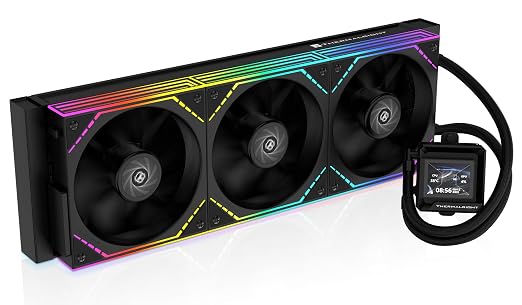
A 360mm liquid cooler with a standout 2 LCD screen, perfect for gamers and creators running a 13900k. The biggest draw is its large, customizable screen that shows system info or fun images in an easy-to-see spot on your PC.
Setting it up involves mounting the 397×120×27mm aluminum radiator in a case that fits the size, which is standard for a triple-fan configuration. The included 3×TL-M12Q 120mm fans connect with a daisy-chain setup, cutting down on cable mess and enhancing airflow. The software lets you change what’s displayed on that LCD, making everyday use a bit more personal and visually interesting beyond just the cooler’s function.
Cooling performance holds up well under gaming and creative workloads thanks to the 3000RPM pump and fans that run up to 2000RPM providing solid airflow (68.9 CFM) and water pressure (2.21mmH2O). The build feels sturdy with the aluminum radiator and quiet operation at around 28.2 dB.
The screen is typically praised for its customization but some users mention it can be a little tricky to configure at first.
The customizable LCD screen draws a lot of positive attention for adding a unique visual element while the cooler maintains solid thermal performance for demanding tasks. On the downside, configuring the screen’s display is mentioned as not the most user-friendly experience in everyday use.
This cooler suits people who want a mix of strong cooling with eye-catching customization in a roomy PC case. Those with smaller cases or who prefer simplicity over extra features may want to look at other AIO coolers without a screen or with smaller radiators.
Pros
- Customizable 2″ LCD screen for system info and images
- Three PWM fans reduce cable clutter with daisy-chain setup
- Strong airflow and water pressure for consistent cooling
- Compatible with most current Intel and AMD sockets
Cons
- Large radiator requires spacious case installation
- LCD software setup can be confusing initially
| Specification | Details |
|---|---|
| Radiator Dimensions | 397×120×27mm |
| Maximum Fan Speed | 2000 rpm |
| Air Flow Capacity | 68.9 cfm |
| Noise Level | 28.2 db |
| Compatibility | AMD AM5 AM4 and Intel LGA1851 1700 1200 115X |
| Power Connector | 4-Pin, 12 volts, 3 watts |
9. LIAN LI HydroShift II OLED 360 AIO Cooler

Choosing a water cooling system that handles the heat from an Intel 13900k is critical, and this Lian Li HydroShift II OLED 360 AIO Cooler stands out for its vivid 6.67” 2K curved OLED display and customizable motorized pump head. It’s tailored for users who want powerful cooling combined with unique visual flair and a personalized setup.
Installing the cooler involves using the motorized pump head, which you can adjust in lift, rotation, and dual-axis movement, making it easy to find the perfect position inside your case without hassle. The OLED display not only looks impressive but lets you monitor system data directly on the pump. The accompanying L-Connect 3 software simplifies controlling these features to fit your preferences.
Its water cooling method handles CPU heat effectively, aided by a maximum fan speed of 2600 rpm. The build feels solid, and the noise level remains relatively low at 33 dB, making it a balanced choice between performance and quiet operation.
Positive feedback often highlights the display and customization, while some users note the complex angle adjustments can take some getting used to.
The OLED display and motorized pump head customization receive constant praise for visual appeal and adaptability, while some find the adjustment controls less intuitive at first. Cooling efficiency keeps temperatures well-managed for demanding CPUs without being overly loud.
Enthusiasts who enjoy visible system stats and flexible hardware orientation will be satisfied. Those wanting a simpler, no-fuss cooler might prefer models without motorized parts or advanced displays.
Pros
- High-clarity OLED display with vivid colors
- Motorized pump head with multi-axis movement
- Quiet operation at 33 dB noise level
- Supports powerful cooling for high-end CPUs
Cons
- Angle adjustments may feel complicated initially
- Water cooling setup requires careful installation
| Specification | Details |
|---|---|
| Cooling Method | Water |
| Noise Level | 33 dB |
| Maximum Rotational Speed | 2600 rpm |
| Compatible Devices | CPU, Desktop |
| Display | 6.67” 2K curved OLED, 500 nits brightness |
10. NZXT Kraken Elite 360 RGB AIO CPU Cooler

Keeping a powerful CPU like the 13900k cool under heavy loads is essential, especially in intense gaming or creative work setups. Designed for desktop use, the NZXT Kraken Elite 360 RGB provides solid water cooling with an attractive, customizable display that suits users wanting impressive cooling and personalized aesthetics.
Installing the cooler involves connecting the 8-pin power connector and integrating it with NZXT’s software to manage the LCD display and RGB lighting. The large IPS screen lets you track system info or show images easily while syncing lighting effects with your build’s style.
Day-to-day operation is quiet, thanks to the low 30 db noise level and efficient pump keeping the CPU temperature in check.
Performance-wise, the pump delivers a high flow rate and sufficient head pressure, giving the 13900k a noticeable temperature advantage without loud fan noise. Build quality feels sturdy, with well-made water cooling and visually striking elements.
Praised for its vibrant IPS display and quiet operation, some users mention the setup can require patience to customize the software fully.
The cooler offers very effective temperature control for heat-heavy CPUs and a visually impressive LCD screen that many find appealing. Most common user difficulty rests in the detailed software setup for display and lighting customization.
Those wanting excellent CPU cooling paired with aesthetic customization will appreciate this model. Users looking for simpler installation or lower power consumption might consider alternative options.
Pros
- Quiet with only 30 db noise level
- Large 2.72-inch high-resolution IPS display
- Customizable with Google Photos, Spotify, YouTube integration
- High cooling performance via efficient pump
Cons
- Software customization can be time-consuming
- Relatively high wattage at 28.44 watts
| Specification | Details |
|---|---|
| Power Connector Type | 8-Pin |
| Voltage | 12 volts |
| Wattage | 28.44 watts |
| Noise Level | 30 db |
| Maximum Rotational Speed | 2400 rpm |
| Air Flow Capacity | 78.86 cfm |
11. Noctua NL-LC1-24 240mm AIO CPU Cooler

Quiet operation stands out with a noise level rated at 22.5 dB, making the Noctua NL-LC1-24 240mm AIO CPU Cooler a reliable choice for anyone needing strong thermal control without noise distractions. Builders working on compact setups will also appreciate the radiator’s compact size paired with high-efficiency fans.
Setup involves fitting the 240mm radiator in tight spaces, which works well for Small Form Factor PCs thanks to its compact design. The two NF-A12x25 G2 PWM 120mm fans run with speed offset, keeping noise low without sacrificing airflow.
The pump’s noise absorber system further cuts down vibrations, making day-to-day use quieter than typical AIO coolers.
Thermal performance is solid due to the Asetek Emma V2 platform, cooling efficiently through water. Construction quality feels premium with a focus on acoustic comfort and durability.
Most users notice how quiet the pump runs, but a few mention the relatively standard 1.8-watt pump power, which could limit extreme overclocking potential.
Reviews commonly highlight the quiet pump design as a major plus, thanks to the acoustic soundproofing and vibration reduction. Some users point out that the pump’s power is modest, which might not satisfy those pushing the CPU to the highest clocks. Daily use delivers effective cooling with minimal noise disruptions.
Ideal for anyone building a near-silent Small Form Factor PC or seeking a cooler that balances sound and performance. Those aiming for extreme overclocking or working with large cases might want to explore alternatives with higher pump wattage or bigger radiators.
Pros
- Quiet pump operation with 3-layer soundproofing
- Compact 240mm radiator fits smaller builds
- Two high-efficiency Noctua fans included
- Strong airflow at low noise levels
Cons
- Limited pump wattage may constrain heavy overclocking
- Radiator size may not suit all large cases
| Specification | Details |
|---|---|
| Power Connector Type | 4-Pin |
| Voltage | 12 volts |
| Wattage | 1.8 watts |
| Cooling Method | Water |
| Noise Level | 22.5 db |
| Maximum Rotational Speed | 1800 rpm |
| Air Flow Capacity | 107.3 cubic meter per hour |
12. Thermalright Frozen Infinity 360 CPU Cooler

Enthusiasts running an Intel 13900K will appreciate a cooler that handles serious heat without making too much noise. Designed for high-performance builds, it suits those wanting strong cooling with a bit of style thanks to ARGB lighting.
Its biggest strength is reliably keeping temperatures down with a water-cooled radiator and triple fans spinning up to 2000RPM.
Setting it up requires a bit of space due to the large 397mm radiator size, but the fans come with temperature control which helps modulate airflow and noise based on demand. The water pump operates quietly, never exceeding 28.2 dB, so day-to-day use stays calm even under load.
Fans balance airflow nicely at 68.9 CFM without feeling intrusive, keeping your processor cool and your PC fairly quiet.
Cooling performance is solid, thanks to the strong pump and well-sized radiator. Build quality feels sturdy with a decent cold plate size of 63x63x60mm. The fans’ S-FDB bearings reduce vibration and wear, enhancing longevity.
Most praise centers on excellent cooling paired with quiet operation. The biggest complaint highlights the cooler’s bulk, which might challenge smaller cases or limited mounting space.
Cooling is impressive with a quiet pump and efficient fans that balance speed and noise well. The primary drawback is its size, which can be a tight fit in smaller cases, limiting compatibility.
People building a large gaming or workstation rig with plenty of room and who want quieter cooling and lighting effects will appreciate this. Those with compact cases or strict noise limits might want to explore alternatives.
Pros
- Quiet operation with noise under 28.2 dB
- Strong airflow at 68.9 CFM keeps CPU cool
- ARGB fans add customizable lighting effects
- S-FDB bearings reduce vibration and extend life
Cons
- Large radiator size requires ample case space
- High-speed fans may still be audible under load
| Specification | Details |
|---|---|
| Radiator Size | 397*120*52 mm |
| Fan Size | 124*120*25 mm |
| Maximum Fan Speed | 2000 RPM |
| Noise Level | ≤28.2 dB(A) |
| Air Flow | 68.9 CFM |
| Power Connector | 4-Pin |
Best AIO Coolers for 13900k Compared Side by Side
| Product | Cooling Method | Max RPM | Air Flow | Noise Level |
|---|---|---|---|---|
| ARCTIC Liquid Freezer III 360 | Liquid | 3000 rpm | 77 cfm | – |
| ARCTIC Liquid Freezer III Pro | Liquid | 3000 rpm | 77 cfm | – |
| Cooler Master 360 Atmos | Water | 2500 rpm | 70.7 cfm | 25 db |
| Thermalright Peerless Vision 360 | Water | 2000 rpm | 68.9 cfm | 28.2 db |
| CORSAIR Nautilus 360 RS | Water | 2100 rpm | – | – |
| MSI MPG CoreLiquid P13 360 | Water | 2050 rpm | 64.9 cfm | – |
| Noctua NL-LC1-36 360mm | Water | 1800 rpm | 107.3 m³/h | 22.5 db |
| Thermalright Frozen Warframe 360 SE | Water | 2000 rpm | 68.9 cfm | 28.2 db |
| LIAN LI HydroShift II OLED | Water | 2600 rpm | – | 33 db |
| NZXT Kraken Elite 360 RGB | Water | 2400 rpm | 78.86 cfm | 30 db |
| Noctua NL-LC1-24 240mm | Water | 1800 rpm | 107.3 m³/h | 22.5 db |
| Thermalright Frozen Infinity 360 | Air | 2000 rpm | 68.9 cfm | 28.2 db |
- Cooling MethodLiquid
- Max RPM3000 rpm
- Air Flow77 cfm
- Noise Level–
- Cooling MethodLiquid
- Max RPM3000 rpm
- Air Flow77 cfm
- Noise Level–
- Cooling MethodWater
- Max RPM2500 rpm
- Air Flow70.7 cfm
- Noise Level25 db
- Cooling MethodWater
- Max RPM2000 rpm
- Air Flow68.9 cfm
- Noise Level28.2 db
- Cooling MethodWater
- Max RPM2100 rpm
- Air Flow–
- Noise Level–
- Cooling MethodWater
- Max RPM2050 rpm
- Air Flow64.9 cfm
- Noise Level–
- Cooling MethodWater
- Max RPM1800 rpm
- Air Flow107.3 m³/h
- Noise Level22.5 db
- Cooling MethodWater
- Max RPM2000 rpm
- Air Flow68.9 cfm
- Noise Level28.2 db
- Cooling MethodWater
- Max RPM2600 rpm
- Air Flow–
- Noise Level33 db
- Cooling MethodWater
- Max RPM2400 rpm
- Air Flow78.86 cfm
- Noise Level30 db
- Cooling MethodWater
- Max RPM1800 rpm
- Air Flow107.3 m³/h
- Noise Level22.5 db
- Cooling MethodAir
- Max RPM2000 rpm
- Air Flow68.9 cfm
- Noise Level28.2 db
How to Choose the Best AIO Cooler for 13900K
Choosing the right AIO cooler for the 13900K depends on factors like cooling performance, radiator size, and compatibility with your case. Prioritizing efficient heat dissipation and proper fit helps avoid overheating and noise issues, saving both money on repairs and frustration during installation.
Cooling Performance
Processors like this one generate a lot of heat, especially under heavy load, so the cooling system’s ability to keep temperatures down is crucial. Pumps need to move coolant efficiently without fail, and radiators must dissipate heat quickly. Models with thicker or longer radiators, such as 240mm or 360mm sizes, generally handle heat better than smaller ones.
The fluid inside is usually a mix designed to resist corrosion and maintain flow, but the overall design of the pump and radiator influences cooling more noticeably.
A well-matched pump and radiator combo keeps the CPU temperature steady even in intense gaming or rendering sessions. Systems with a weak pump or undersized radiator often suffer from thermal throttling, which reduces performance to keep the CPU safe.
For this level of CPU, pay attention to AIO coolers that feature high flow pumps and radiators with dense fin arrays to maximize heat rejection.
Compatibility and Size
Big radiators won’t fit inside every case, so checking available space is important. A 360mm radiator requires mounting options and case clearance that not all mid-towers provide. Users have encountered issues where a radiator blocks memory slots or interferes with tall RAM heatsinks.
Support for the LGA 1700 socket is essential, as older brackets won’t line up properly and can cause installation headaches or poor contact pressure.
Check the cooler specifications for bracket compatibility with this specific socket and confirm that there’s enough clearance around the CPU socket area for your RAM and VRM heatsinks. Some manufacturers include low-profile mounting kits or adjustable brackets to accommodate different setups.
Assembling a rig without the right size and support ends up frustrating and could lead to suboptimal cooling if the cooler can’t be properly installed.
Noise Levels
Fans ramping up during intense CPU use can get loud, with speeds reaching up to 2000 RPM or more. Pumps also produce a low humming noise and sometimes vibrations that can be noticeable if the unit isn’t mounted securely.
Coolers with high-quality, fluid dynamic bearing fans tend to run quieter across a wider range of speeds, which helps maintain a good balance between noise and performance.
At idle, some AIOs slow the fans significantly or stop them altogether, leading to near-silent operation. Heavy load causes fan noise to increase but looking for models with PWM control allows fine-tuning noise vs. cooling.
There’s usually a trade-off, but some coolers manage to keep noise under 30-35 dBA at load, which makes daily use less intrusive. Checking user reviews or product specs for noise ratings at different RPM levels offers a realistic expectation.
Build Quality and Materials
Leaks or corrosion inside an AIO cooler are the worst problems users face, so the quality of tubing, fittings, and radiators matters. Tubes made of thick, reinforced rubber or nylon braided sleeves resist kinking and deterioration over time.
Fittings should have solid seals to avoid coolant loss, and radiators with aluminum fins combined with copper coolant channels provide durable and efficient heat transfer.
The fan blades’ material and design also affect longevity and performance. Rigid, well-balanced plastic blades reduce wear and wobble. A sealed unit that doesn’t allow air in prevents oxidation or fluid evaporation, which can degrade cooling capability over months or years.
Durable build quality translates to a longer lifespan and fewer worries about maintenance or breakdowns in daily use.
Ease of Installation and Maintenance
Installing an AIO cooler can range from straightforward to challenging depending on the mounting design and included hardware. Brackets that come pre-installed or with clear instructions save significant time. Securing the pump unit firmly without over-tightening ensures good contact with the CPU and prevents damage.
Some units require removing the motherboard to mount while others fit from the front, impacting installation ease.
Most AIOs are sealed, so filling or topping up coolant is not an option, making initial fills critical. Cable management also plays a big role: routing pump and fan cables cleanly behind the motherboard tray avoids clutter and allows better airflow.
Having integrated fan headers and control software compatibility allows easy adjustments without digging into the BIOS repeatedly, making life simpler for daily users.
Tips for Optimizing AIO Cooler Performance with the 13900K
Good thermal performance with the 13900K depends heavily on proper mounting and ensuring good contact between the cooler’s cold plate and the CPU surface. Tighten the screws evenly in a cross pattern to avoid pressure imbalances that can reduce heat transfer efficiency.
Using high-quality thermal paste is essential. Apply a thin, even layer without excess; too much paste can create air gaps that hinder heat conduction.
Allow the cooler’s pump to run at a steady speed, as fluctuating pump speeds can increase temperatures under load.
Other tips include:
- Orienting radiator fans for optimal airflow, ideally pushing hot air out of the case.
- Routing tubes carefully to prevent kinks that restrict coolant flow.
- Ensuring your case has sufficient intake fans to balance airflow and maintain consistent cooling under stress.
Common Installation Mistakes to Avoid When Mounting an AIO Cooler
One of the most frequent mistakes during installation is uneven mounting pressure. This can lead to hotspots on the CPU, causing higher temperatures. Use the provided mounting bracket carefully and tighten screws incrementally.
Incorrect orientation of the radiator or pump head can also affect cooling performance and longevity. Avoid positioning the pump so that air bubbles collect inside, as this causes noise and reduces coolant circulation.
Many users skip the step of cleaning the CPU surface and cooler base, which is crucial for maintaining effective thermal contact. Use isopropyl alcohol to remove old thermal paste before applying a new layer.
Additional pitfalls to watch out for:
- Connecting fans to the wrong headers, resulting in insufficient speed control.
- Neglecting to check for clearance issues that could strain tubing or block RAM slots.
Comparing AIO Coolers to Air Coolers for the Intel 13900K
AIO coolers for the Intel 13900K tend to offer more consistent temperature control under load compared to air coolers, primarily due to the active coolant circulation and larger heat dissipation area with radiators.
Air coolers can perform well in cases with good airflow and are often quieter under low to moderate loads, but they may struggle to maintain optimal temperatures during heavy or sustained workloads, where the 13900K can generate significant heat.
Maintenance is another difference: air coolers typically require less upkeep, while AIOs might need periodic monitoring for pump noise or coolant levels, despite being sealed units.
Key considerations:
- AIOs usually occupy less vertical space on the motherboard, improving RAM clearance options.
- Air coolers avoid potential pump failures but can be bulky, impacting case compatibility.
People Also Asked
How to Properly Install an AIO Cooler on 13900k?
Secure the backplate to the motherboard and align the pump block evenly over the CPU. Tighten screws diagonally to prevent uneven pressure. Make sure to apply a thin, even layer of thermal paste before mounting the block to ensure good thermal transfer.
What Size AIO Cooler Fits Perfectly in My PC Case?
Measure your PC case radiator mounting area before purchasing. Many mid-tower cases support up to 240mm or 280mm radiators; larger cases might fit 360mm units. Consider clearance for RAM height and GPU length when checking compatibility.
How Long Do AIO Coolers Typically Last with 13900k?
Most AIO coolers last around 5 to 7 years under normal use, but this varies based on pump quality and usage conditions. Fans and pump bearings can wear out earlier and might need replacement or maintenance during that time.
Are There Common Leaks or Maintenance Issues with AIO Coolers?
Leaks are rare but can occur due to seal degradation or physical damage. Regularly check for unusual noises or coolant discoloration. Keep an eye on coolant levels if your model allows topping off, and inspect tubes and connections periodically.
Is an AIO Cooler Safe for Long-Term Use on High-Performance CPUs?
AIO coolers are generally reliable for long-term use on high-performance CPUs when properly installed and maintained. Regular dusting of fans and radiator fins helps maintain cooling efficiency and prevents overheating during heavy loads.
Conclusion
Choosing the right AIO cooler for the 13900k mainly depends on cooling performance, noise levels, and compatibility with your PC case. Adequate cooling is crucial to protect the CPU during heavy tasks. Quiet operation matters if you spend long hours at your computer.
Ensuring the cooler fits your case and motherboard helps avoid installation problems.
Consider your available space and budget when making the final choice. A larger radiator might cool better but requires a bigger case.
Pick something that matches how much you use your system and your noise tolerance. Refer back to the comparison table and the options listed above to find a balance that works for your setup.

I’m Grant Mitchell, a firearms and hunting writer with years of experience at the range and in the field. I write about rifles, shotguns, handguns, optics, safe storage, cleaning, and responsible ownership, along with practical hunting tips. My goal is to share accurate, safety-first information that helps you choose the right firearm, maintain it properly, and become a more confident shooter.