Top 12 Best AMD Cooler That Will Blow Your Mind
Running a processor hot because of a cheap or poorly matched cooler is a common headache. The best amd cooler can make a noticeable difference, reducing heat significantly and avoiding random shutdowns or performance drops that come from thermal throttling.
A cooler that doesn’t fit well or isn’t powerful enough tends to struggle under load, causing the CPU to run hotter than it should.
What really matters in a best amd cooler is its compatibility with the CPU socket, the quality of the materials like copper heat pipes and aluminum fins, and the airflow capacity of the fan. Most effective models rely on multiple heat pipes and a fan size of around 120 millimeters to move enough air quietly. Proper mounting hardware matters too, ensuring the cooler contacts the CPU evenly without damaging the board or processor.
Easy-to-clean designs help maintain performance over time by preventing dust buildup.
Need a Quick Check?
| Image | Product | Price |
|---|---|---|
Our Top Picks 1  | Thermalright Peerless Assassin 120 SE | Check Price |
Our Top Picks 2  | be quiet! Pure Rock Pro | Check Price |
Our Top Picks 3  | Noctua NH-U12A chromax.Black | Check Price |
Our Selected Top 12 Amd Cooler for Different Needs
This list features a variety of AMD coolers designed to meet different performance needs and budgets. Each review explains how well the cooler performs, who it is best suited for, and highlights its main advantages and limitations.
1. Thermalright Peerless Assassin 120 SE CPU Cooler
Designed for desktop builds needing a strong cooler without a bulky footprint, this air cooler stands out with its quiet operation at just 25.6 dB. It suits anyone after solid thermal performance combined with low noise, especially those who value a balance between power and acoustics.
Setup involves attaching the cooler with a 4-pin power connector, giving you precise fan speed control thanks to its 12-volt rating. The cooler spins up to 1550 rpm, so it keeps things cool without turning into a noise source. Routine cleaning is straightforward since the fan and heatsinks are easy to access, helping maintain airflow over time.
With a capacity to handle 265 watts, it handles heat output from demanding CPUs efficiently. The cooler is built ruggedly with a focus on durability and consistent cooling performance.
Most praise points to its quiet operation, while the common downside is it may be slightly large for tight cases, limiting compatibility for some builds.
The quietness at 25.6 dB receives the most positive feedback, making it ideal for noise-sensitive setups. However, some find the size cumbersome for compact desktops, restricting installation options.
PC builders who prioritize low noise and efficient heat dissipation will appreciate this cooler. Users with smaller cases or those who need higher fan speeds might want to explore alternative coolers.
Pros
- Quiet operation at 25.6 dB
- Strong 265-watt cooling capacity
- Adjustable 4-pin power connector
- Good airflow with 66.17 cfm rating
Cons
- Size may cause fit issues in small cases
- Fan speed capped at 1550 rpm limits max cooling
| Specification | Details |
|---|---|
| Power Connector Type | 4-Pin |
| Voltage | 12 volts |
| Wattage | 265 watts |
| Noise Level | 25.6 db |
| Maximum Rotational Speed | 1550 rpm |
| Air Flow Capacity | 66.17 cfm |
2. Be Quiet! Pure Rock Pro 3 CPU Cooler
be quiet! Pure Rock Pro 3 is an air cooler designed to keep AMD CPUs running cool, especially suited for users pushing their systems with overclocking or heavy workloads.
Its biggest strength lies in the six high-performance copper heat pipes combined with a nickel-plated base that manage heat effectively.
Installation is straightforward, fitting AMD sockets like AM4 and AM5 smoothly. The fan runs quietly at 34.8 dB, barely noticeable during day-to-day operation.
Its 120mm fan with optimized blade angles and a funnel-shaped air outlet steadily moves air, clearing heat away without adding much noise to your setup.
Heat transfer is solid thanks to the six copper pipes, handling demanding tasks with ease. Built with quality materials, it feels sturdy and well-made. Positive feedback often highlights the quiet operation and high cooling capacity, while some users mention the fan speed limit of 2000 rpm as a slight restriction for extreme cases.
Users praise the cooler for running quietly while keeping the CPU temperature low even under heavy loads. Some note the limitation of the fan speed at 2000 rpm, which can restrict maximum cooling in extreme overclocking scenarios.
The cooler suits those wanting a solid, quiet solution for standard to moderately overclocked AMD systems. People with very tight case space or who demand extreme fan speeds might want to look elsewhere for a better fit or higher performance ceiling.
Pros
- Six copper heat pipes for strong heat dissipation
- Quiet operation at under 35 dB
- Easy compatibility with AM4 and AM5 sockets
- Optimized fan blade design improves airflow
Cons
- Fan max speed capped at 2000 rpm
- May be large for compact builds
| Specification | Details |
|---|---|
| Compatible Devices | AM5/AM4 (AMD sockets) |
| Cooling Method | Air |
| Power Connector Type | 4-Pin |
| Noise Level | 34.8 db |
| Maximum Rotational Speed | 2000 rpm |
| Wattage | 3.6 watts |
3. Noctua NH-U12A chromax.Black CPU Cooler
Quiet and efficient, the Noctua NH-U12A chromax.Black suits anyone needing strong cooling without a bulky cooler. Its biggest strength lies in balancing top-tier performance with a compact size that fits most tower cases comfortably.
Installing the cooler is straightforward, thanks to its standard 158mm height and compatibility with ATX and Micro-ATX boards. It doesn’t block RAM slots or PCIe connections, making it convenient for daily builds.
Two 120mm fans adjust speed automatically with PWM, so it delivers full cooling power under load and stays very quiet when idle.
The cooler handles heat exceptionally well, keeping CPUs cool during intense use. Its all-black design feels solid and blends well with many setups. Most commonly, users praise its quiet operation, while a few note the fan speed can ramp up noticeably under heavy load.
Performance is excellent, keeping CPUs cool with very low noise levels while idle. Some notice the fan noise increases when the processor heats up, which might become noticeable during intense tasks.
People wanting quiet day-to-day use with occasional heavy loads will appreciate this cooler. Those looking for a fully silent setup or users with non-standard motherboards may want to explore other options.
Pros
- Compact 158mm height fits most tower cases
- Doesn’t block RAM or PCIe slots
- Extremely quiet at idle
- Strong air flow with 102.1 cfm
Cons
- Fan noise rises under heavy load
- Only fits certain motherboard form factors
| Specification | Details |
|---|---|
| Noise Level | 22.6 db |
| Maximum Rotational Speed | 2000 rpm |
| Air Flow Capacity | 102.1 cfm |
| Voltage | 12 volts |
| Cooling Method | Air |
4. AMD Wraith Prism Cooler Fan

Great value and solid cooling for anyone running AMD setups that need reliable air cooling. What stands out most is its balance between quiet operation and effective heat management.
It’s perfect for desktop users wanting a stock cooler that keeps things neat without loud noise or complex installation.
Installation is straightforward with a 4-pin power connector and standard mounting, fitting easily onto desktop CPUs that support AMD sockets. The air cooling approach is easy to maintain and the fan speed topping out at 1800 rpm offers good flexibility to balance noise and cooling needs. Daily use doesn’t demand much attention beyond occasional dusting to maintain airflow.
It manages heat well considering it pulls 105 watts of power at 12 volts, keeping temperatures stable under normal loads. Built solid with a black finish, the cooler runs quietly at about 30 db, which makes it unobtrusive even in quieter environments.
A common note in reviews points to its good performance at stock settings but limited headroom for overclocking due to fan speed limits.
The AMD Wraith Prism Cooler fan is efficient at keeping the processor cool during heavy workloads, reducing the risk of overheating. Its RGB lighting adds a visual appeal for those who like to customize their setups. A common complaint is the noise level during high-performance tasks, which can be distracting in quiet environments.
People who need effective cooling for AMD processors and appreciate built-in lighting will find this cooler suitable. Those prioritizing silent operation or requiring extremely low noise levels during intensive work should look for alternative cooling solutions. It fits well in typical desktop setups without special silence requirements.
Pros
- Quiet operation at 30 db noise level
- Simple 4-pin power connector for compatibility
- Effective air cooling for up to 105W power CPUs
- Easy to install on supported desktop CPUs
Cons
- Limited fan speed caps cooling potential
- Not designed for heavy overclocking needs
| Specification | Details |
|---|---|
| Power Connector Type | 4-Pin |
| Voltage | 12 volts |
| Wattage | 105 |
| Noise Level | 30 db |
| Maximum Rotational Speed | 1800 rpm |
| Cooling Method | Air |
5. AMD Wraith Prism CPU Cooler
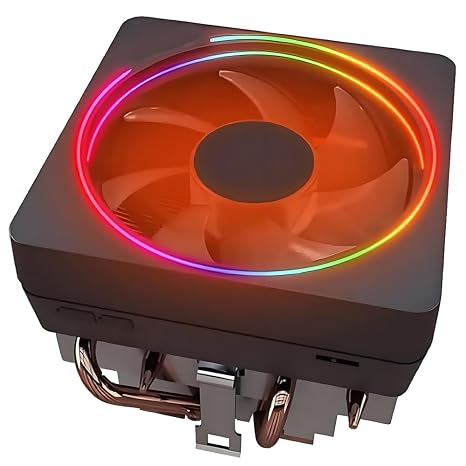
Aluminum heatsink combined with a pure copper base and four 6 mm copper heat pipes give this cooler solid build quality. Perfect for AM4 and AM5 socket users looking for reliable cooling on Ryzen processors. Its standout feature is efficient heat dissipation designed to handle up to 105 watts.
Mounting comes straightforward with the pre-applied silicone thermal paste, so there is no extra mess. It fits most AMD motherboards using the standard bracket.
The fan runs quietly at 14 db, spinning up to 2800 rpm, and moves air efficiently. No special setup steps are needed beyond what the motherboard requires for bracket installation.
Heat transfer is impressive due to the copper heat pipes and base. The small but effective fan keeps temperatures in check without much noise. Construction feels durable, blending aluminum and copper well.
Users praise the solid cooling performance, while the common gripe is that the cooler does not include the mounting bracket itself.
Cooling performance receives strong praise for managing heat well while running quietly. The missing mounting bracket leads to some frustration since it requires the motherboard’s bracket to be in place. Setup is smooth provided the right bracket is already installed.
Those building or upgrading a Ryzen PC with standard cooling needs will find it suitable. Users planning heavy overclocking or lacking the standard AMD bracket might look for options with included brackets or more cooling power.
Pros
- Efficient heat transfer with pure copper base
- Quiet operation at 14 dB noise level
- Compatible with many AMD sockets
- Pre-applied thermal paste included
Cons
- Does not include mounting bracket
- Cooling may not suffice for heavily overclocked CPUs
| Specification | Details |
|---|---|
| Power Connector Type | 4-Pin |
| Voltage | 12 volts_of_direct_current |
| Wattage | 105 watts |
| Noise Level | 14 db |
| Maximum Rotational Speed | 2800 rpm |
| Air Flow Capacity | 45 cfm |
6. ARCTIC Liquid Freezer III Pro 360 CPU Cooler

Impressive cooling power stands out right away for anyone upgrading their desktop with high-performance AMD CPUs. Best suited for users who want efficient, quiet, and reliable liquid cooling, it handles heat with ease thanks to its triple-fan 360mm radiator. Its strength lies in delivering cool temperatures while keeping noise low during everyday tasks and heavy loads.
Installation involves a native offset mounting system tailored for AMD and Intel, making sure the cold plate hits the CPU hotspot perfectly. The included ARCTIC P12 PRO fans work quietly at low speeds but can ramp up when the system heats up. The integrated VRM fan keeps voltage regulators cool, ensuring long-term stability without extra noise.
Running on a 4-pin 12-volt connector, it fits standard setups without fuss.
The cooling performance is impressive, handling heat effectively even under demanding loads, with fans reaching up to 3000 rpm and delivering 77 cfm airflow. The build quality feels solid, combining thoughtful engineering with powerful components. Users praise its silent operation and effective heat dispersion, though some mention that the maximum fan speed can be a bit loud during heavy gaming or intense workloads.
Many users highlight quiet operation as the stand-out feature, especially during normal use. The consistent cooling under heavy load comes with some trade-off in noise when fans hit maximum speed. People appreciate how the VRM fan adds extra reliability by keeping power components cooler.
The cooler suits those who value a balance between silence and strong thermal performance in a spacious PC build. It may not be ideal for very compact cases or setups intolerant of occasional fan noise spikes during intense gaming or rendering sessions.
Pros
- Quieter fans especially at low speeds
- Efficient heat transfer with offset mounting
- Integrated VRM fan stabilizes voltage regulators
- Supports both Intel and AMD sockets
Cons
- High fan speed can get loud under stress
- Requires enough case space for 360mm radiator
| Specification | Details |
|---|---|
| Voltage | 12 volts |
| Power Connector Type | 4-Pin |
| Maximum Rotational Speed | 3000 rpm |
| Air Flow Capacity | 77 cfm |
| Wattage | 3.96 watts |
| Cooling Method | Liquid |
7. AMD Wraith Stealth CPU Cooler

Great for anyone running an AM4 socket AMD setup wanting a straightforward, no-frills cooler that handles everyday tasks well. Its compact size and quiet operation make it a solid choice for those not pushing their CPU to the limits but wanting dependable cooling without extra cost.
Installation is simple thanks to the direct screw mounting designed specifically for AM4 motherboards. The built-in pre-applied thermal paste saves time and hassle during setup, and the 3.5-inch 90mm fan quietly adjusts speed through the 4-pin PWM connector as the CPU temperature changes.
Cleaning is quick since the aluminum heatsink has no complicated design to trap dust.
This cooler keeps typical CPU temperatures in check without generating much noise, proving effective at day-to-day cooling. Constructed with a sturdy aluminum heatsink and a modest-sized fan, it handles basic cooling needs well.
Praise often highlights its quiet performance while most critique its limited cooling capacity under heavy loads.
The quiet performance is frequently praised alongside the ease of mounting directly to the motherboard. Most feedback points out that the cooling capacity isn’t ideal for overclocking or intense workloads, limiting its use to everyday computing.
People running stock AMD systems who want a basic cooler will find this a practical option. Those expecting heavy-duty cooling or planning to push their CPU hard should look for a more powerful solution.
Pros
- Compact size fits tightly on AM4 boards
- Quiet fan operation under normal conditions
- Pre-applied thermal paste saves installation time
- Simple screw mounting avoids brackets
Cons
- Limited cooling for high-performance or overclocked CPUs
- Small fan size may struggle in dusty environments
| Specification | Details |
|---|---|
| Supports Motherboard Socket | AM4 |
| Fan Size | 3.5-inch 90mm |
| Thermal Paste | Pre-applied |
| Power Connector | 4-pin PWM, 9-inch length |
| Heatsink Material | Aluminum |
8. Cooler Master Hyper 212 Black II CPU Cooler

Keeping your Ryzen 7 or similar CPU cool during intense gaming or heavy workloads calls for a reliable cooler, and the Cooler Master Hyper 212 Black II fits that bill. It’s ideal for gamers and productivity users needing consistent cooling power paired with quiet operation.
Installation uses a user-friendly bracket design, which makes fitting it onto the motherboard straightforward, even for first-time builders. The cooler’s fan runs quietly up to 1,750 RPM, balancing airflow and noise well during daily tasks.
The minimalist black cover adds a clean, modern look to any desktop setup without drawing too much attention.
Performance-wise, the four heat pipes with Direct Contact Technology handle up to 220W efficiently, maintaining good thermal headroom during heavy loads. Build quality feels solid with thoughtful engineering for AMD Ryzen CPUs, and the stable performance under strain is a common highlight. Some voices mention the airflow (42 CFM) might not be the highest in class, which can limit cooling under extreme overclocking.
The cooler is praised mainly for stable, quiet cooling performance under typical heavy loads and its straightforward installation method. The common drawback mentioned relates to airflow, which some find insufficient for aggressive overclocking scenarios.
Those running high-performance CPUs without extreme overclocking will find this cooler meets their needs well. Users aiming for the highest possible cooling power or very low noise at max fan speed might want to explore other options.
Pros
- Efficient heat transfer with Direct Contact Technology
- Quiet fan operation even at higher RPMs
- Simple bracket mounting for easy installation
- Minimalist design fits various builds
Cons
- Airflow limited to 42 CFM, not ideal for large overclocks
- Fan noise can increase closer to max RPM
| Specification | Details |
|---|---|
| Cooling Capacity | Up to 220W |
| Fan Speed | Max 2500 RPM |
| Noise Level | 26 dB |
| Air Flow Capacity | 42 CFM |
| Power Connector Type | 4-Pin |
| Voltage | 12 volts |
9. ARCTIC Liquid Freezer III Pro 360 A-RGB CPU Cooler

Providing up to 3000 rpm on its fans, this liquid cooler suits anyone looking for strong cooling power, especially under intense CPU loads. Its standout feature is the integrated VRM fan, which helps keep voltage converters cool for better overall stability.
Setup benefits from the native offset mounting, moving the cold plate closer to the CPU hotspot, which improves heat transfer on both Intel and AMD platforms. The ARCTIC P12 PRO fans run quieter than the original P12 fans, especially at lower speeds, making daily use smoother without much noise disturbance. The 4-pin power connector keeps fan speed control flexible.
Performance-wise, the liquid cooling method and powerful fans handle heat efficiently even when the CPU is pushed hard. The build quality feels solid and the contact frame is optimized for better pressure distribution. Most users notice a clear temperature drop, though a common downside is the overall size, which might challenge smaller cases during installation.
Reviews highlight efficient cooling and quieter operation as major strengths, while many mention installation challenges in compact builds due to its larger radiator and fan setup. The VRM fan is appreciated for maintaining voltage stability during intense computing.
This cooler is great for users focusing on CPU performance under heavy workloads and who have room in their cases. Those with smaller PC cases or prioritizing absolute quietness may want to explore other cooling options.
Pros
- Integrated VRM fan for extra voltage converter cooling
- Quieter P12 PRO fans, especially at low speeds
- Offset mounting matches CPU hotspot for better heat transfer
- Compatible with Intel and AMD sockets
Cons
- Size may limit compatibility with smaller cases
- Fans can reach high speed and noise under heavy load
| Specification | Details |
|---|---|
| Maximum Rotational Speed | 3000 rpm |
| Air Flow Capacity | 77 cfm |
| Voltage | 12 volts |
| Wattage | 3.96 watts |
| Power Connector Type | 4-Pin |
| Cooling Method | Liquid |
10. Thermalright Peerless Assassin 120 Vision MAX CPU Cooler

Enthusiasts building an AMD desktop who want serious cooling power and extra monitoring control will appreciate this cooler. Its standout feature is the 5-inch IPS LCD screen on top, making it ideal for those who like to keep an eye on system stats while pushing their CPU hard.
Setup involves mounting a dual-tower cooler with two fans that attach magnetically. The large display shows real-time temperatures and other system info using TRCC software, which also lets you customize the background. Day-to-day use means quiet operation at just 27 db with airflow at 69 cfm, so you get strong cooling without noise distractions.
Cooling performance stands out thanks to six pure copper heat pipes and a nickel-plated copper base that sits tightly against the CPU. Running the fans at speeds up to 2150 rpm means heat is moved fast and efficiently. The build quality feels solid and durable.
Many highlight the clear display as a strong point, while some mention the cooler’s size as a space consideration around the motherboard.
The built-in 5-inch IPS LCD screen is praised for showing detailed system info during heavy use, making it a favorite for those who appreciate visual monitoring. Space constraints due to its size come up often, especially in smaller cases or crowded CPU zones.
People who want powerful cooling in a mid-to-large desktop case will find it a solid fit. Those with limited clearance or who dislike software configuration might want to look for a less bulky or simpler cooler instead.
Pros
- Integrated 5-inch IPS LCD for real-time monitoring
- Six pure copper heat pipes for efficient heat transfer
- Quiet operation at only 27 db noise level
- Magnetic fan and top cover for easy assembly
Cons
- Large size may block nearby slots on some motherboards
- Software setup for custom display can be tricky
| Specification | Details |
|---|---|
| Power Connector Type | 4-Pin |
| Cooling Method | Air |
| Noise Level | 27 db |
| Maximum Rotational Speed | 2150 rpm |
| Air Flow Capacity | 69 cfm |
11. Noctua NH-D15 chromax.Black CPU Cooler

Known for its quiet yet powerful cooling, the NH-D15 chromax.Black suits anyone overclocking an AMD CPU or chasing silent performance.
Its dual-tower design and dual 140mm fans deliver cooling efficiency comparable to many liquid coolers while fitting nicely into mostly dark or color-coordinated setups.
Setting it up involves balancing the large size, but once installed, the two NF-A15 fans with PWM mean the cooler runs quietly when idle and ramps up cooling smoothly under load. Low-Noise Adaptors keep the noise minimal without sacrificing airflow, making daily use pleasant whether gaming or working.
Built with six heatpipes spanning a wide dual-tower heatsink, it consistently maintains low temperatures even during intense loads. The all-black design complements many PC builds.
Reviews often praise how quiet it stays, though some mention its bulky size makes installation in smaller cases challenging.
Effective noise control is a consistent highlight, with users appreciating how whisper quiet it runs during light loads. The size and bulk cause some difficulty fitting it into compact cases, making installation a bit of a chore for certain builds.
Anyone running high-performance AMD systems who values quiet cooling will be pleased with this cooler. Users with space constraints inside their cases might want to explore smaller or low-profile alternatives instead.
Pros
- Extremely quiet operation when idle
- Strong cooling rivaling watercoolers
- All-black design fits many color themes
- Automatic fan speed control via PWM
Cons
- Large size can complicate installation
- May not fit well in smaller cases
| Specification | Details |
|---|---|
| Cooling Method | Air |
| Fans | Dual NF-A15 140mm |
| Noise Level | 24.6 dB |
| Maximum Rotational Speed | 1500 rpm |
| Air Flow Capacity | 140.2 cubic meter per hour |
12. Thermalright Peerless Assassin 120 Digital ARGB CPU Cooler

Thermalright Peerless Assassin 120 Digital ARGB CPU Cooler excels at keeping AMD CPUs cool with its dual tower and dual fan setup. It suits anyone who needs solid heat dissipation and appreciates a quiet airflow through pure copper heat pipes and a high-speed fan.
Installation goes smoothly thanks to the dual fans with 4-pin PWM connections and a magnetic top cover. The 120x120x28mm fans operate at 1850RPM, producing airflow of 88.89CFM while keeping noise under 25.6DB.
Regular cleaning is manageable due to the cooler’s accessible design, keeping performance steady during daily use.
Strong heat transfer happens through the six pure copper heat pipes linked directly to the CPU. The cooler handles temperature control efficiently and quietly.
Praised for its effective cooling and relatively low noise, some users mention its size could be a tight fit in smaller cases, which is the main limitation.
The cooler is praised for its effective heat transfer and quiet running, benefiting from copper heat pipes and high airflow. Main complaints focus on its large size, which challenges compatibility with compact PC cases. Routine maintenance is straightforward, making it suitable for long-term use.
Those building mid to large-sized desktops looking for strong air cooling will find it dependable. Users with smaller cases or sensitive to even moderate fan noise might want to explore other options with smaller footprints or quieter fans at higher speeds.
Pros
- Good heat dissipation with six pure copper pipes
- Quiet operation at 25.6 dB noise level
- High airflow of 88.89 CFM
- Magnetic top cover for added durability
Cons
- Size may not fit all PC cases
- Fan speed noise could increase under heavy load
| Specification | Details |
|---|---|
| Maximum Rotational Speed | 1850 rpm |
| Noise Level | 25.6 db |
| Air Flow Capacity | 88.89 cfm |
| Power Connector Type | 4-Pin |
| Cooling Method | Air |
Best AMD Coolers Comparison Table
| Product | Cooling Method | Noise Level | Max Rotational Speed | Air Flow Capacity |
|---|---|---|---|---|
| Thermalright Peerless Assassin 120 SE | Air | 25.6 db | 1550 rpm | 66.17 cfm |
| be quiet! Pure Rock Pro | Air | 34.8 db | 2000 rpm | – |
| Noctua NH-U12A chromax.Black | Air | 22.6 db | 2000 rpm | 102.1 cfm |
| AMD Wraith Prism Fan | Air | 30 db | 1800 rpm | – |
| AMD Wraith Prism Cooler | Fan | 14 db | 2800 rpm | 45 cfm |
| ARCTIC Liquid Freezer III Pro | Liquid | – | 3000 rpm | 77 cfm |
| AMD Wraith Stealth | – | – | – | – |
| Cooler Master Hyper 212 Black | Fan | 26 db | 2500 rpm | 42 cfm |
| ARCTIC Liquid Freezer III Pro | Liquid | – | 3000 rpm | 77 cfm |
| Thermalright Peerless Assassin 120 Vision | Air | 27 db | 2150 rpm | 69 cfm |
| Noctua NH-D15 chromax.Black | Air | 24.6 db | 1500 rpm | 140.2 m³/h |
| Thermalright Peerless Assassin 120 Digital | Air | 25.6 db | 1850 rpm | 88.89 cfm |
- Cooling MethodAir
- Noise Level25.6 db
- Max Rotational Speed1550 rpm
- Air Flow Capacity66.17 cfm
- Cooling MethodAir
- Noise Level34.8 db
- Max Rotational Speed2000 rpm
- Air Flow Capacity–
- Cooling MethodAir
- Noise Level22.6 db
- Max Rotational Speed2000 rpm
- Air Flow Capacity102.1 cfm
- Cooling MethodAir
- Noise Level30 db
- Max Rotational Speed1800 rpm
- Air Flow Capacity–
- Cooling MethodFan
- Noise Level14 db
- Max Rotational Speed2800 rpm
- Air Flow Capacity45 cfm
- Cooling MethodLiquid
- Noise Level–
- Max Rotational Speed3000 rpm
- Air Flow Capacity77 cfm
- Cooling Method–
- Noise Level–
- Max Rotational Speed–
- Air Flow Capacity–
- Cooling MethodFan
- Noise Level26 db
- Max Rotational Speed2500 rpm
- Air Flow Capacity42 cfm
- Cooling MethodLiquid
- Noise Level–
- Max Rotational Speed3000 rpm
- Air Flow Capacity77 cfm
- Cooling MethodAir
- Noise Level27 db
- Max Rotational Speed2150 rpm
- Air Flow Capacity69 cfm
- Cooling MethodAir
- Noise Level24.6 db
- Max Rotational Speed1500 rpm
- Air Flow Capacity140.2 m³/h
- Cooling MethodAir
- Noise Level25.6 db
- Max Rotational Speed1850 rpm
- Air Flow Capacity88.89 cfm
How to Choose the Right AMD Cooler
Choosing an effective AMD cooler depends on factors like compatibility with your processor, cooling performance, and noise levels. Prioritizing these ensures your system runs smoothly without overheating, helping you avoid costly repairs and unnecessary replacements over time.
Compatibility and Socket Support
Trying to fit a cooler only to find it does not match your AMD CPU socket can be surprisingly common. Different AMD processors use distinct socket types, such as AM4, AM5, or TR4, and each requires a compatible mounting system.
Overlooking this detail means the cooler simply won’t attach properly, which can cause poor contact with the CPU and inadequate cooling.
Clearance also plays a crucial role. Some coolers are bulky and can interfere with RAM sticks or nearby motherboard components like VRMs or large capacitors. A good cooler offers enough space around the socket for tall RAM modules without forcing compromises.
Confirming support for thermal management across various AMD chip generations ensures the cooler can handle heat output differences without overheating.
Cooling Performance and Thermal Design
Performance under heavy CPU usage determines how effective a cooler really is. Fan size directly affects airflow; larger fans typically move more air at lower speeds, reducing noise. Heat pipes aid heat transfer from the CPU to the fins or radiator, and a higher count usually means better spreading of heat.
Radiator size, common in liquid coolers, must be matched to the processor’s thermal design power (TDP) to keep temperatures stable during demanding tasks.
Matching a cooler’s rating to your CPU’s TDP rating prevents throttling caused by heat buildup. For example, a 95W TDP CPU requires a cooler that can reliably dissipate at least that amount of heat. Cooler models that don’t meet this can cause system instability or reduced performance during gaming or rendering sessions.
Noise Levels
Cooling performance can come at a cost of noise, especially under load when fans spin faster. Some coolers produce distracting whine or buzzing sounds that can make focused work or gaming sessions tiring. Quiet operation modes help by reducing fan speed when temperatures are low, making everyday use less intrusive.
High-quality bearings such as fluid dynamic bearings improve fan lifespan and reduce mechanical noise compared to sleeve bearings. Watching the noise level at both idle and peak fan speeds gives a clearer picture of the cooler’s sound profile.
Checking decibel ratings or user feedback helps avoid models that stay loud even in light-load scenarios.
Build Quality and Materials
The materials used in a cooler’s heat pipes and base impact how efficiently heat moves away from the CPU. Copper is common for base plates due to its excellent thermal conductivity, while aluminum fins help disperse heat at the radiator.
Well-made fans have sturdy blades and frames that withstand constant use without warping or rattling.
Mounting hardware should be solid to provide even pressure on the CPU, preventing poor contact spots. Corrosion resistance matters for long-term use; components exposed to airflow and occasional moisture should maintain performance without degrading. A cooler built with quality materials typically lasts several years without needing replacement.
Ease of Installation and Maintenance
Installing a cooler that uses a complicated bracket system can turn a simple upgrade into a frustrating ordeal. Some models include backplates and thumbscrews that ease mounting even for beginners. Clear, well-illustrated instructions help avoid common errors like uneven mounting pressure or poor thermal paste application.
Maintenance also affects long-term usability. Fans and radiators that are easy to access without removing too many parts simplify cleaning dust buildup that reduces cooling efficiency.
Removable fan blades or magnetic filters help keep airflow unobstructed and prolong cooler life with minimal hassle.
Proper Installation Techniques for Optimal AMD Cooler Performance
The contact between the cooler’s base and the AMD processor’s heat spreader is crucial for heat transfer. Applying a thin, even layer of thermal paste ensures that heat passes efficiently from CPU to cooler. Too much thermal paste can actually reduce cooling efficiency by creating gaps, so use only a pea-sized amount.
Securing the cooler firmly to the motherboard is equally important. Uneven mounting pressure leads to poor contact and higher temperatures. Follow the manufacturer’s instructions to tighten screws in a diagonal pattern to apply even force.
- Ensure the mounting brackets align correctly with AMD sockets to avoid damage.
- Check that fans are oriented for proper airflow direction, usually pushing air towards rear or top exhausts.
- Use the latest firmware or software controls if your cooler includes digital fan speed management.
Maintenance and Cleaning Tips to Extend the Lifespan of Your AMD Cooler
Dust accumulation on fins and fans reduces cooling effectiveness over time. Regular cleaning with compressed air or a soft brush can keep your AMD cooler running efficiently.
Avoid using water or harsh chemicals that might damage the components.
Inspect fan bearings periodically for noise or wobbling, which can indicate wear. Replacing worn fans will help maintain steady airflow. Also, reapply thermal paste every couple of years or if you remove the cooler to ensure continued good thermal contact.
- Power down and unplug your system before cleaning to prevent electrical damage.
- Wipe the cooler’s contact area gently when reapplying thermal paste to remove old residue.
- Verify all mounting screws remain tight after cleaning to maintain proper pressure.
Comparing Air Cooling vs. Liquid Cooling Solutions for AMD Processors
Air cooling remains a popular choice for AMD CPUs because it combines simplicity with effective performance in most setups. Air coolers usually include a heatsink and fan, pulling heat away from the processor into the case airflow.
Liquid cooling systems use pumps, tubes, and radiators to move heat away from the CPU more quickly. They can offer lower temperatures under heavy loads but add complexity and potential maintenance issues such as pump failure and coolant leaks.
- Air coolers are typically easier to install and maintain without special knowledge.
- Liquid coolers can provide quieter operation at high performance levels but may require monitoring for leaks.
- Choosing between them depends on your case space, budget, noise tolerance, and overclocking ambitions.
People Also Asked
How Do I Properly Install My New CPU Cooler?
Align the CPU cooler correctly on the CPU socket and secure it using the mounting brackets or screws provided. Clean the processor surface and apply a small, even layer of thermal paste before attaching the cooler to ensure good heat transfer. Handle the cooler carefully to avoid dislodging any heatsink fins or cables.
What Size Cooler Fits My PC Case and Motherboard?
Measure the maximum cooler height allowed in your PC case and check the socket type supported by your motherboard. Cases with side panel clearance under 160mm typically need low-profile coolers. Note the distance between memory slots and cooler so you don’t block RAM modules with tall heatsinks.
How Long Should a Typical CPU Cooler Last Before Replacement?
A quality air cooler can last several years, usually 5 or more, if kept clean and installed properly. Dust buildup on fins and fans reduces efficiency but cleaning them every few months can extend cooler life. Fans might need replacement when they start making unusual noises or slow down.
Are There Safety Precautions When Handling and Installing a Cooler?
Unplug the power supply before starting to avoid shorts or shocks. Avoid touching the CPU pins or socket pins to prevent damage or static discharge. Handle the cooler gently to avoid bending heatsink fins, and secure mounting firmly but don’t overtighten screws to protect the motherboard.
What Are Common Issues with Liquid CPU Coolers and How to Fix?
Common problems include pump failure, leaks, and clogging from dust or debris. Pump noise or rising temperatures typically indicate an issue needing inspection or replacement. Check tubes for cracks and ensure radiator fans are working. Regularly clean dust build-up to prevent overheating and maintain good liquid flow.
Conclusion
Choosing the best cooler for your AMD processor comes down to how well it fits your case, how quiet it runs, and whether it keeps temperatures low under your typical workload. Airflow, fan size, and compatibility with your motherboard socket type also play important roles.
Cooling performance and noise levels are the main factors that affect daily use and system stability.
Think about the space you have inside your PC case and how much noise you can tolerate before picking a cooler. Budget matters too, depending on how often you plan to push your system hard. Look back at the comparison table and detailed reviews above to find the cooler that fits your needs best.

I’m Grant Mitchell, a firearms and hunting writer with years of experience at the range and in the field. I write about rifles, shotguns, handguns, optics, safe storage, cleaning, and responsible ownership, along with practical hunting tips. My goal is to share accurate, safety-first information that helps you choose the right firearm, maintain it properly, and become a more confident shooter.