Top 12 Best Marine Handheld Radio You Can’t Miss!
Watching waves crash against the hull might be relaxing, but a cheap or poorly chosen marine handheld radio can turn a routine trip into a stressful situation. Dropping your radio in saltwater or struggling to hear an important call because of low output power are common frustrations.
The best marine handheld radio stays functional even in tough conditions and keeps communication clear when you need it most.
A reliable marine handheld radio is built with waterproof and impact-resistant materials, often rated at least IP67 or higher, so it survives immersion and rough handling. Power output also matters; radios with 5-watt transmitters typically offer better range and call clarity compared to lower-powered units.
Size and grip affect ease of use, especially with wet hands, so radios with textured surfaces and ergonomic designs make a difference on the water.
Need a Quick Check?
| Image | Product | Price |
|---|---|---|
Our Top Picks 1  | Cobra BlueBound 350 | Check Price |
Our Top Picks 2  | Standard Horizon HX210 | Check Price |
Our Top Picks 3  | Uniden Atlantis 275 | Check Price |
Our Selected Top 12 Marine Handheld Radio Worth Considering
This list features a carefully chosen selection of marine handheld radios that vary in features and capabilities. Each review highlights how the radios perform in different conditions, the types of users they are best suited for, and their main advantages and limitations to help you make an informed choice.
1. Cobra BlueBound 350 VHF Marine Radio
Communication on water can get tricky, especially worrying about losing your radio overboard. Designed for any size boat, this compact radio stands out with its floating, high-visibility orange core that makes it easy to spot and grab when dropped. It’s perfect for anyone needing reliable marine communication and confidence while out on the water.
Setting up takes just a moment, and switching power levels between 1, 3, and 6 watts fits your range needs and saves battery life. The display adapts for daytime and nighttime use, so reading channel info stays clear around the clock. It’s easy to carry and use, plus the battery saver mode keeps it going as long as possible during outings.
Performance matches well with a max talking range of 25 miles, making it solid for long-distance marine communication. Its waterproof build and submersible design offer reliable durability on the water.
Most users praise how visible and floatable it is, but some mention the battery life could be longer for extended trips.
The floating core and bright color make it incredibly easy to find if dropped in water, which is frequently mentioned as a standout feature. The main issue some find is the 12-hour battery life, which might not cover extended use without recharge.
Anyone who values durability, visibility, and variable power levels in a marine radio will be satisfied. Those needing longer battery endurance or extra technical features may want to consider alternatives.
Pros
- Floating high-visibility orange core
- Adjustable power for battery efficiency
- Day/Night selectable LCD display
- Waterproof and submersible design
Cons
- Battery life may feel short on long trips
- No advanced features like GPS integration
| Specification | Details |
|---|---|
| Number of Channels | 98 |
| Talking Range Maximum | 25 mile |
| Power | Switchable 1/3/6 Watts |
| Battery Average Life | 12 hours |
| Water Resistance Level | Waterproof |
2. Standard Horizon HX210 VHF Marine Radio
With a waterproof rating of IPX7 and a floating design, the Standard Horizon HX210 is ideal for anyone spending time on the water who wants reliable communication. Its standout feature is the water-activated emergency strobe light, adding an important safety layer for boating or fishing trips.
Setting it up is straightforward, thanks to the E20 Easy to Operate Menu System and programmable function keys. The compact case fits well in hand, making it easy to carry around. Charging happens quickly with the AC/DC rapid charger cradle, and the high-capacity 1850 mAh battery lasts for extended use.
The oversized full dot matrix display stays clear in bright conditions and shows all necessary information at a glance.
The primary function of communication performs steadily up to a 5-mile range, covering all USA, International, and Canadian channels, with selectable power levels for flexibility. The build quality stands out with solid waterproofing and good durability for marine conditions. Common praise highlights the bright, clear display and the emergency strobe light.
The most noted drawback is the battery runtime, which might fall short on longer trips.
The emergency strobe light adds a crucial safety feature that users find very reassuring, especially in poor visibility or distress situations. Common feedback points to the battery needing recharges more often than some would prefer, which can be inconvenient on longer outings without charging options.
Those who prioritize waterproof reliability and easy-to-read displays will appreciate this radio. Boaters and fishermen who frequently operate near water will find the flotation and emergency signal valuable. Anyone needing longer battery life or extended communication range should consider other models designed for extended use.
Pros
- Water-activated emergency strobe light
- Floating and submersible IPX7 waterproof rating
- Oversized full dot matrix display
- Rapid 3-hour desktop charger included
Cons
- Battery life may require frequent recharging
- Maximum range limited to 5 miles
| Specification | Details |
|---|---|
| Water Resistance Level | Waterproof (IPX7) |
| Talking Range Maximum | 5 mile |
| Number of Channels | 200 |
| Battery Type | 1850 mAh Li-Ion battery |
| Frequency Range | 76 – 108 MHz |
| Voltage | 12 volts |
3. Uniden Atlantis 275 VHF Marine Radio
Anyone heading out on the water who needs reliable communication will appreciate this compact VHF radio. It suits boaters looking for a strong signal and practical features in a handheld device.
Its biggest strength lies in delivering 6 Watts of power while remaining small enough to carry easily and float on water.
Getting started is simple, as it comes with one AA battery included, making it ready to use right away. The large LCD screen helps you read channels clearly in bright daylight or at night, thanks to its dual backlight.
The built-in flashlight and emergency strobe add safety features that often come in handy. Its compact design fits comfortably in a pocket or on deck without being cumbersome.
Signal strength and durability stand out during use, with a maximum range of 36 miles under good conditions. The radio floats and meets strict waterproof standards at IPX8, so it handles rough marine environments without trouble.
Users often praise its reliable performance and easy handling. One typical complaint is about the limited number of channels, which totals 25.
Strong praise centers on its waterproof design and long communication range, making it trustworthy on open water. The main drawback mentioned is the limited number of channels, which reduces flexibility in busy marine areas.
People who need a dependable radio for occasional or regular boating trips will find it suits well. Those requiring more channels or rechargeable options might want to explore other radios better fitted for those needs.
Pros
- Floats and meets IPX8 waterproof standard
- 6 Watts of power for long-range communication
- Large LCD with day and night backlight
- Includes emergency strobe and built-in flashlight
Cons
- Only 25 channels available for use
- Relies on AA battery, not rechargeable
| Specification | Details |
|---|---|
| Number of Channels | 25 |
| Talking Range Maximum | 36 mile |
| Water Resistance Level | Waterproof |
| Number of Batteries | 1 AA batteries required. (included) |
| Connectivity Protocol | VHF |
4. Retevis RM15 VHF Marine Radio

Designed for serious anglers and boaters, this handheld marine radio stands out with a floating design and IP68 waterproof rating. Ideal for offshore fishing or kayaking, it ensures communication stays reliable even when dropped in water thanks to its saltwater corrosion resistance and emergency strobe light.
Setup is straightforward with a single battery included and a charging system featuring corrosion-resistant contacts. Day-to-day use benefits from the clear NOAA weather alerts and noise reduction technology, making it easier to communicate in windy or noisy marine environments. The radio covers 88 channels, giving plenty of flexibility on the water.
The 6W radio offers solid range communication up to 16 km, performing well in open water conditions. Its sturdy build resists saltwater corrosion and survives immersion up to 1.5 meters for 30 minutes.
Reviewers praise its floating capability and emergency strobe light but note that battery use requires the included nonstandard battery, which may not be easy to replace.
The floating feature combined with the emergency strobe light is highly valued for safety in water activities. The most common critique highlights the use of a nonstandard battery, making replacements less convenient during extended trips.
Those focused on marine safety and saltwater resistance will appreciate this radio’s design and features. Users who want a longer battery life or easier battery replacement may want to explore other options.
Pros
- Floats on water surface if dropped overboard
- Water-activated emergency strobe for location marking
- Corrosion-resistant charging contacts for longer durability
- Up to 16 km talking range with strong signal
Cons
- Requires nonstandard battery, which can be hard to replace
- Battery life lasts about 10 hours on a single charge
| Specification | Details |
|---|---|
| Number of Channels | 88 |
| Talking Range Maximum | 16 km |
| Power Output | 6W VHF Radio Marine |
| Water Resistance Level | IP68 Waterproof Marine VHF Radio |
| Battery Average Life | 10 hours |
| Voltage | 5 volts |
5. Icom M25EVO Blue Marine VHF Radio

Icom M25EVO Blue Marine VHF Radio is made for anyone spending time on the water who needs a reliable, easy-to-use communication tool. Its biggest strength lies in its lightweight, floating design that makes it easy to hold and almost impossible to lose if dropped overboard.
Setting it up is straightforward, with USB-C fast charging making sure you’re ready for the next outing quickly. The slim, ergonomic shape fits comfortably in your hand all day, whether kayaking or cruising.
Floating with a flashing light gives extra confidence, and its weather resistance means it’s ready to handle wet conditions without worry.
It does a solid job keeping communication clear within its 5-mile range, and the battery lasts up to 11 hours, so it’s dependable for longer trips. Built to IPX7 waterproof standards, the radio handles splashes and even submersion without damage.
Common praise highlights how lightweight and compact it is; the most notable downside is the limited 15 channel count, which may not suit everyone.
Icom M25EVO floats on water and blinks for easy spotting after a drop, thanks to its IPX7 waterproof rating. It charges quickly through USB-C and offers up to 11 hours of battery life, making it reliable for long trips. Common drawbacks include the small screen size and occasional difficulty pressing side buttons while wearing gloves.
People who spend time boating or kayaking and want a lightweight, simple radio will appreciate the Icom M25EVO. Those needing a radio with a larger display or more advanced features should look for other models suited to professional marine communication. Its compact design is ideal for casual, recreational use rather than heavy-duty operation.
Pros
- Floats and flashes if dropped in water
- Lightweight and slim for easy handling
- Long 11-hour battery life
- Quick, USB-C fast charging
Cons
- Only 15 channels available
- Maximum 5-mile talking range
| Specification | Details |
|---|---|
| Number of Channels | 15 |
| Battery Life | 11-hour lithium-ion |
| Water Resistance Level | IPX7 |
| Weight | 7.8 oz |
| Charging Type | USB-C fast charging |
| Maximum Talking Range | 5 mile |
6. Uniden MHS75 VHF Marine Radio

Reliable communication on the water comes down to toughness and clear signal. Suited for anyone spending serious time near or on the water, this handheld has a waterproof design that won’t quit even after submersion. Its standout feature is the JIS8 waterproof rating, meaning water won’t mess with your connection.
Getting started is easy because it runs on a single AA battery that lasts around 12 hours, perfect for most day trips. You can switch between 1, 2.5, and 5 watts to match how far or close you need to reach, making it easier to save battery life when less power will do.
The compact size and floating design mean it’s easy to handle and won’t sink if dropped overboard.
Signal clarity stays solid up to a 15-kilometer range, making it reliable for general marine communication. The build is tough with a submersible rating for up to 30 minutes at five feet, so it handles splash and accidental drops well.
Reviews note that while it performs well in wet conditions, some find the limited 16 channels a bit restrictive for busy waterways.
Strong waterproofing and the floating feature make it tough and reliable in wet environments. The most common drawback is the limited 16 channels, which may not satisfy users in heavily trafficked marine areas requiring more communication options.
Ideal for casual boaters or fishermen who need dependable waterproof communication. More demanding mariners needing extensive channel selection should look at other models with broader channel options.
Pros
- Highly waterproof and submersible design
- Multiple power levels for range and battery saving
- Floatable if accidentally dropped in water
- Long battery life with easy battery replacement
Cons
- Limited number of channels (16)
- May feel basic compared to radios with more advanced features
| Specification | Details |
|---|---|
| Water Resistance Level | Waterproof (JIS8) |
| Power Output | 1 / 2.5 / 5 Watt Switchable |
| Battery Type | 1 AA battery (included) |
| Battery Life | 12 hours |
| Talking Range Maximum | 15 kilometer |
| Channels | 16 |
7. Standard Horizon HX891BT VHF Marine Radio

Reliable and compact, the Standard Horizon HX891BT suits anyone needing clear VHF communication on the water. Its standout feature is Bluetooth connectivity, allowing wireless convenience in a durable package designed to handle marine environments.
Setting up the radio is straightforward with a single lithium-ion battery powering it. Daily use benefits from 66 available channels and Bluetooth compatibility, making communication with accessories or other radios simple.
The waterproof design means it handles splashes and rain without worry, while the compact size fits comfortably in your hand or gear.
Performance on the water meets expectations with clear audio in a surprisingly small unit. Building quality leans heavily toward durability, protecting against sideways knocks and moisture. The strongest praise comes from dependable Bluetooth functionality, while the main complaint involves a limited talking range of only 6 feet for those relying solely on Bluetooth accessories.
Bluetooth stands out as a helpful feature for hands-free communication, praised for convenience, though the short 6-foot range restricts its use with accessories. The waterproof and solid build reassure users in wet conditions, making it feel secure on deck.
Those needing simple, reliable VHF communication with added Bluetooth will find good value here. Users expecting longer Bluetooth range or extra batteries included may want to consider alternative options better suited to heavier use or extended range demands.
Pros
- Bluetooth connectivity for wireless use
- Waterproof design suitable for marine conditions
- Compact size fits easily in the hand
- 66 VHF channels available
Cons
- Talking range limited to 6 feet via Bluetooth
- Only one battery required, no spare included
| Specification | Details |
|---|---|
| Number of Channels | 66 |
| Talking Range Maximum | 6 feet |
| Voltage | 7.4 volts_of_direct_current |
| Water Resistance Level | Waterproof |
| Number of Batteries Required | 1 Lithium Ion |
| Connectivity Protocol | Bluetooth |
8. Uniden Atlantis 155 VHF Marine Radio
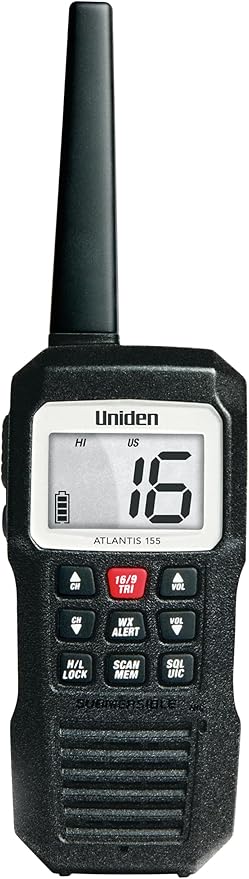
Built with a submersible, floating design, the Uniden Atlantis 155 is perfect for anyone spending time on the water. Its standout feature is its durable, waterproof construction combined with a large, easy-to-read LCD screen, making it reliable and user-friendly in marine conditions.
Setting up the radio is straightforward. It runs on 4 AAA batteries, which are included and offer around 10 hours of battery life, so it won’t leave you stranded mid-trip. The large paper white backlight for daytime and red backlight for nighttime use ensure you can operate it clearly no matter the light conditions.
The radio’s compact size doesn’t skimp on essential features, keeping communication clear without being bulky.
The radio performs well over a maximum range of 15 kilometers, suitable for most coastal and nearshore activities. It meets the IPX8 waterproof standard and JIS8 rating, meaning it floats and remains operational even if submerged.
Its speaker clears out water quickly, though some users note the speaker volume could be louder. The standout build quality is rugged and ready for rough use, while a common critique is the limited number of channels at 16.
Many appreciate how well the radio stays functional and visible underwater and at night, making it highly dependable in marine settings. At the same time, the relatively low channel count and moderate speaker volume come up as frustrations for some users.
This handheld radio suits those needing reliable waterproof performance and clear screen reading during day or night. Those requiring more channels or louder audio might want to look for a different model.
Pros
- Submersible and floating design for water safety
- Largest LCD screen in its class
- Clear visibility with paper white and red backlight
- Speaker clears water quickly after submersion
Cons
- Limited to 16 marine channels
- Speaker volume could be higher for noisy environments
| Specification | Details |
|---|---|
| Number of Channels | 16 |
| Battery Average Life | 10 hours |
| Talking Range Maximum | 15 kilometer |
| Water Resistance Level | Waterproof (IPX8 / JIS8) |
| Number of Batteries | 4 AAA batteries required (included) |
9. Icom M94D VHF Marine Transceiver

Loud audio is the first thing you’ll notice about the Icom M94D, making it ideal for anyone needing clear communication even in noisy marine environments. It’s designed for boaters who value safety features and reliable long-range transmission on the water.
Setting it up is straightforward, and the built-in AIS receiver helps you keep track of nearby vessels right on the screen. You can quickly make DSC individual calls and send distress alerts, which adds a layer of security when you’re out at sea.
The GPS navigation with waypoints guides your route easily on the go, which is handy for daily trips or longer voyages.
The radio puts out a strong 6W signal that covers up to 5 miles, so it keeps you connected well beyond the immediate vicinity. Its waterproof design ensures it can handle rough weather, and the battery lasts a solid 10 hours during typical use, meaning it won’t leave you hanging out on the water. Most people praise the loud 1500 mW speaker, though a few find limited channels a drawback.
Users appreciate the clear, loud audio and the safety features like AIS and DSC that keep communication reliable and quick during emergencies. Some find the limited number of channels restrictive compared to other models. Battery life meets expectations for most outings but depends on consistent charging.
Ideal for those who prioritize clear calls and safety on the water, especially in busy or noisy areas. Those needing more channel options or wanting included batteries might look elsewhere. The waterproof build and GPS navigation appeal to frequent boaters focused on security.
Pros
- Built-in AIS receiver for nearby vessel tracking
- Strong 6W transmit power extends communication range
- Loud 1500 mW speaker ensures clear audio
- Up to 10 hours battery life per charge
Cons
- Only 4 channels available for communication
- Requires AAA batteries, not included with unit
| Specification | Details |
|---|---|
| Transmit Power | 6 W |
| Battery Type | 2400 mAh Li-ion (BP-306) |
| Operating Time | Up to 10 hours |
| Maximum Talking Range | 5 mile |
| Water Resistance Level | Waterproof |
| Number of Channels | 4 |
10. Cobra BlueBound 150 VHF Marine Radio

Perfect for anyone boating on any size vessel, the Cobra BlueBound 150 stands out because it floats and is easy to spot if dropped overboard. Its bright orange casing combined with waterproof build makes it reliable for marine safety in rough conditions.
Setting up is straightforward with the included 5 AAA batteries giving about 11 hours of usage, enough for a full day on the water. Switching power between .5, 1, and 3 watts helps you save battery when talking nearby but provides extra reach when needed.
A digital display and battery saver mode make it easy to monitor during busy trips.
Signal clarity and range hold up well across the radio’s 98 channels, helping you keep in touch out on open water. The radio is built tough with an IPX7 waterproof rating, so it can handle full immersion. The most common gripe is battery consumption, but the floating, bright core is a big plus for safety and ease of retrieval.
The floating orange core is highly praised for making the radio easy to spot and recover if dropped in water. Many comments note the battery life varies by power mode, with some wishing it lasted longer during extended use on higher output.
Boaters who value safety and need a durable, water-ready radio will appreciate this model. Those seeking a longer-lasting battery or rechargeable unit might look for other options better suited to multi-day or heavy use.
Pros
- Bright, floating core for easy retrieval
- Multiple power levels to conserve battery
- Waterproof and submersible design
- Clear digital display and emergency alarm
Cons
- Battery life could drain quicker in high power mode
- Requires five AAA batteries included with purchase
| Specification | Details |
|---|---|
| Number of Channels | 98 |
| Selectable Power | .5 / 1 / 3 Watts |
| Water Resistance Level | Waterproof (IPX7) |
| Battery Type | 5 AAA batteries (included) |
| Battery Average Life | 11 hours |
11. Uniden MHS338BT VHF Marine Radio

Being out on the water means you need clear communication and safety features you can trust. Designed for boaters and those who spend long hours marine-side, its biggest strength is ruggedness combined with smart safety tools, ensuring you stay connected and secure no matter the conditions.
Setting it up is straightforward with the drop-in charging cradle making daily charging simple. The automatic backlight adjusts between white and amber, helping readability from daylight to nighttime. You can save and enter favorite GPS positions, while built-in NOAA alerts keep you updated on weather changes.
Bluetooth connectivity lets you link with an iPhone for added convenience, while the integrated flashlight and water-activated emergency strobe help keep you safe on every trip.
Transmitting at full 6-watt power, the radio reaches out clearly within a 5-mile range, important when out of cell coverage. Its IPX8 submersibility means it can handle drops in water without worry, and it floats if dropped overboard.
Most users say its battery life and emergency features stand out. The main complaint often relates to the limited 25 channels, which might feel restrictive in busy marine areas.
Users appreciate the reliability of the 6-watt power and the safety features like the emergency strobe and integrated flashlight. The radio’s waterproof design that floats adds extra security. However, the limited number of channels can restrict communication options in crowded boating areas.
People who spend significant time on the water needing rugged, clear communication will like this model. Those who require a broader range of channels or extended communication distances may want to consider other options.
Pros
- Built-in GPS with favorite position saving
- Water-activated emergency strobe light
- Automatic backlight switching day and night
- Rechargeable battery with drop-in charging
Cons
- Only 25 channels available
- Some find range limited in busy marine environments
| Specification | Details |
|---|---|
| Number of Channels | 25 |
| Transmit Power | 6.0W (selectable 1.0W, 2.5W, 6.0W) |
| Water Resistance Level | IPX8 Waterproof, floats |
| Talking Range Maximum | 5 mile |
| Battery | Rechargeable Li-ion (included) |
| Connectivity Protocol | Bluetooth |
12. Icom IC-M73 VHF Marine Radio

Boasting 6 watts of transmit power and a waterproof design, this VHF marine radio suits anyone needing reliable communication on the water. Its biggest strength is staying functional even in wet conditions, making it a solid choice for serious boaters who prioritize durability and clarity.
Setup involves charging the included lithium-ion battery and attaching the cigarette lighter adapter for power on the go. The hourglass shape feels natural in your hand, and 128 available channels offer plenty of options. An optional speaker/mic adds convenience for hands-free use during long days on the water.
It performs well with a maximum talking range of 6 miles, delivering clear sound even over distance. Built to be waterproof and submersible, it’s tough against splashes and brief drops in water.
Praise often highlights its solid construction, while the most common gripe mentions the battery life, which runs around 18 hours before needing a recharge.
The radio’s strong build and waterproof design make it dependable in wet environments, but the 18-hour battery life means you need to plan recharges carefully. The clear audio on up to 6 miles stands out in practical use, although extended communication beyond that distance isn’t possible.
Anyone looking for a rugged, waterproof marine radio with solid power and many channels will find this works well. Those needing longer talking ranges or multi-day battery life may want to explore other options tailored for extended offshore trips.
Pros
- Waterproof and submersible design
- Easy-to-hold hourglass shape
- Includes charger and cigarette lighter adapter
- Long battery life for extended trips
Cons
- Maximum talking range limited to 6 miles
- Battery life requires daily charging in heavy use
| Specification | Details |
|---|---|
| Transmit Power | 6 Watts |
| Number of Channels | 128 |
| Battery Type | 1 Lithium Ion (included) |
| Battery Average Life | 18 hours |
| Frequency Range | Tx: 156.025–157.425MHz, Rx: 156.050–163.275MHz |
| Water Resistance Level | Waterproof |
Best Marine Handheld Radios Comparison Table
| Product | Channels | Water Resistance | Battery Life | Max Range |
|---|---|---|---|---|
| Cobra BlueBound 350 | 98 | Waterproof | 12 hours | 25 mile |
| Standard Horizon HX210 | 200 | Waterproof | – | 5 mile |
| Uniden Atlantis 275 | 25 | Waterproof | – | 36 mile |
| Retevis RM15 | 88 | IP68 Waterproof | – | 16 km |
| Icom M25EVO Blue | 15 | Water Resistant | – | 5 mile |
| Uniden MHS75 | 16 | Waterproof | – | 15 km |
| Standard Horizon HX891BT | 66 | Waterproof | – | 6 feet |
| Uniden Atlantis 155 | 16 | Waterproof | 10 hours | 15 km |
| Icom M94D | 4 | Waterproof | – | 5 mile |
| Cobra BlueBound 150 | 98 | Waterproof | 11 hours | – |
| Uniden MHS338BT | 25 | Waterproof | – | 5 mile |
| Icom IC-M73 | 128 | Waterproof | – | 6 mile |
- Channels98
- Water ResistanceWaterproof
- Battery Life12 hours
- Max Range25 mile
- Channels200
- Water ResistanceWaterproof
- Battery Life–
- Max Range5 mile
- Channels25
- Water ResistanceWaterproof
- Battery Life–
- Max Range36 mile
- Channels88
- Water ResistanceIP68 Waterproof
- Battery Life–
- Max Range16 km
- Channels15
- Water ResistanceWater Resistant
- Battery Life–
- Max Range5 mile
- Channels16
- Water ResistanceWaterproof
- Battery Life–
- Max Range15 km
- Channels66
- Water ResistanceWaterproof
- Battery Life–
- Max Range6 feet
- Channels16
- Water ResistanceWaterproof
- Battery Life10 hours
- Max Range15 km
- Channels4
- Water ResistanceWaterproof
- Battery Life–
- Max Range5 mile
- Channels98
- Water ResistanceWaterproof
- Battery Life11 hours
- Max Range–
- Channels25
- Water ResistanceWaterproof
- Battery Life–
- Max Range5 mile
- Channels128
- Water ResistanceWaterproof
- Battery Life–
- Max Range6 mile
How to Choose the Right Marine Handheld Radio
Choosing a marine handheld radio involves considering factors like range, waterproof rating, battery life, and ease of use to ensure reliable communication on the water. Selecting the right features helps avoid costly replacements and safety issues, making your boating experience smoother and safer.
Transmission Power and Range
Out on open water, the difference between a clear call and dropped signal often comes down to wattage. Radios with higher transmission power, such as 5 watts, push signals much farther than those with only 1 watt.
Lower watt devices might work fine close to shore but often struggle at a distance or in poor weather conditions. The antenna’s quality influences this more than people expect; a well-made, longer antenna can significantly extend communication range over water.
Range rarely matches the maximum stated in specifications because fog, heavy rain, and obstacles like boats or islands interfere with signals. Expect about 1 to 2 miles on low power, and 5+ miles under ideal conditions on high power. Prioritizing at least 3 to 5 watts and a sturdy, properly mounted antenna keeps messages clear when they’re most needed.
Durability and Water Resistance
Saltwater and constant exposure to moisture quickly ruin electronic gear that isn’t suited for the marine environment. A radio with a waterproof rating of IP67 or better ensures it can survive accidental drops in water or heavy rain. Cases made from corrosion-resistant materials like reinforced polycarbonate or stainless steel components hold up longer than basic plastics.
Handling a radio while moving on a boat introduces a high risk of drops. Radios designed with shockproof housing include rubberized edges and reinforced corners that prevent the internal parts from breaking after impacts. Without these features, the device may fail when you need it most.
Battery Life and Charging
Extended boating trips require radios that won’t die halfway through the day. Battery life around 10 to 12 hours on a single charge covers most outings.
Lithium-ion batteries are common due to their longer lifespan and ability to hold charge better than older NiMH types. Some models offer removable batteries that let you swap in fresh power quickly without waiting at shore.
Fast charging options can restore a full charge in around 2 to 3 hours, saving time in emergencies or between trips. Lack of rechargeable capability often means dealing with disposable batteries, which is costly and impractical in remote settings.
Ease of Use and Controls
Sunlight glare often makes radio screens unreadable out on the water, so a bright, high-contrast display is crucial for quick information checks. Controls that can be operated easily while wearing wet or thick gloves improve usability during rough weather.
Large, well-spaced buttons with tactile feedback prevent accidental presses and ensure accuracy while underway.
Having programmable channels and a dedicated button for switching to emergency or frequently used channels saves valuable seconds. Models that support quick access functions reduce fumbling through menus under stress.
Safety and Compliance Features
Handheld radios intended for marine use should have built-in emergency alert and distress signal features like DSC (Digital Selective Calling) to summon help instantly. Radios compliant with marine communication laws guarantee you’re operating legally and on correct frequencies, reducing interference with other vessels.
Integrated NOAA weather alerts keep users informed about storms or hazardous conditions, which can be lifesaving at sea. Channel scanning functions monitor multiple channels simultaneously, making sure no critical communication is missed during an emergency.
Proper Maintenance and Storage for Marine Handheld Radios
Saltwater and moisture can quickly degrade marine handheld radios if not cared for properly. Regular cleaning after each outing is vital to remove salt deposits and grime.
Use fresh water and a soft cloth to wipe down the unit, avoiding harsh chemicals that can damage seals and plastic parts.
Storing the radio correctly also extends its life:
- Keep it in a dry, cool place away from direct sunlight or extreme temperatures.
- Remove batteries if the radio won’t be used for extended periods to prevent corrosion and leakage.
- Ensure all caps and seals are tightly closed before stowing to keep moisture out.
Frequent inspection of the antenna and buttons for signs of wear or damage helps maintain clear communication. Taking these practical steps ensures the radio remains reliable during critical moments on the water.
Maximizing Safety: Best Practices for Using Marine Handheld Radios
Consistent communication can prevent emergencies in marine environments. One solid practice is to perform a radio check before leaving the dock. This confirms that your radio functions and is set to the correct channel, often channel 16 for distress calls and hailing.
Keeping a waterproof case handy safeguards the device during unexpected weather changes. Operators should speak clearly and hold the radio about an inch from their mouth to reduce static and interference.
It helps to follow these guidelines:
- Reserve channel 16 for emergencies and initial contact only to keep it open.
- Use weather channels regularly to monitor updates for your area.
- Always identify your vessel at the start of any communication to avoid confusion.
Applying these habits minimizes misunderstandings and improves response times when safety is on the line.
Comparing Marine Handheld Radios with Fixed VHF Systems
Marine handheld radios offer mobility advantages over fixed VHF systems because they can be carried throughout the vessel and used in emergency situations away from the helm. Their compact size makes them convenient, but the trade-off is generally shorter range and smaller batteries compared to fixed units.
Fixed VHF systems usually have more powerful antennas mounted on the boat’s highest point, providing greater communication distances. They often integrate with other onboard electronics, such as GPS, enabling advanced functions like DSC (Digital Selective Calling) for automated distress signals.
In contrast, handheld radios:
- Rely on smaller antennas so their effective range depends heavily on surroundings and battery life.
- Are more affordable and easy to replace.
- Provide an essential backup communication method if the main system fails.
Choosing between handheld and fixed units depends on the size of the vessel and the specific communication needs during outings.
People Also Asked
How Do I Care for My Marine Handheld Radio Properly?
Marine handheld radios should be rinsed with fresh water after exposure to saltwater and dried thoroughly. Storing them in a dry, cool place helps prevent corrosion and battery drainage during long periods of non-use.
What Size Marine Handheld Radio Is Ideal for Small Boats?
Compact models around 6 to 7 inches long are best for small boats. They fit easily in a pocket or mounting bracket without taking up too much space but still provide good battery life and range.
Are Marine Handheld Radios Compatible with Standard Boat Communication Systems?
Most marine handheld radios can communicate on standard marine VHF channels used by boat systems. Checking the radio’s channel compatibility ensures you can reach shore stations or other vessels.
How Long Does the Battery Usually Last on a Marine Handheld Radio?
Batteries typically last 8 to 12 hours on a full charge during continuous use. Carrying a spare battery or portable charger is useful for longer trips or emergencies.
What Are Common Problems with Marine Handheld Radios and Solutions?
Common issues include poor signal due to antenna damage and water ingress causing malfunction. Regular antenna checks and storing the radio away from moisture can prevent most problems.
Conclusion
Choosing a marine handheld radio comes down to clear reception, battery life, and waterproof design. These elements ensure you stay connected and safe while on the water. Durability and ease of use also play important roles, especially if you spend long hours outdoors or in rough conditions.
Consider how much space you have for storage, how often you’ll use the radio, and what fits your budget before making a choice. The comparison table above can help you weigh these factors side by side, along with the detailed options listed earlier, to find the best fit for your needs.

I’m Grant Mitchell, a firearms and hunting writer with years of experience at the range and in the field. I write about rifles, shotguns, handguns, optics, safe storage, cleaning, and responsible ownership, along with practical hunting tips. My goal is to share accurate, safety-first information that helps you choose the right firearm, maintain it properly, and become a more confident shooter.