Top 12 Best Handheld VHF Marine Radio with DSC Revealed!
Getting caught on the water with a handheld VHF radio that struggles with signal or dies quickly is a common frustration. The best handheld vhf marine radio with dsc avoids these issues by offering reliable communication, especially in emergency situations where clarity and instant alerts matter.
Poorly chosen units often lack durability and proper DSC functions, which can lead to missed distress calls or confusion in crowded channels.
Durability, battery life, and DSC performance are key factors in choosing a solid handheld marine radio. Look for radios built with water-resistant materials rated at least IPX7, meaning they can withstand immersion in water.
Battery life around 8 to 12 hours of continuous use is typical for reliable models. The DSC function should include a dedicated distress button that transmits your exact GPS location automatically, which is critical for safety on the water.
Need a Quick Check?
| Image | Product | Price |
|---|---|---|
Our Top Picks 1  | Standard Horizon HX891BTBK | Check Price |
Our Top Picks 2  | Icom M94D Marine VHF | Check Price |
Our Top Picks 3  | Uniden MHS338BT VHF Radio | Check Price |
Our Selected Top 12 Handheld Vhf Marine Radio with Dsc Worth Buying
This list features carefully chosen handheld VHF marine radios with DSC, highlighting their performance, suitability for different users, and key advantages and disadvantages. Each review provides clear insights to help identify the most appropriate device for specific marine communication needs.
1. Standard Horizon HX891BTBK
Finding a reliable handheld VHF marine radio that fits comfortably in your hand and offers clear communication matters a lot out on the water. Suitable for boaters who want simple operation combined with Bluetooth connectivity, the Standard Horizon HX891BTBK stands out for staying waterproof and keeping channels easily accessible in a compact size.
Setup is straightforward with just one battery to insert and immediate access to 66 channels. The Bluetooth feature helps pair with compatible two-way radios and accessories for convenient hands-free use. Carrying it feels light and manageable thanks to its modest dimensions, while the volume and channel selection work well for quick adjustments during a busy day on the boat.
Its main job of maintaining a strong VHF connection performs reliably, delivering clear audible output at around 30 dB. Waterproof build means it handles splashes and rain without worry, though the Bluetooth’s talking range is limited to 6 feet, which might restrict some flexibility.
The radio feels solidly made, but some might find the overall reach short for extended communication beyond immediate vicinity.
The HX891BTBK receives praise for its solid build and dependable waterproof design, keeping communication clear on the water. The common downside is the limited Bluetooth talking range of just 6 feet, which can feel restrictive when paired accessories aren’t worn close by.
Boaters needing a compact, water-ready radio with easy channel access will appreciate this model. Those requiring longer Bluetooth range for hands-free or more distant communication should look for an alternative offering more extensive connectivity.
Pros
- Compact and easy to hold
- Waterproof for marine use
- Bluetooth pairs with accessories
- Access to 66 channels
Cons
- Bluetooth talking range only 6 feet
- Single battery may limit long-term use
| Specification | Details |
|---|---|
| Number of Channels | 66 |
| Connectivity Protocol | Bluetooth |
| Water Resistance Level | Waterproof |
| Talking Range Maximum | 6 feet |
| Voltage | 7.4 volts_of_direct_current |
| Number of Batteries | 1 Lithium Ion battery required |
2. Icom M94D VHF Marine Transceiver
Showing nearby vessel traffic directly on screen thanks to the built-in AIS receiver, this marine radio suits anyone needing quick, clear communication and enhanced safety on the water. Its integrated AIS and DSC make distress alerts and individual calls much easier, which is a big advantage for safety-minded boaters.
Setting it up is straightforward, and navigating through its functions feels natural. The GPS navigation helps guide you to saved waypoints, which comes in handy for everyday trips or longer routes.
Buttons are well laid out, and pairing with other Icom VHF devices fits smoothly into marine communication setups.
Delivering 6 W of transmit power ensures a solid range, while the 1500 mW speaker keeps audio loud and clear, even over engine noise and busy environments. The built quality feels tough and waterproof, making it a reliable companion on rough waters.
Some users mention the limited number of channels as a small downside.
The clearest praise highlights the integrated AIS and DSC features that simplify safety calls and distress signals. Most complaints point to the limited number of channels, which can be restrictive in busy marine environments.
Boaters who prioritize safety and want a reliable, easy-to-use radio with AIS benefit from this device. Those needing more channels or longer talk ranges might look for other options better suited to heavy communication demands.
Pros
- Built-in AIS receiver shows nearby vessels
- Strong 6 W transmit power for long range
- Clear, loud 1500 mW speaker audio output
- Long battery life up to 10 hours
Cons
- Only 4 communication channels available
- Requires AAA batteries for operation
| Specification | Details |
|---|---|
| Power Output | 6 W |
| Battery Life | Up to 10 hours (2400 mAh Li-ion battery) |
| Audio Output | 1500 mW speaker |
| Water Resistance | Waterproof |
| Number of Channels | 4 |
3. Uniden MHS338BT Marine VHF Radio
Boaters and maritime enthusiasts who need reliable communication will appreciate a handheld marine radio designed to handle tough conditions on the water. The Uniden MHS338BT suits people who want strong transmit power and built-in GPS features. Its biggest strength lies in the combination of durability and clear range thanks to full 6-watt transmit power.
Setting up involves a simple drop-in charging cradle and the radio charges on its Li-ion battery. The automatic backlight adjustment shifts between white in daylight and amber at night, making nighttime use easy on the eyes. Bluetooth connectivity allows pairing with an iPhone, and the waterproof design means you can confidently use it in wet conditions.
NOAA weather alerts and an FM radio keep you updated, while the water-activated emergency strobe and flashlight add safety in emergencies.
Performance-wise, transmission can reach up to 5 miles with power levels adjustable from 1.0W to 6.0W, giving flexibility for both close and farther contacts. The radio is solidly built with an IPX8 submersible rating and a floating design, so it won’t sink if dropped overboard. Most praise centers on its solid signal and ease of use, while some mention the limited number of channels, just 25 channels, as a slight drawback.
The radio delivers strong, reliable communication with clear signals and a durable waterproof design that floats if dropped. Its most frequent downside lies in having only 25 channels, which can limit flexibility for users in busy or complex areas.
People valuing durable construction, solid transmit power, and handy safety features will find this radio a good match. Those needing a wider channel selection or extended battery options might want to consider alternative radios.
Pros
- Full 6-watt transmit power for extended range
- IPX8 waterproof and floats if dropped
- Integrated GPS with position saving
- Water-activated emergency strobe light and flashlight
Cons
- Only 25 channels available for communication
- Battery runs on a single rechargeable cell
| Specification | Details |
|---|---|
| Number of Channels | 25 |
| Transmit Power | 6.0 W (high), 2.5 W (medium), 1.0 W (low) |
| Water Resistance Level | IPX8 submersible |
| Talking Range Maximum | 5 mile |
| Battery Type | Rechargeable Li-ion, included |
4. Retevis RM40 GPS DSC VHF Marine Radio

Offering built-in GPS and DSC features, the Retevis RM40 GPS DSC VHF Marine Radio is ideal for anyone spending serious time on the water who values safety and reliable communication. Its standout strength is the ability to send distress signals instantly with your exact location, making it a solid choice for fishing, kayaking, or sailing where quick rescue matters.
Setting up involves powering the unit with the included lithium-ion battery and syncing it with your smartphone or tablet if needed. Daily use is straightforward thanks to its clear channel selection across 98 channels and GPS updates, which keep your position current. The one-button distress call and Man Overboard alarm provide extra security when heading offshore, ideal for staying connected in challenging conditions.
Transmission reaches up to 5 miles, ensuring communication over a good distance in most coastal and nearshore situations. The waterproof design handles wet environments without worry, built to endure marine life’s demands. Most users appreciate its dependable GPS update and DSC function, while a few mention the battery life could be longer under heavy use.
It performs well for its intended purpose on open water.
The most praised feature is the ease of sending a distress signal with exact GPS coordinates, which greatly improves safety. Common complaints focus on battery life, as heavy users might find the 12-hour runtime insufficient on multi-day outings.
People spending time closer to shore or in smaller boats benefit most from the safety features and GPS updates. Those needing longer transmission range or extended battery life for lengthy offshore expeditions might want to consider other options.
Pros
- Built-in GPS for accurate real-time positioning
- One-button DSC distress calls with GPS location
- Waterproof design suitable for marine conditions
- MOB alarm shares location instantly for rescue
Cons
- Battery life may fall short during extended use
- Range limited to 5 miles, not for long offshore trips
| Specification | Details |
|---|---|
| Number of Channels | 98 |
| Talking Range Maximum | 5 mile |
| Voltage | 7.4 volts |
| Water Resistance Level | Waterproof |
| Number of Batteries | 1 Lithium Ion batteries required. (included) |
| Battery Average Life | 12 hours |
5. Cobra BlueBound 350 VHF Handheld Marine Radio

Cobra BlueBound 350 VHF Handheld Marine Radio is a reliable choice for boaters seeking a compact, easy-to-use radio with dependable power and safety features. It stands out with a high-visibility floating core that makes it nearly impossible to lose in the water, ideal for any size vessel.
Setting up the radio is straightforward thanks to its clear digital display and easy channel access covering 98 channels. Switching between 1, 3, and 6 watts fits various range needs without draining the battery excessively.
The day/night selectable LCD ensures you can read the screen clearly under sunlight or at night, and its waterproof design makes it trustworthy in rough conditions.
Its main job of communication is handled well with up to 6 watts of power and a talking range of 25 miles. The radio feels solid and can survive being dropped in water without trouble. The most praised feature is its buoyant, bright orange core that simplifies recovery, yet some users note the battery life of 12 hours may require recharging during longer trips.
The floating core is highly praised for preventing loss overboard and stands out as a practical safety feature. Common feedback points to the battery life as the main limitation, especially during extended hours on the water.
People who value safety and easy handling will appreciate this radio. Sailors or fishermen planning very long trips or requiring extended battery life might need a more powerful option or extra batteries.
Pros
- High-visibility orange floating core for easy retrieval
- Day/Night visible LCD display
- Switchable power for optimized battery life
- Waterproof and submersible construction
Cons
- Battery lasts about 12 hours, may need frequent recharges
- Range varies with conditions, sometimes less than 25 miles
| Specification | Details |
|---|---|
| Number of Channels | 98 |
| VHF Power | 1/3/6 Watts switchable |
| Talking Range Maximum | 25 mile |
| Battery Average Life | 12 hours |
| Water Resistance Level | Waterproof |
6. Standard Horizon HX210 Handheld Marine VHF

Handles marine communication with ease, especially for boaters who want a compact, reliable tool. It suits anyone needing quick emergency access and local FM radio in a waterproof setup. Its standout feature is the built-in water activated emergency strobe light, which adds a safety layer beyond just communication.
Getting started is straightforward thanks to the E20 easy menu system and programmable function keys. It fits comfortably in hand and has a solid grip. The included rapid charger quickly powers the high-capacity 1850 mAh battery, keeping it ready for extended use.
Receiving weather updates, all USA and international channels, plus FM broadcast bands means staying well informed.
Communication is clear up to 5 miles, with adjustable transmission power at 6W, 2.5W, or 1W for various distances. The floating, submersible case with IPX7 waterproof rating means it survives accidental drops in water without damage.
The oversized full dot matrix display is easy to read in different light conditions. Some users mention the menu can feel a bit simple for advanced users but appreciate the straightforward design.
Many appreciate the emergency strobe for added safety, especially in rough conditions, while the menu simplicity is a common note, as it may lack depth for more tech-savvy users. The waterproof floating case is consistently praised for maintaining function during accidental water exposure.
People needing a dependable, easy-to-use marine radio with extra safety features will find this a solid fit. Those seeking extended range or advanced menu options might want to consider other models with higher power or user interface complexity.
Pros
- Water-activated emergency strobe light included
- Fast 3-hour rapid desktop charging
- Compact, floating, and very waterproof design
- Broad channel and FM radio reception
Cons
- Menu system may feel basic for some users
- Maximum talking range limited to 5 miles
| Specification | Details |
|---|---|
| Water Resistance Level | Waterproof (IPX7) |
| Talking Range Maximum | 5 mile |
| Battery Type | Lithium Ion |
| Output Power | Selectable 6W / 2.5W / 1W |
| Channels | 200 (All USA, International, Canadian) |
| Frequency Range | 76-108 MHz (FM band) |
7. Cobra BlueBound 650 VHF Handheld Marine Radio

Great for boaters needing reliable communication, this radio impresses with its adjustable power levels that balance range and battery life well. Ideal for anyone wanting clear channel monitoring alongside weather updates, its standout feature is definitely the Tri-Watch mode, which helps stay aware of key channels during busy conditions on the water.
Setting the radio up is straightforward with a clear digital display that switches between day and night modes, making it easy to read anytime. Tri-Watch lets you stay tuned to Channels 9, 16, and a chosen channel simultaneously, which is handy for tracking both emergency and general communications.
Battery Saver mode extends its life to roughly 12 hours, making it dependable for longer trips without frequent recharging.
Performance is solid with 6 watts of VHF power that can be dialed down to save battery when not reaching far distances. The unit is waterproof and built to handle marine conditions, adding reassurance on rough waters. Many appreciate the weather channel alerts and the long range it provides.
Some users note the radio might feel a bit bulky for pocket carry, which could be less convenient for some.
Cobra BlueBound 650 offers adjustable power levels, allowing use of 1, 3, or 6 watts depending on the range needed. Tri-Watch mode lets you monitor multiple channels including 9 and 16, which is useful in busy boating areas. Day/Night display adjusts for visibility in various lighting conditions. Some mention that the device could benefit from better button feedback.
Great for those needing efficient channel monitoring and weather alerts on the water. Small boats and day trippers will likely appreciate the adjustable power and clear display. People who need very rugged radios with advanced digital selective calling might prefer a different model.
Pros
- Tri-Watch monitors three channels simultaneously
- Adjustable power settings for range and battery use
- Waterproof design suitable for marine use
- Day/Night display for high visibility
Cons
- Can feel bulky for continuous pocket carry
- No mention of charging time or battery replacement ease
| Specification | Details |
|---|---|
| Number of Channels | 98 |
| VHF Power | 6 Watt (switchable to 1/3 Watts) |
| Battery Average Life | 12 hours |
| Water Resistance Level | Waterproof |
| Display | Day/Night selectable LCD |
| Connectivity Protocol | Bluetooth |
8. Standard Horizon HX891BT Floating Handheld VHF

Designed with a waterproof casing and a compact form, the Standard Horizon HX891BT Floating Handheld VHF suits those needing a reliable marine communication tool. Its built-in WAAS GPS and DSC safety features stand out as the biggest strengths, providing essential location and emergency functions right at your fingertips.
Setting it up is straightforward since the radio pairs with Bluetooth for wireless operation, making daily communication easier. Weather alerts and the built-in FM radio add practical layers of convenience, while the noise-cancelling microphone ensures your transmissions are clear amid windy, noisy conditions. Navigation through waypoints directly from the device simplifies route planning without extra gear.
It performs well delivering 6W transmit power, with options to lower power for battery saving. The 700mW loud audio cuts through marine noise effectively. The waterproof build holds up in wet environments as expected on water.
Most praise centers on its reliable GPS locking and distress signal function, while the most frequent complaint concerns the slight bulkiness for prolonged handheld use.
Daily use benefits from accurate GPS positioning and the instant DSC distress button, assuring clear, reliable communication and safety when out on the water. The bulkiness can make it less comfortable to hold for extended periods, but the rugged waterproof build addresses marine environment demands well.
Ideal for boaters who prioritize dependable safety features and clear transmission amid wind and waves. Users seeking a more lightweight or compact radio for casual use might prefer other options with smaller profiles and less feature density.
Pros
- Integrated GPS with WAAS accuracy
- Noise-cancelling microphone improves voice clarity
- Selectable transmit power for flexibility
- Waterproof design for marine conditions
Cons
- Slightly bulky for long-term handheld use
- No mention of weight specifics for comfort
| Specification | Details |
|---|---|
| Number of Channels | 66 |
| Transmit Power | 6W/2W/1W selectable |
| Audio Output | 700mW loud audio |
| GPS | Built-in 66-channel WAAS GPS |
| Connectivity | Bluetooth |
| Water Resistance | Waterproof |
9. Standard Horizon HX890 Handheld VHF Radio

Water resistance and solid channel options stand out immediately, making it ideal for anyone needing a dependable handheld VHF marine radio. Its waterproof design and good range suit boaters looking for safety and reliable communication without extra bulk.
Setup involves inserting a single specific battery, and daily use is straightforward with 66 channels to choose from. The radio’s VHF tuner ensures clear reception, and its compatibility with other VHF two-way radios means you can easily stay connected. Carrying it feels manageable due to its size and waterproof build, which lets you focus on communication without worrying about water damage.
Performance on the water meets the expectations with a talking range of up to 5 miles, making short to medium distance communication effective. The build quality reflects its intended marine environment use, resisting water exposure reliably. Reviews often praise its clarity and durability, while some note that the battery type requirement can be limiting if you don’t keep a spare on hand.
Many users find the radio’s waterproof construction and clear signal standout features for marine safety. The most common drawback is the need for a specific battery, which requires carrying spares to avoid interruptions.
Boaters who need reliable, waterproof communication will find this radio fits their requirements perfectly. Those requiring longer range or prefer more flexible battery options might want to consider alternatives.
Pros
- Waterproof for marine environments
- 66 available communication channels
- Clear voice transmission up to 5 miles
- Compatible with standard VHF two-way radios
Cons
- Requires a single, specific battery type
- Range may fall short in very open water conditions
| Specification | Details |
|---|---|
| Number of Channels | 66 |
| Water Resistance Level | Waterproof |
| Talking Range Maximum | 5 mile |
| Number of Batteries | 1 Product Specific batteries required. |
| Connectivity Protocol | VHF |
10. Standard Horizon HX890BK Handheld VHF Radio

Great for boaters wanting a reliable and waterproof handheld VHF radio that includes DSC functionality. Ideal for those who prioritize strong communication during marine trips with clear audio and easy-to-use features.
Setup is straightforward, powered by a single lithium-ion battery that keeps the device ready for daily outings. Noise reduction helps cut through wind and wave sounds, making conversations clearer.
Conveniently fits with compatible accessories like belt clips and wrist straps, and USB connectivity allows for quick charging or data transfer.
Communication on the marine frequency is solid, delivering up to 1 watt of speaker output power which is clear and audible. The radio’s waterproof, submersible design provides confidence in wet conditions. Most users appreciate its sturdy build and clear sound.
Some find the battery life could be longer during extended use.
Clear and reliable audio with strong waterproofing stands out as a key strength. Most common downside involves the battery not lasting through very long sessions without recharging. Noise reduction works well for cutting background sounds during calls.
People spending regular time on the water who need solid communication will appreciate its build and features. Those looking for longer battery life or more powerful output might want to explore other options.
Pros
- Effective noise reduction for clear communication
- Waterproof and submersible for marine conditions
- Single lithium-ion battery keeps it lightweight
- USB connectivity for charging and data
Cons
- Battery life may not last very long
- Speaker output limited to 1 watt
| Specification | Details |
|---|---|
| Power Source | Battery Powered |
| Frequency | 156 MHz |
| Water Resistance Level | Waterproof |
| Additional Features | Noise Reduction, Submersible |
| Speaker Maximum Output Power | 1 watts |
| Compatibility | Marine VHF Radios, VHF Radios, Microphones, Antennas, Belt Clips, Wrist Straps |
11. Standard Horizon HX890NB Handheld VHF Radio

Going out on the water calls for reliable communication, especially in emergencies. Perfect for boaters who need clear channels and a durable device, the Standard Horizon HX890NB stands out for its waterproof design and solid range, making it a dependable companion on deck or near shore.
Setting up the radio is straightforward, running on a single lithium-ion battery, which means less hassle swapping cells. The 66 channels cover the usual marine frequencies you’d expect, and it connects easily via USB for charging or updates.
It feels comfortable to hold and its submersible feature means you don’t have to worry about sudden splashes or rain.
The radio performs well with a reliable talking range of up to 5 miles, which suits most coastal needs. Its build is tough enough to take knocks and stays functional underwater briefly, adding a solid layer of safety. The main praise centers on its durability and clear signal, while the common complaint usually concerns battery life being shorter than desired during heavy use.
The radio’s solid waterproof build and clear communication range up to 5 miles make it reliable in marine environments. Users often mention the quick drain of the lithium-ion battery as a drawback, especially on longer outings without charging options.
Boaters who prioritize durability and need a dependable connection for coastal trips will appreciate this radio. Those requiring longer range or extended battery life during multi-day adventures might want to explore alternative models.
Pros
- Waterproof design for wet conditions
- Submersible for reliable emergency use
- Single lithium-ion battery ease
- USB connectivity for charging and updates
Cons
- Battery life can underperform with heavy use
- Maximum range limited to 5 miles
| Specification | Details |
|---|---|
| Number of Channels | 66 |
| Additional Features | Submersible |
| Talking Range Maximum | 5 mile |
| Water Resistance Level | Waterproof |
| Number of Batteries | 1 Lithium Ion batteries required. |
| Connectivity Protocol | USB |
12. Uniden UM385 Fixed Mount Marine VHF Radio
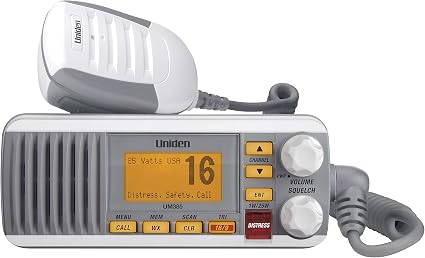
Offering DSC capabilities and triple watch features, this marine VHF radio suits serious boaters who prioritize safety and reliable communication. Its waterproof design and ability to alert you to changing weather make it a strong companion on open waters.
Setting the radio up involves tuning into one of 40 international marine channels, which covers plenty of ground for everyday communication. The handheld mic attaches conveniently to the wheel, letting you transmit messages without taking your eyes off navigation. It’s sturdy enough to handle splashes, meeting IPX4 waterproof standards, so rain or spray won’t knock it out during use.
Communication comes through clearly, with a maximum range of 40 miles depending on conditions. The build feels solid, especially in the handheld mic, designed to stay reliable in rough weather.
Positive notes highlight the timely weather alerts and easy channel switching, while some find the waterproof rating only keeps it safe from splashes, not full submersion.
The most praised aspect is the clear weather alerts that keep you informed and ready to act on the water. Common disappointment comes from the limited waterproofing that protects only against splashes, which could be a downside in heavy rain or accidental drops in water.
This radio fits well for those spending serious time on boats who want a dependable communication tool with safety features. Sailors needing full waterproof protection or longer guaranteed range might want to explore other options better tailored to extreme conditions.
Pros
- Triple watch keeps channels monitored continuously
- DSC enables quick emergency location transmission
- Handheld mic mounts at wheel for safety
- Weather alert warns of approaching storms
Cons
- Waterproof only to splashes, not submersion
- Range depends on conditions, may vary up to 40 miles
| Specification | Details |
|---|---|
| Number of Channels | 40 |
| Water Resistance Level | Waterproof (IPX4) |
| Talking Range Maximum | 40 miles |
| Connectivity Protocol | DSC |
| Additional Features | Waterproof, S. A. M. E Weather Alert, Triple Watch |
Best Handheld VHF Marine Radios with DSC Comparison Table
| Product | Channels | Max Range | Battery Type | Waterproof |
|---|---|---|---|---|
| Standard Horizon HX891BTBK | 66 | 6 feet | Lithium Ion | Waterproof |
| Icom M94D Marine VHF | 4 | 5 mile | AAA | Waterproof |
| Uniden MHS338BT VHF Radio | 25 | 5 mile | Product Specific | Waterproof |
| Retevis RM40 GPS DSC VHF | 98 | 5 mile | Lithium Ion | Waterproof |
| Cobra BlueBound 350 VHF | 98 | 25 mile | – | Waterproof |
| Standard Horizon HX210 VHF | 200 | 5 mile | Lithium Ion | Waterproof |
| Cobra BlueBound 650 VHF | 98 | – | – | Waterproof |
| Standard Horizon HX891BT Floating | 66 | – | – | Waterproof |
| Standard Horizon HX890 VHF | 66 | 5 mile | Product Specific | Waterproof |
| Standard Horizon HX890BK VHF | – | – | Battery Powered | Waterproof |
| Standard Horizon HX890NB VHF | 66 | 5 mile | Lithium Ion | Waterproof |
| Uniden UM385 Fixed VHF | 40 | 40 miles | – | Waterproof |
- Channels66
- Max Range6 feet
- Battery TypeLithium Ion
- WaterproofWaterproof
- Channels4
- Max Range5 mile
- Battery TypeAAA
- WaterproofWaterproof
- Channels25
- Max Range5 mile
- Battery TypeProduct Specific
- WaterproofWaterproof
- Channels98
- Max Range5 mile
- Battery TypeLithium Ion
- WaterproofWaterproof
- Channels98
- Max Range25 mile
- Battery Type–
- WaterproofWaterproof
- Channels200
- Max Range5 mile
- Battery TypeLithium Ion
- WaterproofWaterproof
- Channels98
- Max Range–
- Battery Type–
- WaterproofWaterproof
- Channels66
- Max Range–
- Battery Type–
- WaterproofWaterproof
- Channels66
- Max Range5 mile
- Battery TypeProduct Specific
- WaterproofWaterproof
- Channels–
- Max Range–
- Battery TypeBattery Powered
- WaterproofWaterproof
- Channels66
- Max Range5 mile
- Battery TypeLithium Ion
- WaterproofWaterproof
- Channels40
- Max Range40 miles
- Battery Type–
- WaterproofWaterproof
How to Choose the Best Handheld VHF Marine Radio with DSC
Consider factors like waterproof rating, battery life, and clear audio quality to ensure reliable communication in marine environments. Choosing a radio with effective DSC functionality improves safety by allowing quick distress signaling. Prioritizing these features helps avoid costly replacements and potential emergencies.
Dsc Functionality and Compliance
Failing to have proper Digital Selective Calling (DSC) integration can lead to missed emergency alerts, which makes a difference in critical situations at sea. Radios that fully support DSC allow you to send distress signals with your unique MMSI number, ensuring rescue teams can identify your vessel precisely. Missing this feature or incorrect MMSI pairing causes delays or communication failures during emergencies.
Look for devices that authenticate your vessel’s MMSI number and comply with international marine communication regulations like ITU-R M.493-14. Full DSC functionality includes automated distress calling, individual, group, and all-ships calling, plus acknowledgment features. Without these, you won’t be able to maximize the safety benefits designed into the system.
Transmission Power and Range
Transmitter power has a direct impact on how far your signal can reach across open water. Common handheld radios offer power settings around 1 to 6 watts. Higher power extends range but drains the battery faster.
Having multiple power modes helps balance signal strength with battery life, allowing you to switch to lower wattage when close to shore or other vessels.
Antenna quality and where you carry or mount the radio also influence transmission clarity. A longer, less flexible antenna often works better, but it must remain practical for handheld use.
Spotting a radio with decent power modes and a good antenna configuration prevents frustration from poor reception or limited communication during trips.
Battery Life and Charging Options
Running out of battery power during a long day on the water can turn a simple trip into a headache. Radios with at least 8-10 hours of talk time tend to cover typical usage, but extended trips demand longer-lasting power or spare batteries.
Rechargeable lithium-ion batteries are common and offer good capacity, but having extra battery packs ready is a practical backup.
Charge options vary: many radios now support USB charging for convenience, while some come with dedicated docks providing faster or more stable charging. A few models even offer solar compatibility, allowing off-grid replenishing. Paying attention to these practical charging methods ensures your radio stays ready during extended outings.
Durability and Waterproofing
Marine environments wear down gadgets quickly due to saltwater, sun, and accidental impacts. Radios built with sturdy plastics or reinforced housings tend to hold up better against drops and rough handling.
Check for waterproof ratings like IPX7 or IPX8, which ensure the device can withstand submersion or heavy splashing without malfunctioning.
Resistance to corrosion and UV rays is just as important for long-term reliability. Avoid models with exposed metal parts prone to rust.
Also, durable finishes help maintain visibility of controls and labels over time. Investing in a radio that handles moisture, shock, and environmental stress prevents frequent replacements or unexpected failures.
User Interface and Ease of Use
Operating a radio with gloves or in wet conditions often feels frustrating when buttons are small or displays unclear. High-quality handheld radios feature crisp, backlit screens that remain readable in bright sunlight or low light. Buttons should be large enough to press reliably, with firm feedback to avoid accidental presses or missed inputs.
Menus and controls that are logically organized reduce the time it takes to switch channels or initiate emergency calls. Quick access keys or dedicated distress buttons are essential for fast action.
User interfaces designed with simplicity help prevent mistakes during stressful moments when every second counts.
Proper Maintenance and Care for Your Handheld VHF Marine Radio with DSC
Keeping a handheld VHF marine radio with DSC in good working condition requires regular maintenance. Saltwater exposure can cause corrosion, so rinsing the radio with fresh water after use on saltwater trips helps prevent damage.
Avoid submerging the device unless it’s specifically rated for full immersion. Inspect the antenna and battery contacts for signs of wear or corrosion every few weeks.
Proper battery care is also crucial. Recharge the battery fully before storing the radio for an extended period. Remove the battery during long-term storage to prevent leaks that can damage internal components.
Store the radio in a cool, dry place away from direct sunlight to avoid battery degradation.
Regularly test your radio by performing a channel scan and ensuring the DSC function correctly sends and receives signals. A clean charging port and keeping the protective casing intact are additional steps that help extend the device’s lifespan.
Safety Protocols and Best Practices When Using DSC Marine Radios
Using DSC marine radios effectively involves understanding specific safety protocols. Before setting out, program your MMSI number into the radio, which allows DSC to send a distress signal with your vessel’s information automatically.
Make sure the radio is turned on and has a clear signal to coastal stations or nearby vessels.
- Always monitor channel 16, the international calling and distress frequency, for emergencies or communications.
- Use DSC distress alerts responsibly; initiating a false alert can divert rescue resources.
- Follow up any DSC distress signal with a voice call on channel 16 to provide additional details if possible.
Routine checks on battery life and antenna connections improve signal clarity. Understanding basic radio etiquette, such as waiting for a clear channel before transmitting and keeping messages brief, helps maintain clear communication onboard and with other boats.
Comparing Handheld VHF Marine Radios with DSC to Fixed-Mount Alternatives
Handheld VHF marine radios with DSC offer portability that fixed-mount units cannot match. These handheld devices are ideal for use on small boats, kayaks, or as backup radios because they can easily be carried around or used off the vessel. Their compact size makes them convenient but may come with shorter battery life compared to fixed models.
Fixed-mount radios typically have more powerful transmitters and larger antennas, resulting in better range and signal strength in open water. Many fixed units also provide additional features such as integrated GPS and more extensive display screens for easier navigation of channels and functions.
Choosing between the two depends on your needs. A handheld radio with DSC is sufficient for nearshore use and emergency backup, while fixed-mount systems suit boats spending long periods offshore where communication range and system integration are priorities.
People Also Asked
How Do I Properly Care for a Handheld VHF Marine Radio with DSC?
Keep the radio dry and rinse it with fresh water after exposure to saltwater. Store it in a cool, dry place and replace the battery regularly to maintain good performance.
What Size Handheld VHF Marine Radio with DSC Should I Buy?
Choose a size that balances portability with battery life; a medium-sized radio often provides easier handling and longer use between charges. Consider how often you’ll carry it or wear it on a life vest.
Are Handheld VHF Marine Radios with DSC Compatible with All Boats?
Most handheld VHF radios with DSC work with any boat as long as the radio is properly registered and programmed with your vessel information. Confirm compatibility with your boat’s equipment if integrating with other systems.
How Long Does the Battery Last on a Typical Handheld VHF Radio?
Typical battery life ranges from 6 to 12 hours depending on usage and model. Carrying spare batteries or a portable charger can be helpful for longer trips.
What Are Common Problems with Handheld VHF Marine Radios with DSC?
Common issues include weak signals, battery drainage, and difficulty receiving DSC calls due to poor antenna connections. Keeping contacts clean and checking settings regularly helps avoid these problems.
Conclusion
Choosing a handheld VHF marine radio with DSC means focusing on clear audio quality, reliable signal range, and easy-to-use DSC features. Battery life and weather resistance also matter since the device needs to work well on the water under different conditions.
Another thing to check is the size and weight, as you’ll want something comfortable to hold for long periods.
Think about where you’ll keep the radio, your budget, and how often you’ll use it. Some models fit better in tight spaces or come at a lower cost, while others might be better for frequent use with extra features. Take another look at the comparison table and the detailed picks to find the best fit for your needs.

I’m Grant Mitchell, a firearms and hunting writer with years of experience at the range and in the field. I write about rifles, shotguns, handguns, optics, safe storage, cleaning, and responsible ownership, along with practical hunting tips. My goal is to share accurate, safety-first information that helps you choose the right firearm, maintain it properly, and become a more confident shooter.


