Top 12 Best AIO 240mm Cooler That Will Boost Your PC Now
Many PC builders have faced the frustration of their CPU overheating or the cooler making excessive noise due to poor airflow. The best aio 240mm cooler can keep CPU temperatures stable under load while running quietly, something a lower-quality model often fails to manage.
It’s common to hear complaints about leaks or mounting issues with cheaper options, which can cause both performance setbacks and potential hardware damage.
A reliable 240mm AIO cooler typically features durable materials like copper cold plates for efficient heat transfer and corrosion-resistant aluminum radiators. The radiator size matters for fitting standard mid-tower cases, and the fan performance also plays a key role, fans spinning between 1200 and 2000 RPM strike a balance between cooling and noise. Proper mounting mechanisms prevent leaks and simplify installation, while sealed loops minimize maintenance, making upkeep easier over time.
Need a Quick Check?
| Image | Product | Price |
|---|---|---|
Our Top Picks 1  | ARCTIC Liquid Freezer III 240 | Check Price |
Our Top Picks 2  | Thermalright FW 240 SE ARGB | Check Price |
Our Top Picks 3  | CoolerMaster ML240L RGB V2 | Check Price |
Our Selected Top 12 Aio 240mm Cooler Picks for Every Need
This list features 12 carefully chosen 240mm all-in-one coolers, each reviewed for performance, compatibility, and design. Readers will discover the strengths and weaknesses of each model, helping them find the best fit for their specific cooling needs and system setups.
1. ARCTIC Liquid Freezer III Pro 240
Great cooling performance and quiet operation make this AIO cooler a solid choice for anyone wanting to keep their CPU temperatures low without excess noise. It suits users with both Intel and AMD builds, especially those who care about efficient heat transfer and system reliability.
Installation is straightforward, with native offset mounting that aligns the cold plate with the CPU hotspot for better heat transfer. The included P12 PRO fan provides a quiet experience at low speeds while ramping up well under heavy load.
The integrated VRM fan runs automatically via PWM to keep voltage regulators cool, adding an extra layer of protection without extra noise.
The cooler handles high loads efficiently, thanks to the 3000 rpm max speed and 77 cfm airflow of the fan. Build quality feels solid with thoughtful pressure distribution on Intel sockets to protect the CPU.
Most users find the fan quiet and effective, though some mention the VRM fan can be noticeable under certain conditions.
The integrated VRM fan adds effective cooling to voltage converters without much noise most of the time, which is the feature praised most often. Some users do find the VRM fan’s sound noticeable during demanding tasks, making it the most common downside. The balance between cooling power and noise is a trade-off here.
Anyone running CPUs that tend to get hot or want extra cooling for VRMs will appreciate this cooler. Quiet computing fans looking for minimal noise at low loads will find it suitable. Those who want absolute silence at max fan speeds may want to consider alternatives.
Pros
- Quiet operation especially at low fan speeds
- Integrated VRM fan for added voltage regulator cooling
- Optimized contact pressure for longer CPU life
- Compatible with both Intel and AMD sockets
Cons
- VRM fan noise noticeable under some conditions
- Maximum fan speed may be loud at peak
| Specification | Details |
|---|---|
| Maximum Rotational Speed | 3000 rpm |
| Air Flow Capacity | 77 cfm |
| Voltage | 12 volts |
| Wattage | 3.96 watts |
| Power Connector Type | 4-Pin |
2. Thermalright FW 240 SE ARGB
Aluminum and a large 240mm radiator make this water cooler a solid choice for desktop users seeking quick heat removal. It fits well with mid-range to high-performance CPUs, especially where noise control matters most.
The standout feature is the use of double fans optimized to balance speed and quiet operation.
Setup can feel straightforward given its standard sizing, fitting most cases that support 240mm radiators. The TL-P12W-S fans operate up to 2000 rpm and adjust speed based on CPU temperature, which helps keep noise down during lighter loads.
The sturdy S-FDB bearings and blade design lower vibration and noise, helping maintain a calm environment while gaming or working.
Heat dissipation is effective thanks to the powerful fans and pump combo, which keeps temperatures stable under load. The cooler is well-built with quality materials and size that support strong cooling performance.
Most praise centers on how quiet it runs relative to its airflow, while some mention the noise level nearing 29.8 dBA under full speed as a downside.
The cooling setup is praised for excellent heat dissipation combined with quiet function thanks to high-quality fan bearings and blade design. Common feedback points to the noise level being near 29.8 dBA at peak speeds, which can be louder than expected during heavy load.
Those who prioritize quiet performance and stable CPU temperatures will appreciate this design. Users with cases supporting larger radiator thickness should consider it, while those with strict noise sensitivity or limited case space might explore alternatives with slimmer or quieter fans.
Pros
- Quiet operation with PWM temperature control
- High air flow at 70.84 cfm
- Strong build with quality bearings
- Large radiator for efficient heat removal
Cons
- Noise level reaches up to 29.8 dBA at max speed
- Relatively thick radiator may limit some case compatibility
| Specification | Details |
|---|---|
| Maximum Rotational Speed | 2000 rpm |
| Noise Level | 29.8 dBA |
| Air Flow Capacity | 70.84 cfm |
| Voltage | 12 volts_of_direct_current |
| Power Connector Type | 4-Pin |
3. CoolerMaster MasterLiquid ML240L RGB V2
Bright RGB lighting stands out immediately, perfect for those who want their cooler to look as good as it performs. Suited for anyone using AMD or Intel processors compatible with the included mounting kits, especially folks who want quiet cooling without sacrificing style. Its biggest strength lies in balancing strong cooling with a calm acoustic profile.
Installation is straightforward thanks to wide socket support including the latest LGA1700 and AMD AM4 platforms. Fans run very quietly at 30 db while delivering a steady 62 cfm airflow, making daily operation quiet and comfortable.
The refreshed fan blade design improves airflow without adding noise, and the dual chamber pump works efficiently without demanding much power from your system.
Cooling performance keeps processors stable under load, thanks to a 260-watt capability and reliable water cooling method. Build quality feels sturdy, especially with the high-grade EPDM seal designed to prevent leaks over time. Fans spin at a maximum of 1800 rpm, combining good airflow with minimal noise, though some mention that RGB lighting may be a bit bright for low-light setups.
The cooler receives praise for maintaining a balance between quiet performance and effective temperature control through its dual chamber pump and redesigned fan blades. Bright RGB lighting is often highlighted but can be too intense for users who prefer a subtler look, standing out as the main complaint.
Those wanting a cooler that looks good while working quietly on a wide range of CPU sockets will appreciate this model. Users sensitive to bright RGB effects or who want higher fan speeds might want to explore alternatives better suited to their preferences.
Pros
- Quiet operation with 30 db noise level
- Strong cooling holds up to 260 watts
- Supports many AMD and Intel sockets
- Durable industrial-grade anti-leak seal
Cons
- RGB lighting can be too bright in dark rooms
- Maximum fan speed limited to 1800 rpm
| Specification | Details |
|---|---|
| Power Connector Type | 4-Pin |
| Voltage | 12 volts |
| Wattage | 260 watts |
| Noise Level | 30 db |
| Maximum Rotational Speed | 1800 rpm |
| Air Flow Capacity | 62 cfm |
4. ARCTIC Liquid Freezer III Pro 240 A-RGB
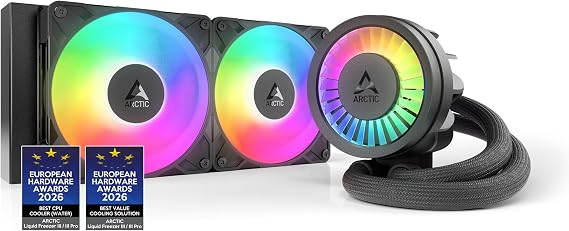
An AIO cooler designed with precision for Intel and AMD setups, it shines brightest through its advanced heat dissipation and optimized pressure distribution to protect your CPU. Ideal for those who want reliable, consistent cooling without noisy fans demanding their attention.
Setting it up is straightforward, thanks to the native offset mounting that matches up perfectly with the CPU hotspot. The included ARCTIC P12 PRO fans kick in quietly, especially noticeable at lower speeds, while the integrated VRM fan helps keep other critical components cool. The sturdy water cooling method keeps temperatures in check day to day, letting you focus on your tasks or gaming without constant monitoring.
It manages heat thoughtfully, ensuring your processor runs cooler under heavy loads thanks to efficient contact pressure and a well-positioned cold plate. Build quality feels solid, with well-made connectors and components.
A common praise highlights quiet operation paired with strong airflow, while some mention the water cooling setup requires occasional checks to prevent any maintenance issues.
Quiet operation combined with strong cooling capacity is the most appreciated feature, while some notice the need for careful maintenance over time. This blend keeps CPU temperatures solid but involves a bit of attention when running long sessions.
People running high-performance Intel or AMD systems will appreciate the precise cooling and quiet fans. Folks preferring simpler, less hands-on solutions might want to explore other air coolers or less complex AIOs.
Pros
- Optimized contact pressure for better heat dissipation
- Quieter operation at low fan speeds
- Integrated VRM fan improves overall system stability
- Supports latest Intel LGA1851 and LGA1700 sockets
Cons
- Requires occasional maintenance to prevent wear
- Maximum rotational speed stated as 1 rpm may be a data error
| Specification | Details |
|---|---|
| Power Connector Type | 4-Pin |
| Voltage | 12 volts |
| Wattage | 3.96 watts |
| Cooling Method | Water |
| Compatible Devices | AMD, Intel |
| Air Flow Capacity | 77 cfm |
5. Thermalright Aqua Elite 240 V3

Keeping your CPU cool during demanding tasks can make a big difference in system stability. Designed for desktops, this 240mm liquid cooler suits those who want efficient heat dissipation with a quiet operation. Its standout feature is the low noise level combined with high airflow, offering both performance and quietness.
Installation involves mounting the black aluminium fin heat sink plate along with the 240 cold row size radiator, which fits well in most mid to larger cases. The included 120mm ARGB fan runs quietly and delivers strong airflow, keeping temperatures down without fuss. The water pipe mesh adds durability to the cooling loop.
Everyday use stays cool with minimal vibrations and a pump that hums quietly at 2800 RPM.
Cooling performance is strong thanks to the fourth generation pump head and carefully designed radiator surface. The cooler handles heat well during gaming sessions or heavy work while operating at just 25 dB noise. Build quality feels solid with a unique octagonal pump head design that also adds a bit of flair with ARGB lighting.
The main complaint is that the maximum fan speed caps at 1800 RPM, which might limit extreme overclock cooling.
The strongest praise comes from its quiet performance with efficient cooling thanks to the 4th generation pump. The most frequent complaint is the fan speed limit of 1800 rpm, which restricts extra-heavy cooling needs.
Those looking for a reliable, low-noise 240mm cooler will be happy with this unit. Users who need ultra-high fan speeds or have tighter case spaces might want to consider different options.
Pros
- Quiet operation at 25 db noise level
- Durable mesh water pipe for longevity
- ARGB lighting on uniquely shaped pump head
- Good airflow with 66.17 cfm on included fan
Cons
- Maximum fan speed limited to 1800 rpm
- May not fit smaller cases easily
| Specification | Details |
|---|---|
| Power Connector Type | 4-Pin |
| Voltage | 5 volts |
| Wattage | 2.64 watts |
| Noise Level | 25 db |
| Maximum Rotational Speed | 1800 rpm |
| Air Flow Capacity | 66.17 cfm |
6. MSI MAG Coreliquid A13 240

Running quietly at just 14.4 dB while packing a punch with a high-performance pump up to 3800 RPM, the MSI MAG Coreliquid A13 240 suits those who want efficient cooling without noise distractions. It’s especially good for anyone upgrading to the latest LGA 1851 platform thanks to its out-of-the-box compatibility.
Setting it up is straightforward, with a 4-pin power connector simplifying the connections. The split-flow aluminium radiator, combined with a water cooling method, keeps temps down efficiently on desktop setups. The ceramic bearing pump balances speed with quiet operation, so there’s neither annoying whine nor sacrifice in performance during daily tasks or gaming sessions.
It does its cooling job well, reducing heat reliably while running very quietly. The radiator is solidly built for durability, and the integrated pump cuts down motor resonance.
The strongest praise highlights how quiet it stays during heavy workloads, while some have noted the maximum fan speed of 5200 RPM can feel a bit high when pushed to the limit.
Quiet operation during heavy loads stands out as a major plus, supported by the ceramic bearing pump that reduces motor noise. However, fan noise increases noticeably once speeds hit the maximum 5200 RPM, which can be a downside in some cases.
Good fit for those building a new LGA 1851 desktop who value low noise and reliable cooling. Users needing ultra-quiet systems at full speed or compatibility beyond desktops might look for alternatives.
Pros
- Quiet operation with just 14.4 dB noise level
- Out-of-the-box support for LGA 1851
- Durable split-flow aluminium radiator design
- High airflow capacity of 60.78 cfm
Cons
- Maximum fan speed can be quite loud if pushed
- Limited to desktop compatibility only
| Specification | Details |
|---|---|
| Power Connector Type | 4-Pin |
| Voltage | 12 volts_of_direct_current |
| Wattage | 2.16 watts |
| Noise Level | 14.4 db |
| Maximum Rotational Speed | 5200 rpm |
| Air Flow Capacity | 60.78 cfm |
7. NZXT Kraken Plus 240 RGB

Anyone looking to keep their CPU cool during intense workloads will find the NZXT Kraken Plus 240 RGB a solid option. It’s especially well-suited for those who want powerful performance paired with a customizable display.
The single biggest strength lies in its efficient cooling combined with an eye-catching LCD screen that shows system stats or fun custom images.
Setting it up is pretty straightforward thanks to just four screws and a single cable, which simplifies installation and cable management. The included RGB Core fan offers vibrant lighting without complicating airflow.
Day-to-day use is quiet, too, with noise levels around 31.9 db, making it unobtrusive even under load. The pump’s high flow and head pressure ensure the CPU runs cooler without extra noise distractions.
Performance is consistent with what you’d expect from a good 240mm liquid cooler. It stays efficient under heavy CPU use, and the build quality feels solid and well thought out.
The custom LCD is a unique addition that users praise for its clarity and customization options. Common complaints involve the pump speed, maxing out at 2800 rpm, which some say could be a bit loud during maximum performance, but it balances well overall.
Praise often highlights the custom LCD screen’s brightness and ease of customization through software. The most common downside is the pump noise at peak speeds, which can interrupt an otherwise quiet setup. The cooling efficiency stays solid during demanding tasks, and the lighting effects complement the aesthetics of a modern build.
This cooler suits users who want strong CPU cooling while adding a unique visual feature. Gamers and content creators running latest AMD or Intel processors will appreciate it. Those needing ultra-low noise or extremely high cooling headroom might look for a model with quieter pumps or bigger radiators.
Pros
- Easy, clean installation with one cable and four screws
- Customizable 1.54″ LCD for real-time info and animations
- Supports newest AMD and Intel CPU sockets
- Quiet operation at 31.9 db under load
Cons
- Some noise at maximum 2800 rpm pump speed
- Wattage limited to 12 watts, may limit overclocking potential
| Specification | Details |
|---|---|
| Power Connector Type | 4-Pin |
| Voltage | 12 volts_of_direct_current |
| Wattage | 12 watts |
| Cooling Method | Water |
| Compatible Devices | Supports latest AMD and Intel sockets, including AM5 and LGA 1851 |
| Noise Level | 31.9 db |
| Maximum Rotational Speed | 2800 rpm |
8. ID-COOLING Frostflow X 240

Excellent heat transfer from the CPU sets this liquid cooler apart, with a 240mm radiator and two 120mm PWM fans designed for strong cooling. It’s best suited for desktop users looking for a quieter cooling solution that matches well with white-themed PC builds.
Installation is straightforward, fitting various Intel and AMD sockets without needing extra adapters. The white LED lighting on the pump adds a subtle touch to your setup without being flashy.
Fans adjust their speed automatically via PWM, so noise levels stay low unless the CPU gets very hot, keeping your system calm under normal use.
The cooling performance is solid, effectively reducing CPU temperatures thanks to good airflow and a sizable radiator. The build quality feels reliable with standard water cooling materials. Some users mention the 2-pin power connector limits fan control options, but the quiet operation at 30 dB is frequently praised.
Users appreciate the quiet operation and effective cooling, especially during everyday use, but the 2-pin connector restricts full fan speed control for advanced tweaks. The white LED lighting is a simple but nice visual touch without overwhelming the build’s aesthetics.
People who want reliable cooling with minimal noise and easy compatibility will be satisfied with this cooler, especially if they value clean-looking setups. Those needing more sophisticated fan control or a quieter maximum fan speed might prefer other options.
Pros
- Good heat dissipation with 240mm radiator
- Quiet operation thanks to PWM fans
- Compatible with many Intel and AMD sockets
- Subtle white LED lighting on pump
Cons
- 2-pin power connector limits fan control
- Maximum fan speed can get noisy at 2500 rpm
| Specification | Details |
|---|---|
| Voltage | 12 volts |
| Wattage | 4.8 watts |
| Cooling Method | Water |
| Noise Level | 30 db |
| Maximum Rotational Speed | 2500 rpm |
| Power Connector Type | 2-Pin |
9. Noctua NL-LC1-24 240mm AIO Cooler

Noctua NL-LC1-24 240mm AIO Cooler stands out for exceptional quietness paired with strong cooling power. It suits enthusiasts who want a reliable liquid cooler that stays whisper-quiet while handling demanding desktop CPUs without hogging space.
Compact size and acoustic design make it ideal for small form factor builds.
Installation is straightforward thanks to a 240mm radiator that fits well in most cases. Two Noctua NF-A12x25 G2 PWM fans come pre-attached, optimized for low noise at various speeds.
The pump uses a layered soundproofing system that noticeably reduces vibrations, making constant daily use pleasantly quiet without sacrificing cooling effectiveness.
Cooling is consistent and solid, holding temperatures well under load with airflow rated at 107.3 cubic meters per hour. The build quality feels premium, relying on Asetek Emma V2 technology that prioritizes reliability.
Most praise highlights its near-silent operation, while some note the radiator’s compact size might limit peak cooling in very high-TDP CPUs.
The quiet pump and advanced soundproofing are standout features, making it one of the calmest AIO coolers to run continuously. Common feedback points to the balance between compact radiator size and cooling capacity, which can feel limited under extreme CPU stress.
This model is great for anyone looking for near-silent performance in a smaller PC build. Users with extremely demanding cooling needs or very large cases might want to explore larger radiators or additional cooling options instead.
Pros
- Very low pump vibration and noise
- Compact 240mm radiator fits smaller cases
- Acoustic-optimized fans for quiet operation
- Reliable Asetek Emma V2 cooling platform
Cons
- Radiator size may limit cooling on very high-TDP CPUs
- Fans capped at 1800 rpm might struggle with extreme loads
| Specification | Details |
|---|---|
| Cooling Method | Water |
| Noise Level | 22.5 db |
| Maximum Rotational Speed | 1800 rpm |
| Power Connector Type | 4-Pin |
| Voltage | 12 volts |
| Wattage | 1.8 watts |
10. Be Quiet! Pure Loop 3 240

Running the Pure Loop 3 240mm feels reliable even during intense gaming or video editing sessions. Ideal for anyone needing strong cooling power, it manages to keep temperatures low without turning your PC into a noisy distraction.
Its quiet operation stands out as the biggest strength for those who value silence.
Installation is straightforward, compatible with a wide range of Intel and AMD sockets. The two 120mm fans with a closed loop motor help maintain a steady fan speed regardless of radiator resistance. Its PWM pump is whisper-quiet due to the 6-pole 3-phase motor, so daily use is peaceful while still delivering great cooling performance.
Cooling power is impressive, holding up well under peak CPU loads. The build quality feels solid, especially the radiator and fans designed to provide high air pressure.
The most praised feature is the quietness, while some mention the fan speed reaching up to 2100 rpm can be audible under heavy loads.
Quiet operation with a powerful pump receives strong praise, making it great for noise-sensitive setups. The main complaint comes from the fans becoming noticeably loud when running at full speed during intense workloads.
Anyone looking for solid cooling and low noise will appreciate this cooler. Those prioritizing near-silent operation even under full load might prefer an option with quieter fans or lower maximum RPM. It fits well in systems where performance and reasonable noise are balanced.
Pros
- Quiet 6-pole 3-phase motor pump
- High air pressure fans for efficient cooling
- Supports a wide range of Intel and AMD sockets
- Consistent fan speed with closed loop motor feature
Cons
- Fans can be audible at maximum 2100 rpm
- Noise level can reach 36.8 db under load
| Specification | Details |
|---|---|
| Compatible Devices | Intel sockets: 1851/1700/1200/1151/1150/1155, AMD sockets: AM5/AM4 |
| Noise Level | 36.8 db |
| Maximum Rotational Speed | 2100 rpm |
| Air Flow Capacity | 59.6 cfm |
| Voltage | 12V |
| Power Connector Type | 4-Pin |
11. Antec Skeleton 240 ARGB

Antec Skeleton 240 ARGB is suited for anyone looking to cool high-performance CPUs without fuss. Its standout feature is the impressive cooling power thanks to the copper base plate and high-density fins. It’s a solid pick for those wanting a reliable 240mm AIO cooler with eye-catching illumination.
Setup is straightforward, fitting Intel LGA 115X, 1200, 1700, 20XX, and AMD AM4/AM5 sockets easily. The skeleton-frame pump head adds a personal touch with customizable ARGB lighting syncing via motherboard software. High-density tubes and hydraulic bearing fans keep noise levels low and operation stable, so it works quietly in daily computing or gaming.
Performance is strong for handling heavy loads, with copper base plate and PWM fans that support cooling even under strain. Build quality feels durable, with elastic tubing designed to last. Fans spin up to 2000 rpm at 32 dB, praised for quiet operation but some reviews mention the ARGB lighting controller could be more versatile.
Cooling performance receives high marks for keeping CPU temperatures low during intense workloads. The pump and fan design enable quiet and stable operation. Most commonly, ARGB lighting controls are noted as less flexible, which might limit appearance tweaks for some setups.
Gamers or PC builders seeking efficient cooling with a visual flair will appreciate this cooler. Those needing completely silent operation or advanced lighting control may want to explore alternatives that specialize in those features.
Pros
- Strong cooling with copper base plate
- Customizable ARGB lighting synced to motherboard
- Quiet operation under load
- Wide socket compatibility
Cons
- ARGB controller functionality limited in some setups
- Fans can reach higher noise at max speed
| Specification | Details |
|---|---|
| Voltage | 120 volts |
| Wattage | 120 watts |
| Noise Level | 32 db |
| Maximum Rotational Speed | 2000 rpm |
| Air Flow Capacity | 72.29 cubic_centimeters_per_minute |
| Power Connector Type | 4-Pin |
12. NZXT Kraken Core 240 RGB

NZXT Kraken Core 240 RGB uses a single-frame design that reduces cables and screws for easier installation and a cleaner build. Suited for desktop users seeking a balance between strong cooling and quiet operation, its most notable feature is the powerful yet quiet 3,100 RPM pump that handles gaming and multitasking well.
Setup is straightforward as it connects directly to the motherboard, cutting down on cable clutter and extra controller boxes. The PWM-enabled fans make it simple to adjust speeds, offering precise control without much noise. The optimized fan blades deliver better airflow, which you notice during heavier loads, and the RGB lighting adds a subtle flair without being distracting.
Performance keeps the CPU cool under pressure with its efficient water cooling and high static pressure fans. The build is solid, emphasizing quiet running at just 31.9 dB noise level.
Praise often points to the effective cooling and easy installation. At the same time, some mention it could be quieter when fans spin up towards max RPM.
The strongest praise for this cooler is its effective combination of quiet, powerful pump performance paired with easy installation thanks to direct motherboard connectivity. Noise tends to increase noticeably when fans reach their top speed, which some find less ideal during intense tasks.
People looking for a cooler that balances quiet daily use with reliable cooling will appreciate the design and features here. Those needing the absolute lowest noise at all times or advanced power control may want to explore other options.
Pros
- Quiet operation during moderate use
- Easy motherboard connection, no extra controllers
- Efficient air pushing with optimized fan blades
- Clean build with single-frame fan design
Cons
- Can get noisy at maximum fan speed
- Limited voltage and power customization options
| Specification | Details |
|---|---|
| Maximum Rotational Speed | 3100 rpm |
| Noise Level | 31.9 db |
| Air Flow Capacity | 75.05 cfm |
| Power Connector Type | 4-Pin |
| Voltage | 5 volts_of_direct_current |
| Wattage | 8.88 watts |
Best AIO 240mm Coolers Comparison Table
| Product | Cooling Method | Compatible Devices | Maximum Rotational Speed | Noise Level |
|---|---|---|---|---|
| ARCTIC Liquid Freezer III 240 | Water | AMD, Intel | 3000 rpm | – |
| Thermalright FW 240 SE ARGB | Water | Desktop | 2000 rpm | 29.8 db |
| CoolerMaster ML240L RGB V2 | Water | Desktop | 1800 rpm | 30 db |
| ARCTIC Liquid Freezer III A-RGB | Water | AMD, Intel | 1 rpm | – |
| Thermalright Aqua Elite 240 V3 | Air, Water | Desktop | 1800 rpm | 25 db |
| MSI MAG Coreliquid A13 240 | Water | Desktop | 5200 rpm | 14.4 db |
| NZXT Kraken Plus 240 RGB | Water | AMD, Intel | 2800 rpm | 31.9 db |
| ID-COOLING Frostflow X 240 | Water | Desktop | 2500 rpm | 30 db |
| Noctua NL-LC1-24 AIO | Water | Desktop | 1800 rpm | 22.5 db |
| be quiet! Pure Loop 3 | Water | AMD, Intel | 2100 rpm | 36.8 db |
| Antec Skeleton 240 ARGB | Water | Desktop | 2000 rpm | 32 db |
| NZXT Kraken Core 240 RGB | Water | Desktop | 3100 rpm | 31.9 db |
- Cooling MethodWater
- Compatible DevicesAMD, Intel
- Maximum Rotational Speed3000 rpm
- Noise Level–
- Cooling MethodWater
- Compatible DevicesDesktop
- Maximum Rotational Speed2000 rpm
- Noise Level29.8 db
- Cooling MethodWater
- Compatible DevicesDesktop
- Maximum Rotational Speed1800 rpm
- Noise Level30 db
- Cooling MethodWater
- Compatible DevicesAMD, Intel
- Maximum Rotational Speed1 rpm
- Noise Level–
- Cooling MethodAir, Water
- Compatible DevicesDesktop
- Maximum Rotational Speed1800 rpm
- Noise Level25 db
- Cooling MethodWater
- Compatible DevicesDesktop
- Maximum Rotational Speed5200 rpm
- Noise Level14.4 db
- Cooling MethodWater
- Compatible DevicesAMD, Intel
- Maximum Rotational Speed2800 rpm
- Noise Level31.9 db
- Cooling MethodWater
- Compatible DevicesDesktop
- Maximum Rotational Speed2500 rpm
- Noise Level30 db
- Cooling MethodWater
- Compatible DevicesDesktop
- Maximum Rotational Speed1800 rpm
- Noise Level22.5 db
- Cooling MethodWater
- Compatible DevicesAMD, Intel
- Maximum Rotational Speed2100 rpm
- Noise Level36.8 db
- Cooling MethodWater
- Compatible DevicesDesktop
- Maximum Rotational Speed2000 rpm
- Noise Level32 db
- Cooling MethodWater
- Compatible DevicesDesktop
- Maximum Rotational Speed3100 rpm
- Noise Level31.9 db
How to Choose the Right 240mm AIO Cooler
Selecting a quality 240mm AIO cooler requires focusing on cooling performance, build quality, and compatibility with your system. Prioritizing these factors ensures efficient heat management, quieter operation, and easy installation, ultimately preventing future upgrades or repairs and saving both time and money.
Cooling Performance
Radiator design greatly influences how well the whole system cools your processor. Radiators with dense fin arrays and a good surface area remove heat faster but need fans that can push enough air through.
Fans rated around 40 to 70 CFM often find a sweet spot, giving solid airflow without being too loud. A pump running at consistent high RPM ensures the coolant keeps moving effectively, avoiding hot spots around the CPU.
Less efficient radiators or weak fans mean temperatures can stay higher during gaming or heavy workload sessions, sometimes causing throttling. Pumps that slow down or are unreliable might lead to overheating or component damage over time.
Look for metal radiators, usually aluminum or copper, combined with sturdy, well-balanced fans and pumps that report speed through software for reliable monitoring.
Compatibility and Fit
Choosing a product that matches your CPU socket is crucial. Several socket types exist, from Intel LGA 1700 to AMD AM5, and each requires brackets that fit snugly. Wrong compatibility wastes time and leads to poor thermal contact.
The radiator’s size must also fit your case layout, 240 mm usually refers to two 120 mm fans side by side, so space above the motherboard and in front or top of the case matters.
Clearance with tall RAM modules and nearby VRMs can be tight. Thicker radiators might block airflow around other components, or tubes can interfere with motherboard headers. Check the radiator thickness, it commonly ranges from 25 to 30 mm, to avoid surprises.
Always verify the spacing from your case’s spec and compare tube length against your case dimensions for comfortable installation.
Noise Levels
Fan noise levels change dramatically with RPM. Fans running at 1500 to 2000 RPM can produce noticeable hum or whine, which becomes distracting in quiet setups. Pumps are usually quieter but might emit a faint buzzing if the bearings wear out or are poorly designed.
Systems that allow you to control fan speed curves and pump intensity make balancing cooling and silence easier, so you can dial up performance only when needed.
Choosing fans with low decibel ratings, typically below 30 dBA at maximum speed, helps keep background noise down. Pumps that operate steadily without sudden changes in noise contribute to a less intrusive experience. Those who prioritize low sound levels should look for sets with software that lets you customize speeds, running fans slower at idle then ramping up reduces overall noise without compromising temperature control.
Build Quality and Materials
Radiators made from thicker aluminum or copper last longer and resist warping under heat cycles better than cheaper materials. Tubing quality matters too, soft rubber tubes tend to degrade or develop leaks after some years, while reinforced, braided covers prevent kinks and abrasions. The water block should have a copper base for better heat conduction and a solid pump housing to avoid cracks or leakage points.
Good systems have anti-corrosion coatings or additives to prevent buildup inside the loop that can impair cooling efficiency. Leak prevention isn’t just about sturdy fittings; clamps or compression seals on tubing avoid drips during movement or installation.
Durable parts save hassle down the line, cutting down on replacement costs and unexpected failures.
Installation and Maintenance
Mounting the radiator and block can be challenging in cramped cases. A straightforward bracket system with thumbscrews speeds up installation.
Radiators often come with brackets for multiple sockets, simplifying setup without extra purchases. Some designs keep screws and mounting points accessible even once the cooler is fully attached, making future adjustments or upgrades easier.
Cleaning fans and radiator fins without full disassembly helps maintain performance over time. Removable fan mounts or quick-release clips are beneficial. Clear instructions with diagrams reduce guesswork, especially about orientation or thermal paste application.
Hardware kits including all the necessary screws, backplates, and spacers avoid frustrating trips back to stores or waiting for missing parts.
Optimizing Cooling Performance with Custom Fan Curves
Adjusting fan curves can make a noticeable difference in how well a 240mm AIO cooler manages heat. Most motherboard software and some standalone controllers allow users to set custom profiles, balancing noise levels and cooling power based on temperature triggers. Setting the fans to spin faster once the CPU reaches a certain temperature threshold prevents overheating during heavy loads without running loud all the time.
Conversely, slowing fans down during light use helps reduce noise and wear.
Key points to consider when optimizing fan curves:
- Start with a baseline profile and monitor CPU temps under various workloads
- Adjust fan speeds incrementally rather than large jumps
- Use software that synchronizes fan speed with pump speed for consistent cooling
- Consider your case airflow since it affects radiator efficiency
Fine-tuning this balance improves cooling efficiency and helps components last longer.
Routine Maintenance Tips to Prolong AIO Cooler Lifespan
Maintaining an AIO cooler can help avoid performance drops and extend its functional life. Dust build-up is the primary enemy, especially on the radiator fins and fans, where airflow is critical. Use compressed air to clean these parts at least once every few months depending on your environment.
Avoid spraying air directly into the pump area to prevent moisture damage.
Check the pump operation by feeling for vibrations or listening for unusual sounds periodically. A failing pump drastically reduces cooling efficiency and can cause CPU temperatures to spike.
Cable management also matters for preserving cooler function, as obstructed tubing or cables can stress connectors and tubing.
Daily usage practices to keep in mind:
- Clean dust filters and radiator surfaces regularly
- Verify pump function by physical inspection or software monitoring
- Secure tubing to avoid kinks or excessive bending
- Replace thermal paste whenever the cooler is reinstalled after significant periods
Common Installation Mistakes and How to Avoid Them
Installing a 240mm AIO cooler can be straightforward but missteps often reduce its effectiveness. One frequent mistake is uneven mounting pressure on the CPU block.
This can lead to poor thermal contact, causing higher temperatures. It helps to follow manufacturer instructions for tightening screws in a crisscross pattern, applying even pressure.
Another common issue involves radiator placement. Mounting it in a way that traps air inside or impedes airflow reduces heat dissipation. Make sure the radiator fans are oriented correctly to exhaust hot air or bring in cool air depending on your case airflow design.
Avoid tight bends in the tubing as these can restrict coolant flow and increase wear.
Installation tips:
- Clean the CPU surface thoroughly before applying thermal paste
- Test fit radiator and fans to confirm clearance with other components
- Connect pump and fan headers according to motherboard instructions for proper RPM control
- Check for leaks by running the system briefly before closing the case
People Also Asked
How Do I Install an AIO 240mm Cooler Properly?
Mount the radiator to your case’s designated fan slot, usually top or front. Tighten screws evenly to avoid bending. Apply thermal paste correctly on the CPU before attaching the block, and make sure the pump cables are connected to the right motherboard headers for power and control.
Will a 240mm AIO Cooler Fit in My PC Case?
Most mid-tower and larger cases support 240mm radiators, but check your case’s specifications to confirm. Some smaller or budget cases may only fit 120mm or 140mm radiators. Measuring the case’s radiator mounting points and clearance for fans helps avoid fitting issues.
How Long Does a 240mm AIO Cooler Typically Last?
A 240mm AIO cooler generally works well for 3 to 5 years. Pump failure or coolant degradation often limits lifespan, and fans may also wear out over time. Regularly cleaning dust off the radiator keeps cooling performance consistent during that period.
What Are Common Problems with AIO 240mm Liquid Coolers?
Common problems include pump noise, coolant evaporation causing performance drops, and fan failures. Air bubbles trapped in the system can also lead to noise or reduced cooling. Topping off coolant isn’t possible on sealed units, so replacement is usually necessary if issues arise.
Is It Safe to Use an AIO 240mm Cooler for Gaming PCs?
A 240mm AIO cooler is safe and effective for gaming PCs, handling higher CPU temperatures better than many air coolers. Pump reliability and fan quality affect stability during long gaming sessions. Make sure to maintain proper airflow in the case to support the radiator’s cooling.
Conclusion
Cooling performance and noise levels should be the top priorities when selecting a 240mm AIO cooler. How well the cooler fits your case is just as important. Also consider the build quality and reliability since it will be running for long periods.
Make sure to pick a cooler that matches your budget and the space available inside your case. Consider how often you plan to use it and balance features accordingly. The comparison table and detailed picks above offer straightforward options to fit different needs and setups.

I’m Grant Mitchell, a firearms and hunting writer with years of experience at the range and in the field. I write about rifles, shotguns, handguns, optics, safe storage, cleaning, and responsible ownership, along with practical hunting tips. My goal is to share accurate, safety-first information that helps you choose the right firearm, maintain it properly, and become a more confident shooter.