Top 12 Best 1366 CPU Cooler That Will Blow Your Mind!
Many people with older computer builds know the trouble of an overheating processor slowing everything down or causing unexpected shutdowns. Finding the best 1366 cpu cooler matters because the socket requires good contact, reliable airflow, and enough power to handle warm chips under load.
A poorly matched cooler often leads to high temperatures and noisy operation that makes long sessions uncomfortable.
The main factors that separate a good 1366 cpu cooler from a poor one include the cooler’s size, its fan speed and airflow measured in CFM, and the quality of the heat pipes and base material. Cooler bases with copper or a copper-aluminum combo conduct heat better than plain aluminum. Fan speeds typically sit between 800 and 1500 RPM for a balance between noise and cooling.
Proper mounting hardware that fits the 1366 socket securely ensures stable performance and easier maintenance over time.
Need a Quick Check?
| Image | Product | Price |
|---|---|---|
Our Top Picks 1  | Generic 4-Pipe Air Cooler | Check Price |
Our Top Picks 2  | RGB 120mm Aluminum Fan | Check Price |
Our Top Picks 3  | DS 2200RPM PWM Fan | Check Price |
Our Selected Top 12 1366 Cpu Cooler for Every Budget
This list features a variety of CPU coolers compatible with 1366 sockets, each evaluated for performance, suitability for different user needs, and design features. You will find clear insights on their strengths and weaknesses to help choose the best option for your setup and budget.
1. CPU Air Cooler with 4 Heat Pipes and 120mm Fan
Hot CPUs slow down gaming or work, so a reliable cooler is essential. Designed for a wide range of Intel and AMD sockets, this CPU Air Cooler suits anyone looking for steady cooling without fuss. Its best feature is the direct heat pipe contact that keeps temperatures steady under load.
Installing the cooler involves aligning it with your CPU socket, supported on popular platforms including the older 1366 socket. The 120mm fan runs quietly at 26 db and uses a 4-pin connector for PWM control, so fan speed adjusts based on CPU temperature.
Daily use feels stable, with the four heat pipes efficiently pulling heat away from the processor.
It delivers solid cooling thanks to four 6mm heat pipes and a direct contact area of 25mm that manages the heat well during demanding tasks. The build feels sturdy, with the fan spinning quietly at up to 1650 rpm.
Some users mention the fan noise as a minor complaint, but most praise its consistent cooling performance without overheating.
The product’s strongest point is its steady cooling performance with efficient heat pipes and a quiet fan. The most common complaint revolves around the fan noise becoming noticeable when the CPU works hard for extended periods. Installation and compatibility receive no negative remarks in reviews.
Anyone needing solid cooling on older or mid-range CPUs, especially on sockets like 1366, will be satisfied. High-performance CPUs that generate significantly more heat may need a more powerful or liquid cooling solution to keep temperatures lower and noise minimal.
Pros
- Supports many Intel and AMD sockets including 1366
- Quiet operation at 26 db noise level
- Four 6mm heat pipes improve heat dissipation
- 120mm fan balances airflow and noise well
Cons
- Fan noise can be noticeable under heavy load
- Wattage limited to 1.45 watts, not for very high-end CPUs
| Specification | Details |
|---|---|
| Power Connector Type | 4-Pin |
| Voltage | 12 volts_of_direct_current |
| Wattage | 1.45 watts |
| Maximum Rotational Speed | 1650 rpm |
| Noise Level | 26 db |
| Air Flow Capacity | 68.2 cfm |
2. 120mm Aluminum CPU Cooling Fan with RGB
Running at 1500RPM, this 120mm RGB CPU fan offers a solid cooling solution for Intel LGA Socket 1366 and other compatible sockets. Perfect for those with 3rd or 4th Gen Core i3, i5, or i7 CPUs who want a balance between airflow and visual appeal thanks to its colorful static RGB ring.
Installation involves connecting the 3-pin power connector to your motherboard. The aluminum fin heat sink runs 40mm thick, helping push 40 cubic feet per minute of air while keeping noise down to a modest 25 decibels. The static color RGB halo effect adds a subtle aesthetic touch without complicating setup or use.
Cooling performance is solid for entry-level needs, handling daily CPU temperatures effectively while keeping noise low. The frame and fan materials feel reliable, with aluminum fins promoting good heat dissipation. Most praise highlights the vivid RGB ring’s look, while a common downside is limited fan speed for higher-end cooling demands.
Many users appreciate the visual appeal provided by the unique halo-shaped RGB ring, which stands out without adding complexity. On the downside, the fan’s speed ceiling means it might struggle to keep temperatures lower under heavy CPU loads.
Great for those running mid-range Intel processors looking for a quiet cooler with some flair. Users with high-performance CPUs or heavy overclocking needs may want to consider a more powerful fan option to ensure better heat management.
Pros
- Quiet operation at 25 decibels
- Vivid static RGB ring lighting
- Compatible with a wide range of Intel sockets
- Solid aluminum fin heat sink for better cooling
Cons
- Limited fan speed caps cooling performance
- RGB lighting lacks color customization
| Specification | Details |
|---|---|
| Maximum Rotational Speed | 1500 rpm |
| Air Flow Capacity | 40 cfm |
| Noise Level | 25 db |
| Wattage | 3.8 watts |
| Power Connector Type | 3-Pin |
3. DS 2200RPM PWM Aluminum CPU Cooling Fans
People building or upgrading desktops with Intel Socket 1366 will appreciate a cooler that balances airflow and quiet operation. Known for its reliable heat dissipation, this 9CM fan suits those who want consistent performance without drawing too much attention from noise levels.
Installation fits standard 4-pin connections, making setup straightforward for anyone familiar with motherboard fan headers. The PWM control lets your system adjust fan speed automatically based on temperature, so it runs faster only when needed.
The included LED lighting works with popular motherboard RGB setups, adding some subtle visual flair without extra complexity in daily use.
It provides strong airflow up to 40 CFM while spinning between 1000 and 2200 RPM, cooling effectively through its aluminum blades. Users note that the build feels solid and reliable, though some mention the noise hitting up to 35 dB at high speeds can be a bit noticeable.
It handles heat well but can get louder under heavy loads.
The strongest praise highlights reliable heat dissipation with automatic speed control through the motherboard’s PWM feature. The most common complaint centers on noise levels reaching 35 dB during high-speed operation, which some find distracting.
This cooler works well for anyone wanting solid performance with RGB lighting on Intel 1366 setups. Those needing a quieter solution might look at other quieter fan options or liquid cooling alternatives for their builds.
Pros
- Good airflow for cooling Intel Socket 1366 CPUs
- PWM control adjusts speed automatically
- Aluminum blades for durability and heat dissipation
- Compatible with major motherboard RGB systems
Cons
- Noise level can be noticeable at maximum speed
- LED lighting requires compatible motherboard software
| Specification | Details |
|---|---|
| Maximum Rotational Speed | 2200 rpm |
| Air Flow Capacity | 40 cfm |
| Power Connector Type | 4-Pin |
| Voltage | 12 volts |
| Noise Level | 35 db |
| Wattage | 3.8 watts |
4. ALSEYE M120D Plus CPU Cooler with Dual ARGB Fans

Vibrant ARGB lighting combined with a dual 120mm fan setup makes this cooler stand out for anyone wanting both looks and solid cooling. Suited for those with socket 1366 CPUs, it delivers great airflow while adding a personal touch to your PC’s appearance.
Setup involves connecting the 3pin/4pin fans and syncing the ARGB lighting with your motherboard controls or adjusting them manually. The dual fans have PWM speed control, which helps keep noise down while maintaining airflow. Running at a maximum of 1900 RPM, the cooler stays fairly quiet at 38 db, making it easy to forget it’s even running during day-to-day tasks.
Cooling performance is impressive with a rated airflow of 73.76 cfm, able to handle up to 235 watts effectively using air cooling alone. The build feels solid, though some mention the lighting can be a bit bright for sensitive eyes.
Most users praise its strong cooling ability and look, but a few find cleaning the fans to be a bit fiddly due to their placement.
The cooler is praised for its powerful airflow and eye-catching ARGB lighting that suits aesthetic builds. The most common complaint is the intensity of the lighting, which may not suit every environment. Cleaning requires care because the dual fans sit close together, making dust removal a bit challenging.
Anyone prioritizing a balance of strong air cooling and impressive visual effects will appreciate this unit. Those sensitive to bright lights or looking for easier maintenance might want to consider a different cooler without intense lighting or with a more accessible fan layout.
Pros
- Vibrant customizable ARGB lighting
- Dual 120mm fans with PWM control
- Strong 235 watt cooling capacity
- Relatively quiet at 38 db
Cons
- Lighting can be overly bright for some
- Fans tricky to clean due to tight spacing
| Specification | Details |
|---|---|
| Power Connector Type | 3pin/4pin |
| Voltage | 12 volts |
| Wattage | 235 watts |
| Noise Level | 38 db |
| Maximum Rotational Speed | 1900 revolutions per second |
| Air Flow Capacity | 73.76 cfm |
5. Thermalright Peerless Assassin 120 SE CPU Cooler

Thermalright Peerless Assassin 120 SE CPU Cooler by Thermalright delivers solid air cooling performance for desktop PCs. It stands out with its quiet operation and effective heat dissipation, making it a great fit for those wanting reliable cooling without loud noise.
Setting up involves attaching the cooler with the included brackets which feel sturdy and secure. The 4-pin power connector supports PWM control, allowing the fan speed to adjust comfortably based on system temperature.
Running at a maximum of 1550 rpm, it balances airflow and noise well, providing steady cooling while staying under 26 dB noise levels during daily use.
It cools effectively up to 265 watts, sufficient for many CPUs without overclocking at extreme levels. The build quality feels durable with solid materials typical of Thermalright’s reputation, giving confidence in long-term use.
Most praise highlights its quiet performance, while a common complaint is that it may be a bit large for compact cases.
The cooler is praised often for its quiet operation during normal use, keeping noise low without sacrificing airflow. A repeated downside is its size, which might be too bulky for smaller case builds and limit compatibility.
Those with standard or larger desktop cases looking for quiet, reliable cooling will appreciate its design. Users with very compact setups or wanting higher maximum fan speeds should consider other options better suited to tight spaces or aggressive cooling.
Pros
- Quiet operation below 26 dB
- Effective cooling up to 265 watts
- Durable build quality
- Adjustable fan speed with PWM
Cons
- May take up more space in compact cases
- Fan speed capped at 1550 rpm
| Specification | Details |
|---|---|
| Power Connector Type | 4-Pin |
| Voltage | 12 volts |
| Wattage | 265 watts |
| Noise Level | 25.6 db |
| Maximum Rotational Speed | 1550 rpm |
| Air Flow Capacity | 66.17 cfm |
6. Thermalright Assassin X120 Refined SE CPU Air Cooler

Cooling feels steady and dependable on daily use, perfect for those who want solid airflow without extra noise. It suits people building or upgrading a desktop who prioritize quiet operation alongside efficient heat dissipation.
Its main strength lies in balancing airflow capacity with a modest noise level.
Setup requires mounting that fits standard desktop sockets, connected through a 4-pin power connector. The fan speed adjusts up to 1550 rpm, offering control over cooling intensity and quietness.
You get reliable airflow at 66.17 cfm, enough to keep most CPUs cool without much fuss or noise interruptions during regular tasks.
Performance keeps CPU temperatures in check with heat pipe and fan-based cooling. The build feels solid, reflecting over 20 years of Thermalright’s experience in computer accessories.
Strong airflow combines with quiet operation at 25.6 db noise level. A common drawback is that the cooling power might not suit extreme overclocking needs or very high TDP CPUs.
The fan delivers steady airflow with low noise, making it a practical and quiet choice for everyday desktop cooling. Most complaints arise from those needing more intense cooling for overclocked or power-hungry CPUs where it hits its limits. Assembly fits most desktops but isn’t tailored for extreme setups.
People looking for a quiet, dependable mid-range CPU cooler will appreciate its balance of airflow and noise. Users pursuing aggressive overclocking or high thermal output CPUs should consider alternatives designed for heavy-duty cooling performance.
Pros
- Quiet operation at just 25.6 db
- Good airflow of 66.17 cfm for cooling
- Compatible with standard desktop CPUs
- Reliable 4-pin connector supports fan control
Cons
- May struggle with high-end overclocked CPUs
- Fan speed capped at 1550 rpm limits cooling power
| Specification | Details |
|---|---|
| Power Connector Type | 4-Pin |
| Voltage | 12 volts_of_direct_current |
| Cooling Method | Heat pipe and fan-based |
| Noise Level | 25.6 db |
| Maximum Rotational Speed | 1550 rpm |
| Air Flow Capacity | 66.17 cfm |
7. Noctua NH-U9S Single Tower CPU Cooler
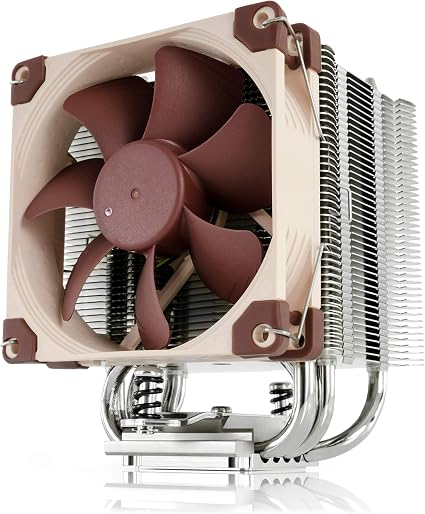
Compact and efficient, the Noctua NH-U9S is a solid choice for anyone with limited space but wanting reliable cooling for Intel or AMD CPUs. Its biggest strength lies in fitting into small cases without blocking RAM or PCIe slots, making it perfect for ITX and Small Form Factor builds.
Installation is straightforward, thanks to the SecuFirm2 mounting system and included thermal paste. The compact 125mm height means it fits easily in tighter cases, and the 92mm NF-A9 fan runs quietly with automatic speed control.
You’ll notice how it doesn’t interfere with nearby components like RAM or PCIe cards, which helps avoid build headaches.
Cooling performance stays strong for its size, handling everyday tasks and moderate workloads without overheating. The build quality feels solid and durable, with a focus on quiet operation.
Most praise highlights how quiet and compact it is, while some users mention that it’s not the best option for extreme overclocking or high-TDP CPUs.
Many users appreciate how quiet and space-friendly this cooler is, especially its ability to fit in ITX cases without blocking other components. The most frequent downside mentioned is that it may struggle with more demanding processors or heavy overclocking setups.
People building compact or quieter systems with midsize CPUs will find this cooler a great match. Those planning to push their CPUs beyond stock speeds or run high-power chips should look for larger or more powerful coolers.
Pros
- Compact 125mm height fits small cases
- Ultra-quiet NF-A9 92mm PWM fan
- Complete mounting kit simplifies installation
- No RAM or PCIe slot overhang
Cons
- Limited cooling for high-TDP CPUs
- Fan size may produce less airflow than larger models
| Specification | Details |
|---|---|
| Height | 125mm |
| Fan Size | 92mm |
| Compatibility | Intel LGA1851, LGA1700, LGA1200, LGA115x and AMD AM5 & AM4 |
| Mounting System | SecuFirm2 with offset option |
| Warranty | 6 years |
8. Antec Ultra 360 ARGB Liquid CPU Cooler

Copper base plate and a mirror lighting pump head set the tone for a cooler that merges solid cooling with stylish lighting effects. Great for anyone wanting dependable performance on Intel LGA 1366 sockets while adding some subtle but layered ARGB flair to their setup.
Installation comes down to plugging in a few 3-pin connectors for pump power and LED control. The 120mm ARGB fans run PWM-controlled, making speed adjustments responsive to system demands. Regular desktop cleaning mainly involves keeping dust off the radiator fans.
Noise levels stay reasonable at 33.05 db, letting the cooler stay quietly efficient during daily tasks and gaming.
Temperature handling is impressive thanks to the combination of a highly efficient pump and a large copper base plate, helping keep CPUs well within safe zones. The mirror lighting on the pump catches attention without being flashy, though some find the 2600 rpm fan speed produces a noticeable hum under load. The cooler fits a broad array of Intel and AMD platforms, proving it’s versatile as well as powerful.
Performance praised centers on the cooler’s strong thermal control aided by its copper base plate and efficient pump. The most frequent downside is noise generated when fans spin up to full 2600 rpm during demanding workloads.
Ideal for users wanting solid cooling and RGB effects on Intel LGA 1366 or similar platforms who don’t mind fan noise under stress. Those preferring ultra-quiet setups or simpler installations might look for alternatives with quieter fans or fewer connectors.
Pros
- Strong cooling with efficient copper base plate
- Multi-angle mirror lighting pump head
- Supports numerous Intel and AMD sockets
- Quiet operation at moderate fan speeds
Cons
- 2600 rpm fans can be noisy under heavy load
- Installation requires managing multiple 3-pin connectors
| Specification | Details |
|---|---|
| Cooling Method | Water |
| Noise Level | 33.05 db |
| Maximum Rotational Speed | 2600 rpm |
| Air Flow Capacity | 67.62 cfm |
| Voltage | 12 volts_of_direct_current |
9. CPU Heat Sink Cooling Fan for Intel LGA Sockets

Big heat sinks coated in aluminum usually catch your eye first, especially on an Intel LGA socket CPU cooler designed to stop your processor from running hot during heavy workloads. It’s well suited for users pushing their systems hard, including gamers and video editors, who need reliable cooling performance to keep things stable.
Installation is straightforward with a 4-pin power connector that lets the fan adjust speeds based on CPU temperature. The large aluminum heat sink and four copper heat pipes work together to pull heat away efficiently. Daily use shows the fan running quietly and ramping up smoothly when the CPU gets busier.
Clean-up involves occasional dusting of the fins but nothing too difficult given the open design.
The cooler handles heat removal very well thanks to the copper pipes transferring warmth quickly into the aluminum fins. It’s solidly built and feels durable, fitting securely onto an Intel LGA socket without any wiggle. Most praise focuses on its noticeable drop in CPU temperatures under load, while the main gripe tends to be the fan noise at maximum speed during intense activity.
Strong cooling performance with quick heat dissipation through copper pipes is what stands out in everyday use. The fan can get noticeably loud when spinning at its top speed, which some find distracting.
Those who run high-performance Intel LGA desktop CPUs and want effective heat management should consider it. Users sensitive to noise or preferring near-silent setups might want to look at other cooling options.
Pros
- Large aluminum heat sink for better heat spread
- Four copper heat pipes speed heat transfer
- Variable fan speed via 4-pin connector
- Handles high TDP CPUs well
Cons
- Fan noise louder at maximum 2500 rpm speed
- Requires regular cleaning to maintain airflow
| Specification | Details |
|---|---|
| Power Connector Type | 4-Pin |
| Wattage | 3 watts |
| Cooling Method | Air |
| Maximum Rotational Speed | 2500 rpm |
| Compatible Devices | Desktop |
10. upHere Low Profile CPU Cooler with 120mm Fan

UpHere’s Low Profile CPU Cooler with 120mm Fan is the go-to choice for building compact systems that need solid cooling without bulk. Ideal for small-form-factor cases like ITX, it fits many Intel and AMD sockets while keeping a low height of just 85mm, making it especially useful where space is tight.
Setting it up is straightforward since the unique design lets you install it quickly without removing the fan first. The cooler comes with a hydraulic bearing fan that runs quietly and lasts a long time. Its low profile makes daily use comfortable with a consistently quiet operation, so it won’t add distracting noise to your workspace.
Cooling performance matches expectations for its size, handling everyday desktop needs well without overheating. The build feels solid for a budget option, and the quiet hydraulic fan is a definite plus.
Common feedback notes that while it cools quietly, its cooling power may not suit heavy overclocking or very high loads.
The strongest praise for this cooler centers on how quietly it operates thanks to its hydraulic bearing fan and compact size. A common complaint highlights its limited cooling capability, making it less suitable for overclocked or power-hungry CPUs.
Builders putting together small or mid-range desktop setups will appreciate the space-saving design and quiet operation. Those running heavily overclocked processors or demanding CPU cooling should consider a more powerful alternative.
Pros
- Compatible with many Intel and AMD sockets
- Compact height fits small-form-factor cases
- Quiet hydraulic bearing fan
- Easy installation without fan removal
Cons
- Limited cooling power for high-performance CPUs
- Noise level higher than ultra-quiet models
| Specification | Details |
|---|---|
| Power Connector Type | 3-Pin or 4-Pin |
| Voltage | 12 volts |
| Wattage | 1.45 watts |
| Noise Level | 14.4 sones |
| Maximum Rotational Speed | 1800 rpm |
| Total Height | 85mm |
11. Dual Tower CPU Air Cooler with 120mm Fan

Keeping a CPU cool without blocking the RAM or struggling with complicated installation is what many builders look for, and this dual tower CPU air cooler fits right in. It works well with a wide range of sockets, including 1366, making it great for various desktop builds.
Its biggest strength is how it combines compatibility and easy setup without compromising on cooling power.
Setting it up is quite straightforward since there’s no need to remove the existing fan, which saves time and effort. The cooler has a 120mm fan running at a maximum speed of 1650 rpm with a quiet noise level around 25 dB, so it doesn’t disturb daily work. Its design takes RAM clearance seriously, meaning you won’t run into issues with taller memory modules during installation.
Cooling performance is solid thanks to the heat pipe design and a good balance between fan speed and noise. The build feels sturdy enough for continued use, and users often highlight how easy it is to install.
However, some mention that it isn’t the quietest cooler out there, which might matter if you’re after silent operation specifically.
The cooler’s biggest selling point is its easy installation method combined with compatibility across many sockets, including 1366. Users appreciate this for quick setups, but the noise level, though low, isn’t the quietest, which may be noticeable in very silent builds.
This cooler suits people looking for a versatile, straightforward solution without RAM clearance issues. Those who need ultra-low noise or multiple fans might want to explore other options.
Pros
- Works with a wide range of Intel and AMD sockets
- Easy installation without removing existing fan
- Does not interfere with RAM clearance
- Quiet at 25 dB noise level
Cons
- Fan noise not the absolute quietest available
- Only one 120mm fan included
| Specification | Details |
|---|---|
| Power Connector Type | 4-Pin |
| Voltage | 12 volts_of_direct_current |
| Wattage | 1.45 watts |
| Noise Level | 25 db |
| Maximum Rotational Speed | 1650 rpm |
| Cooling Method | Air, Heat Pipe |
12. CPU Fan Radiator Cooler with 4 Heat Pipes

Four copper heat pipes make this CPU cooler a solid choice for anyone needing reliable cooling on LGA 1366 and other popular sockets. Its biggest strength lies in efficient heat transfer, keeping processors cool during heavy use.
Installing takes some care but fits well on sockets like LGA 1155 and AM3 too. The white fan runs quietly at 22dBA while pushing 48 CFM of air, meaning it doesn’t disturb your workspace. Its compatibility with mainstream Intel and AMD CPUs adds to the convenience for everyday desktop or server setups.
It handles heat removal effectively thanks to the aluminum base and copper pipes, resulting in steady CPU temperatures. The build feels sturdy enough for long-term use, though some mention the fan speed can be a bit loud at times. Most users find the setup uncomplicated and appreciate the quiet operation.
Many appreciate the quiet cooling provided by the fan and the solid heat dissipation from the copper pipes. At the same time, some find the fan noise more apparent when spinning at maximum speed. The cooler is dependable, especially if outright silence isn’t a strict requirement.
People running mainstream Intel or AMD CPUs on supported sockets will find it fits without trouble. Users needing absolute whisper-quiet or extremely simple mounting may want to consider other options. This cooler suits those valuing broad compatibility and efficient airflow over minimal fan noise.
Pros
- Broad socket compatibility
- Quiet hydraulic bearing fan
- Effective heat dissipation with 4 copper pipes
- Suitable for desktop and server use
Cons
- Fan noise noticeable under full load
- Installation can require patience
| Specification | Details |
|---|---|
| Socket Compatibility | LGA 775, 1155, 1156, 1366, AM2, AM2+, AM3 |
| Fan Speed | 2200±10% RPM |
| Noise Level | 22 dB |
| Air Flow Capacity | 48 CFM |
| Power Connector Type | 3-Pin |
| Voltage | 12 volts |
Comparison of Best 1366 CPU Coolers
| Product | Cooling Method | Noise Level | Maximum RPM | Air Flow Capacity |
|---|---|---|---|---|
| Generic 4-Pipe Air Cooler | Air | 26 db | 1650 rpm | 68.2 cfm |
| RGB 120mm Aluminum Fan | Air Fans Cooler | 25 db | 1500 rpm | 40 cfm |
| DS 2200RPM PWM Fan | Air | 35 db | 2200 rpm | 40 cfm |
| ALSEYE M120D Plus ARGB | Air | 38 db | – | 73.76 cfm |
| Thermalright Peerless Assassin | Air | 25.6 db | 1550 rpm | 66.17 cfm |
| Thermalright Assassin X120 SE | Heat pipe and fan | 25.6 db | 1550 rpm | 66.17 cfm |
| Noctua NH-U9S Cooler | – | – | – | – |
| Antec Ultra 360 ARGB | Water | 33.05 db | 2600 rpm | 67.62 cfm |
| Intel LGA Heat Sink Fan | Air | – | 2500 rpm | – |
| upHere Low Profile Cooler | Air | 14.4 sones | 1800 rpm | – |
| Dual Tower 120mm Cooler | Air, Heat Pipe | 25 db | 1650 rpm | – |
| 4-Pipe Radiator CPU Fan | Air | 22 db | 2200 rpm | 48 cfm |
- Cooling MethodAir
- Noise Level26 db
- Maximum RPM1650 rpm
- Air Flow Capacity68.2 cfm
- Cooling MethodAir Fans Cooler
- Noise Level25 db
- Maximum RPM1500 rpm
- Air Flow Capacity40 cfm
- Cooling MethodAir
- Noise Level35 db
- Maximum RPM2200 rpm
- Air Flow Capacity40 cfm
- Cooling MethodAir
- Noise Level38 db
- Maximum RPM–
- Air Flow Capacity73.76 cfm
- Cooling MethodAir
- Noise Level25.6 db
- Maximum RPM1550 rpm
- Air Flow Capacity66.17 cfm
- Cooling MethodHeat pipe and fan
- Noise Level25.6 db
- Maximum RPM1550 rpm
- Air Flow Capacity66.17 cfm
- Cooling Method–
- Noise Level–
- Maximum RPM–
- Air Flow Capacity–
- Cooling MethodWater
- Noise Level33.05 db
- Maximum RPM2600 rpm
- Air Flow Capacity67.62 cfm
- Cooling MethodAir
- Noise Level–
- Maximum RPM2500 rpm
- Air Flow Capacity–
- Cooling MethodAir
- Noise Level14.4 sones
- Maximum RPM1800 rpm
- Air Flow Capacity–
- Cooling MethodAir, Heat Pipe
- Noise Level25 db
- Maximum RPM1650 rpm
- Air Flow Capacity–
- Cooling MethodAir
- Noise Level22 db
- Maximum RPM2200 rpm
- Air Flow Capacity48 cfm
How to Choose the Right 1366 CPU Cooler
Selecting the right 1366 CPU cooler involves considering compatibility with your processor socket, cooling efficiency, and noise levels. Prioritizing these factors ensures effective temperature management, which prevents overheating and extends hardware lifespan, ultimately saving money and avoiding potential system failures.
Socket Compatibility
Many coolers marketed for Intel sockets may not fit properly on the LGA 1366 slot due to differences in mounting mechanisms. Using a cooler without native support for this socket often means extra effort to modify brackets or risk an insecure fit, which can cause poor contact and overheating.
Look for a cooler that includes specific mounting hardware designed for LGA 1366 to ensure stable installation. This stock of brackets, screws, and backplates should align exactly without forcing. Double-check the cooler’s compatibility with your motherboard layout, particularly around VRMs and RAM slots, to avoid blocking components or complicating cable management.
Cooling Performance
Processor models that fit LGA 1366 sockets typically have a Thermal Design Power (TDP) ranging from around 95W to 130W or more, so the cooler should match or exceed this rating. Underrating results in higher CPU temperatures, leading to throttling or reduced lifespan.
Effective heat dissipation relies on heat pipes that touch the CPU directly or via a smooth base, paired with an arrangement of thin aluminum fins that increase surface area. Fans sized 120mm or larger generally push more air quietly and maintain steady CPU temps under load better than smaller fans.
Noise Levels
Loud fan noise becomes noticeable during gaming or heavy workloads if the cooler lacks good noise management. Fans spinning constantly at high speed can disrupt a quiet workspace or recording environment.
Coolers with PWM fans adjust speed dynamically based on temperature, dropping noise during light use. Additional features like rubber pads or isolation mounts help lower vibration transmission to the case, reducing rattles. Checking fan decibel ratings in the specs can give a realistic idea of typical noise levels.
Physical Dimensions and Clearance
Many coolers designed for desktops can be too tall or wide to fit inside compact or mid-tower cases with side panels or tempered glass. A cooler that touches or blocks RAM slots leaves little room for memory upgrades or cable routing.
It pays off to measure the height of a cooler and compare it with case CPU cooler clearance, usually specified in the manual as 160mm to 165mm maximum. Width and depth must not obstruct PCIe slots or power connectors. Leave breathing room around the socket for airflow, ideally a few centimeters beyond the cooler’s edges.
Build Quality and Materials
Copper heat pipes offer superior thermal conductivity compared to aluminum but come at a higher cost. A base made from copper with aluminum fins balances heat transfer with weight and cost effectively.
The quality of the fan’s bearing type, such as fluid dynamic bearings (FDB), impacts operational noise and longevity. Fans with cheap sleeve bearings often fail sooner and produce more noise. The overall build should feel solid without loose parts, and coatings or anodization on fins prevent corrosion over years of use.
Optimizing Airflow for Enhanced Cooling Performance
Good airflow directly impacts how well a CPU cooler performs, especially on sockets like 1366 that often pair with high-TDP processors. Positioning intake and exhaust fans to create a clear path for air can lower temperatures significantly. Avoid placing cables or other obstructions in the airflow path, as this reduces efficiency.
Using fans with a higher static pressure rating helps push air through dense fin stacks often found on coolers designed for socket 1366 processors.
Consider these points for better airflow:
- Install the cooler’s fan(s) to align with the case fans for a consistent front-to-back airflow.
- Keep the inside of your PC case clean and free from dust to prevent clogs that block air passage.
- Ensure that the intake fans bring in cool air from outside the case, and exhaust fans expel warm air.
- Use fan speed control options via BIOS or software to maximize cooling under load without excessive noise.
Putting together these airflow strategies makes the cooler’s heat dissipation more reliable and stable under stress.
Proper Maintenance Practices to Prolong Your CPU Cooler’s Lifespan
Regular cleaning is essential to keep your CPU cooler working well over time, especially in setups with socket 1366 processors that can generate considerable heat. Dust accumulation on the heatsink fins and fan blades restricts airflow and lowers cooling effectiveness.
Using compressed air every few months or whenever dust buildup is visible can maintain cooling performance.
Practical maintenance tips include:
- Power down and unplug your PC before starting any cleaning to avoid damage.
- Remove the cooling fan from the heatsink to blow air through the fins properly.
- Clean the fan blades carefully to avoid bending or damaging them.
- Reapply thermal paste on the CPU during reassembly about every couple of years or if you notice higher temperatures.
- Check that all mounting screws remain tight to maintain proper contact between the cooler base and CPU.
Consistent upkeep ensures your cooler continues to function efficiently and reduces the risk of thermal throttling or hardware failure.
Alternative Cooling Solutions for 1366 Socket CPUs
While traditional air coolers are common for LGA 1366 CPUs, water cooling offers an alternative for those seeking lower temperatures or quieter operation. All-in-one (AIO) liquid coolers can provide better heat dissipation by moving heat away from the CPU via a closed-loop system. This is beneficial for overclocked or high-load scenarios where air cooling might struggle.
Some points on alternative cooling:
- Ensure compatibility with the 1366 socket when selecting an AIO or custom liquid cooling kit, as mounting solutions vary.
- Maintenance can be more involved than air coolers; periodic checks for pump operation and coolant levels are necessary with custom loops.
- AIO coolers typically come pre-filled and require less upkeep, making them a middle ground between air and custom water cooling.
- Water blocks designed for 1366 CPUs often have optimized contact surfaces to improve thermal transfer.
Exploring these options can give you better thermal control, especially in compact builds or systems with limited airflow.
People Also Asked
Will This Cooler Fit My 1366 CPU Socket Properly?
The cooler fits the 1366 CPU socket if it explicitly lists compatibility with LGA 1366 motherboards. Check for mounting brackets designed specifically for the 1366 socket to ensure proper alignment and secure attachment.
How Do I Safely Install a 1366 CPU Cooler?
Install the cooler by carefully applying a small amount of thermal paste on the CPU before mounting it. Secure the cooler evenly on all screws to avoid uneven pressure and potential damage to the CPU or motherboard.
What Are Common Problems with 1366 Socket CPU Coolers?
Common problems include improper mounting pressure, fan noise due to dust buildup, and thermal paste drying out over time. Regular cleaning and proper installation can help maintain optimal cooling performance.
How Long Does a Typical 1366 CPU Cooler Last?
A typical 1366 CPU cooler can last several years, often 5 to 8 years, depending on usage and maintenance. Replacing the fans when they become noisy or less efficient can extend the overall cooling life.
Can I Use This Cooler on a 1366 CPU with Overclocking?
Using a 1366 cooler with overclocking is possible but depends on the cooling capacity. High-performance air coolers or liquid coolers are better choices to maintain safe temperatures during overclocking.
Conclusion
Choosing the right 1366 CPU cooler depends mainly on how much space you have inside your case, how quiet it runs, and whether it can handle the heat your processor produces. Cooler size matters because some won’t fit in smaller setups, and fan noise is important if you prefer a quiet system.
Cooling performance ensures your CPU maintains safe temperatures under load.
Consider your case dimensions and budget before making a choice to get a cooler that suits your setup and usage. Check the comparison table and reviews above for specific details to help you decide. Picking the cooler that fits your needs will keep your system running smoothly without unnecessary expense or complications.

I’m Grant Mitchell, a firearms and hunting writer with years of experience at the range and in the field. I write about rifles, shotguns, handguns, optics, safe storage, cleaning, and responsible ownership, along with practical hunting tips. My goal is to share accurate, safety-first information that helps you choose the right firearm, maintain it properly, and become a more confident shooter.


