Top 12 Best AIO Cooler for Ryzen That Will Blow Your Mind
Overheating, unstable performance, and loud fan noise are common issues when using a poorly matched cooler with Ryzen processors. The best aio cooler for ryzen provides efficient heat transfer, keeping temperatures steady under load and preventing unexpected throttling during gaming or heavy multitasking.
Many users learn the hard way that not all all-in-one liquid coolers handle AMD’s Ryzen chips with the same level of effectiveness.
What makes a good aio cooler for Ryzen is primarily the quality of the pump and radiator size. A reliable pump ensures consistent coolant flow to maintain stable CPU temps, while at least a 240mm radiator is typically needed to properly disperse heat from higher-end Ryzen chips.
Compatibility with your specific CPU socket is also key to secure and even contact. Ease of maintenance matters too, as dust buildup on radiators can reduce cooling performance over time.
Need a Quick Check?
| Image | Product | Price |
|---|---|---|
Our Top Picks 1  | ARCTIC Liquid Freezer III Pro | Check Price |
Our Top Picks 2  | Cooler Master 240 Core II | Check Price |
Our Top Picks 3  | Noctua NL-LC1-36 360mm | Check Price |
Our Selected Top 12 Aio Cooler for Ryzen Worth Considering
This list features a carefully chosen selection of all-in-one coolers suited for Ryzen processors, highlighting their performance capabilities, ideal user scenarios, and notable advantages and drawbacks. Each review provides practical insights to help you identify the best fit for your needs and build.
1. ARCTIC Liquid Freezer III Pro 360 CPU Cooler
An all-metal design and liquid cooling setup make this model ideal for Ryzen builds needing serious heat management. Best suited for gamers and power users looking for quiet operation paired with strong cooling performance.
It stands out most for combining a high airflow fan with a smart cold plate offset for better heat transfer.
Installation involves setting the cold plate to align with Ryzen CPU hotspots thanks to the native offset mounting. Day-to-day use benefits from the P12 PRO fan that runs quieter than usual, especially at low speeds, but can ramp up to 3000 rpm when system temperatures rise.
The integrated VRM fan helps maintain stable voltage converter temps, so no extra cooling is necessary around the motherboard.
The cooler handles heat load well during intense CPU tasks, keeping frequencies stable under pressure. The build feels solid with well-distributed contact pressure designed to extend CPU life. Praise often focuses on how quiet yet powerful the fan is, while the main complaint centers on the size and weight making installation a tighter fit in smaller cases.
The coolest aspect repeatedly mentioned is how quietly the fans run despite their power. However, many find the bulky radiator takes up more space than expected and requires careful planning before installation. The VRM fan adds extra cooling reliability for voltage components around the CPU socket.
Those running Ryzen processors in mid to large towers with space to spare will appreciate the performance and quiet operation. Compact or budget builds needing simpler setups might lean toward smaller AIOs or air coolers instead due to size constraints and installation difficulty.
Pros
- Quiet operation even at higher fan speeds
- Integrated VRM fan cools voltage converters directly
- Efficient heat transfer with offset cold plate design
- High airflow P12 PRO fans handle intense loads
Cons
- Larger radiator size limits compatibility with some cases
- Weight and bulkiness complicate installation
| Specification | Details |
|---|---|
| Power Connector Type | 4-Pin |
| Voltage | 12 volts |
| Wattage | 3.96 watts |
| Maximum Rotational Speed | 3000 rpm |
| Air Flow Capacity | 77 cfm |
| Cooling Method | Liquid |
2. Cooler Master 240 Core II AIO CPU Cooler
ARGB lighting often catches the eye first on a PC build, and the Cooler Master 240 Core II AIO Cooler delivers on that with its infinity mirror design. It suits those with Ryzen 7 processors who want solid cooling combined with quiet operation and easy installation on modern AM5 or AM4 platforms.
Installation feels quick thanks to compatible brackets for AM5, AM4, LGA1851, and LGA1700 sockets. The cooler’s dual-chamber pump design targets CPU hotspots efficiently, keeping temps in check. Fan speeds adjust dynamically between 650 and 1,750 RPM, running quietly enough to stay at a comfortable noise level during gaming or work sessions.
The CryoFuze thermal paste helps maintain steady heat transfer at a wide temperature range.
Performance stands out with a water pump designed to boost flow precisely where Ryzen 7 CPUs generate the most heat. The build feels solid, with fans pushing up to 70.5 CFM airflow at a modest 30 dB noise level.
One highlight is the stable thermal paste maintaining cool temps, but some find the fan’s 3-pin connector less flexible than PWM connections. The cooler balances solid performance with low noise.
The infinity mirror ARGB lighting is a strong highlight that boosts the visual appeal of any gaming setup. Cooling performance and noise levels consistently match expectations, though some notice fan control limits due to the 3-pin connector, affecting fine-tuning options. The included thermal paste supports stable operation across diverse conditions.
Users with Ryzen 7 builds wanting effective cooling plus visual flair will like this cooler. Those who want precise fan curves or push extreme overclocking might consider models with full PWM control and faster fans instead.
Pros
- ARGB infinity mirror design looks great
- Quiet operation with dynamic PWM fan control
- Compatible with latest AM5 and AM4 sockets
- CryoFuze thermal paste ensures stable temperatures
Cons
- 3-pin power connector limits advanced fan control
- Fan max speed might not satisfy extreme overclockers
| Specification | Details |
|---|---|
| Maximum Rotational Speed | 1750 rpm |
| Noise Level | 30 db |
| Air Flow Capacity | 70.5 cfm |
| Power Connector Type | 3-Pin |
| Voltage | 12 volts_of_alternating_current |
| Wattage | 12 watts |
3. Noctua NL-LC1-36 360mm AIO CPU Cooler
Choosing a large 360mm AIO like this suits anyone wanting premium cooling paired with low noise. Its standout feature is the combination of advanced pump noise absorber technology and Noctua’s award-winning fans, making it ideal for quiet gaming setups or intensive workstation builds running Ryzen processors.
Installation works well with typical desktop setups thanks to the 4-pin power connector and standard water cooling method. The three 120mm fans come with speed-offset controls that keep noise down while still moving a solid 107.3 cubic meters of air per hour. Users will notice the quieter pump and low vibration levels thanks to the 3-layer acoustic soundproofing structure.
Thermal performance ranks high due to the premium Asetek Emma V2 cooling platform paired with a large radiator. The build quality feels remarkably solid, especially the fans and pump assembly.
Noise levels stay low at 22.5 dB, which reviewers frequently praise, though some mention the size might not fit every case easily.
Quiet pump operation and low noise levels receive the most praise, highlighting the acoustic innovations like the 3-layer soundproofing. The common complaint revolves around the overall size, making it less compatible with compact or restricted chassis designs.
People building roomy, performance-focused Ryzen systems who prioritize silence will appreciate this cooler. Users with smaller cases or tight installation space should look for smaller solutions to avoid fitment problems.
Pros
- Quiet pump with reduced vibration
- Large radiator for efficient cooling
- Speed-offset fans optimize acoustics
- Solid and premium build quality
Cons
- Size may not fit smaller cases
- Power consumption slightly higher at 1.8 watts
| Specification | Details |
|---|---|
| Power Connector Type | 4-Pin |
| Voltage | 12 volts |
| Wattage | 1.8 watts |
| Noise Level | 22.5 db |
| Maximum Rotational Speed | 1800 rpm |
| Air Flow Capacity | 107.3 cubic meter per hour |
4. CoolerMaster MasterLiquid ML240L V2 CPU Cooler

Keeping a Ryzen CPU cool during intense tasks can be tricky, but this liquid cooler is built to handle that challenge. Ideal for gamers or creators looking for reliable cooling with customizable RGB lighting, its standout feature is the quiet, efficient cooling thanks to an upgraded dual chamber pump and refined fan design.
Setting it up involves mounting the radiator and fans in your case, which fits well with most Ryzen sockets including AM4. The 4-Pin power connector controls fan speed smoothly, keeping noise around 30 dB while providing steady airflow at 62 CFM.
Customizing the RGB lighting is straightforward, letting you personalize your rig’s look without extra hassle.
Performance stays consistent with 260 watts of cooling power handled by a 3rd generation pump that reduces vibrations. The build uses high-grade materials to prevent leaks, offering reliable durability. Reviews often highlight how quiet it runs during heavy loads, but some point out the 240mm size might be tricky in smaller cases.
The cooling stays impressively quiet during demanding workloads, thanks to the combination of the 3rd generation dual chamber pump and redesigned SickleFlow fans. Most users appreciate the extra reliability from the industrial-grade seal that minimizes concerns about leaks over time. However, the radiator size means it doesn’t fit comfortably in every PC case, which can limit options.
Builders with cases that support a 240mm radiator and a preference for customizable lighting will find this cooler fits well. Those working with compact cases might need to consider smaller coolers to avoid installation headaches or clearance issues around other components.
Pros
- Quiet airflow with improved fan blade design
- Customizable RGB lighting effects
- Strong seal reduces risk of leaks
- Compatible with multiple AMD and Intel sockets
Cons
- 240mm radiator size can be tight for smaller cases
- May require careful mounting for optimal fit
| Specification | Details |
|---|---|
| Power Connector Type | 4-Pin |
| Voltage | 12 volts |
| Wattage | 260 watts |
| Noise Level | 30 db |
| Maximum Rotational Speed | 1800 rpm |
| Air Flow Capacity | 62 cfm |
5. ARCTIC Liquid Freezer III Pro 360 A-RGB CPU Cooler

77 cfm airflow and a maximum rotational speed of 3000 rpm offer serious cooling for Ryzen setups. Suited for users looking to keep high-performance CPUs cool, especially under heavy loads, this AIO cooler is built to handle demanding tasks while also focusing on the longevity of the CPU.
Setting up features like native offset mounting reduces stress on the CPU by aligning the cold plate with the hotspot, which helps the coolant do its job more effectively. An integrated VRM fan keeps voltage regulators cool, contributing to overall system stability. The P12 PRO fans run quietly and handle variable speeds without sounding harsh, making everyday use comfortable.
Performance is impressive at managing high heat output, thanks to the combination of a 360mm radiator and a strong airflow capacity. The build feels solid, with attention paid to the mounting pressure to avoid damage. Praise often mentions how much quieter it is compared to older fan models, while complaints sometimes focus on the 4-pin connector limiting fan customization on some motherboards.
The quietness of the P12 PRO fans is frequently praised, making it suitable for noise-sensitive environments. Common complaints revolve around limited fan control due to the 4-pin connector, which might restrict fine-tuning options for some users.
This cooler will satisfy those who want reliable temperature management and quieter daily operation in demanding Ryzen builds. Users needing more advanced fan control or extremely low noise on top-end settings might consider alternative AIOs.
Pros
- Quiet operation even at high load
- Integrated VRM fan improves system stability
- Optimized mounting reduces CPU stress
- Strong airflow of 77 cfm
Cons
- 4-pin connector limits fan control options
- High rotational speed may still sound under max load
| Specification | Details |
|---|---|
| Cooling Method | Liquid |
| Maximum Rotational Speed | 3000 rpm |
| Air Flow Capacity | 77 cfm |
| Power Connector Type | 4-Pin |
| Voltage | 12 volts |
| Wattage | 3.96 watts |
6. Thermalright Aqua Elite 240 V3 CPU Cooler

People building a Ryzen desktop who want reliable cooling with visual appeal will appreciate this cooler. Its standout feature is the efficient combination of a 240mm radiator and a well-designed pump that keeps temperatures down without much noise.
Installation is straightforward, and the cooler includes standard 120mm ARGB fans for a good balance of airflow and quiet operation. The water pipe comes with a protective mesh to prevent wear.
Daily use means low vibration and steady performance thanks to the fourth-generation pump head running at up to 2800 RPM, all while keeping noise levels at a modest 25 dB.
Cooling performance is solid for a 240mm setup, keeping Ryzen CPUs comfortably cool under load. The black aluminium fin heat sink not only looks good but also offers good heat dissipation. The pump’s design supports a long lifespan of about 40,000 hours.
A common drawback mentioned is that the maximum fan speed is 1800 RPM, which might restrict airflow needed for extreme overclocking.
The strongest praise centers on its quiet, low vibration operation combined with a long-lasting pump. The most common complaint points out that the fan speed limit of 1800 RPM reduces maximum airflow potential for users pushing high CPU loads.
Those seeking steady cooling at reasonable noise levels with added RGB will find this cooler suitable. People planning heavy overclocking or very high-performance demands should look for options aiming at higher fan speeds and greater airflow capabilities.
Pros
- Low vibration during operation
- Long pump lifespan of up to 40,000 hours
- ARGB fan adds customizable lighting
- Protective mesh on water pipe included
Cons
- Fan speed capped at 1800 RPM
- May not suffice for extreme overclocking needs
| Specification | Details |
|---|---|
| Power Connector Type | 4-Pin |
| Voltage | 5 volts |
| Wattage | 2.64 watts |
| Noise Level | 25 db |
| Maximum Rotational Speed | 1800 rpm |
| Air Flow Capacity | 66.17 cfm |
7. ARCTIC Liquid Freezer III Pro 240 CPU Cooler

Exceptional cooling performance meets thoughtful design with the ARCTIC Liquid Freezer III Pro 240. Perfect for Ryzen builds, its main strength lies in efficiently managing CPU heat while also tackling VRM temperatures thanks to the integrated fan.
It suits those who want a cooler that keeps both the processor and motherboard components reliably cool under pressure.
Installation revolves around a native offset mounting system that targets the CPU hotspot for better heat transfer. Setup works for AMD sockets without fuss, and the contact frame optimizes pressure, which helps prevent long-term wear.
Day-to-day noise remains low, particularly because the P12 PRO fan stays quiet even when spinning faster during heavy loads.
Cooling capability stands out, providing solid thermal performance due to the high airflow capacity of 77 cfm and a maximum fan speed of 3000 rpm. Construction feels sturdy, and the inclusion of a PWM-controlled fan for the VRM helps extend component life.
The common downside is the noise level at maximum speeds, which some find noticeable in quiet rooms.
The standout feature is how well the cooler manages both CPU and VRM heat, offering reliable performance with lower noise at typical speeds. Some notice elevated sound when the fans hit top RPM, which can be distracting in quiet environments. Setup is straightforward thanks to the offset mounting design focused on Ryzen chips.
Those running Ryzen systems who need stable temperatures under load will appreciate this cooler’s dual-fan approach and efficient design. People sensitive to noise or who prefer completely silent setups might want to explore air coolers or hybrids that prioritize ultra-low noise instead.
Pros
- Efficient VRM cooling with integrated fan
- Powerful yet quieter P12 PRO fan
- Optimized mounting for Ryzen hotspot
- Compatible with both AMD and Intel sockets
Cons
- Noisier at maximum fan speeds
- Water cooling may require some maintenance
| Specification | Details |
|---|---|
| Power Connector Type | 4-Pin |
| Voltage | 12 volts |
| Wattage | 3.96 watts |
| Cooling Method | Water |
| Maximum Rotational Speed | 3000 rpm |
| Air Flow Capacity | 77 cfm |
8. Thermalright Aqua Elite 120 V3 CPU Cooler

Thermalright Aqua Elite 120 V3 makes a reliable choice for cooling Ryzen processors, standing out for its efficient water cooling and quiet operation. Ideal for desktop users looking to keep temperatures low without a bulky setup, it offers a smooth blend of solid construction and appealing ARGB lighting effects.
Setup involves connecting the standard 120mm ARGB fan and syncing it with your motherboard’s 5V 3-pin header for lighting. The fourth generation pump head works quietly, while the black aluminium fin heat sink efficiently dissipates heat.
The protective mesh around the water pipe helps avoid damage, contributing to a durable, stable experience during daily gaming or work sessions.
Cooling performance stays consistent, with the pump running steadily at low vibration and the fan spinning at a maximum 1500 rpm to move enough air at 66.17 cfm. Build quality is solid thanks to premium materials, but some users might find the noise level of 25.6 dB noticeable in quieter environments. The balance of cooling and lighting impresses, though it doesn’t completely eliminate fan noise.
The Aqua Elite 120 V3 is praised for its cool operation with quiet pump noise and a well-designed water pipe mesh. The most common drawback is the noise from the fan at higher speeds, which can be a minor distraction for quieter setups.
This cooler suits Ryzen users who value lighting and compact water cooling without heavy noise suppression. Those needing more powerful cooling or ultra-quiet performance might want to look at larger AIO units or alternatives designed for silence.
Pros
- Quiet pump with low vibration
- 120mm ARGB fan with rich lighting effects
- Durable protective mesh on the water pipe
- Efficient heat dissipation with aluminium fins
Cons
- Fan noise can be noticeable at full speed
- Single fan limits cooling compared to larger models
| Specification | Details |
|---|---|
| Power Connector Type | 4-Pin |
| Voltage | 12 volts |
| Wattage | 7.2 watts |
| Cooling Method | Water |
| Noise Level | 25.6 db |
| Maximum Rotational Speed | 1500 rpm |
9. CORSAIR NAUTILUS 360 RS CPU Cooler

Quiet and efficient cooling makes this a solid pick for anyone running Ryzen CPUs. Best suited for users wanting powerful airflow combined with straightforward setup, its standout feature is the RS120 fans that keep temperatures in check without too much noise.
Setup feels tidy thanks to the daisy-chained RS120 fans connecting via a single cable to the motherboard, cutting down on cable clutter. These fans deliver strong airflow with CORSAIR AirGuide tech to direct cooling where it’s needed most.
Magnetic Dome Bearings keep noise levels low during daily operation, making it easy to work or game without distraction.
Cooling performance lives up to expectations for a 360mm AIO, handling even demanding Ryzen processors well. Build quality shows attention to detail with a water cooling method designed for desktops.
Most praise mentions how quiet and effective the fans are, while some note the rotational speed maxing out at 2100 RPM might limit overclocking headroom.
Strong airflow combined with a quiet magnetic bearing fan system is the main highlight, keeping Ryzen CPUs cool without much noise. Most users appreciate how well the cooling is directed by the AirGuide technology, while some feel the max fan speed could be higher for extreme performance needs.
Will suit anyone wanting effective, quiet cooling with an easy setup on current Ryzen sockets. Those seeking very high fan speeds or extreme overclocking might consider other options offering higher maximum RPMs.
Pros
- RS120 fans with strong airflow and static pressure
- Single cable for all fans reduces installation clutter
- Quiet magnetic dome bearing fans
- Wide CPU socket compatibility
Cons
- Maximum fan speed capped at 2100 rpm
- May not suit heavy overclocking demands
| Specification | Details |
|---|---|
| Cooling Method | Water |
| Maximum Rotational Speed | 2100 rpm |
| Power Connector Type | 4-Pin |
| Compatible Devices | Desktop |
| CPU Socket Compatibility | AMD AM5, AM4; Intel LGA 1851, LGA 1700 |
10. Noctua NL-LC1-24 240mm AIO CPU Cooler

Quiet and efficient cooling suits PC builders aiming for a silent Ryzen setup. Its biggest strength lies in keeping temperatures down without adding noticeable noise, even in compact cases.
Installation involves fitting the compact 240mm radiator easily into small form factor builds. The two 120mm fans come with speed-offset to balance airflow and sound, while the advanced pump noise absorber reduces vibration.
Daily use means running quietly under load, thanks to the soundproofing design and reliable water cooling method.
Maintaining low temperatures for Ryzen CPUs feels natural with strong thermal performance from the Asetek Emma V2 platform. The build quality is solid, with premium fans and a focused vibration reduction system. Most users praise how quiet it stays, while the occasional note is about maximum fan speed being limited to 1800 rpm, which might restrict overclocking potential.
Users appreciate the quiet pump and fan setup that keeps Ryzen CPUs cool without adding noise. Common feedback notes the fan speed maximum could be higher for aggressive overclocking, but it suits most builds well.
Enthusiasts wanting near-silent operation in a compact PC will find this cooler ideal. Those pushing Ryzen chips to high overclock speeds might look for a cooler with faster fan capacity.
Pros
- Low noise operation with advanced pump soundproofing
- Compact radiator fits in smaller cases
- Efficient airflow from award-winning fans
- Reliable closed-loop water cooling design
Cons
- Maximum fan speed capped at 1800 rpm
- May limit extreme overclocking headroom
| Specification | Details |
|---|---|
| Voltage | 12 volts |
| Power Connector Type | 4-Pin |
| Maximum Rotational Speed | 1800 rpm |
| Noise Level | 22.5 db |
| Air Flow Capacity | 107.3 cubic meter per hour |
| Cooling Method | Water |
11. Thermalright Frozen Warframe 360 SE V2 CPU Cooler
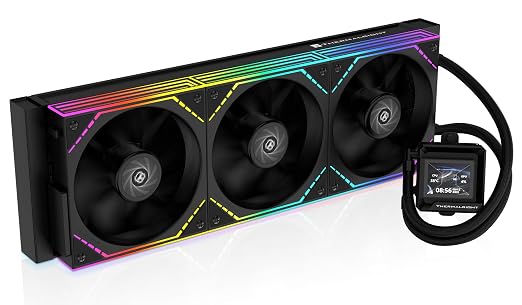
Aluminum forms the base of this 360mm AIO liquid cooler, designed for gamers and creators aiming for solid liquid cooling with some flair. Its standout feature is a large 2 LCD screen that shows system stats and custom images, giving your PC a personal touch while keeping temps under control.
Setting it up involves mounting a sizable 397×120×27mm radiator and hooking up three 120mm PWM fans daisy-chained to keep wiring tidy. The 2000RPM fans provide good airflow without excessive noise at 28.2 dB. Daily use means steady cooling supported by a 3000RPM pump, with customizable LCD feedback pushing system info or fun animations without much fuss.
Cooling performance works well thanks to its large radiator and airflow-capable fans, making it suitable for demanding AMD Ryzen setups. Build quality feels solid with quality materials throughout. Most praise centers on its stable temps and vibrant display.
The chief complaint involves the pump’s noise level, which can be noticeable under load.
Stable cooling performance and an eye-catching customizable LCD screen are the main strengths of this cooler. Most critiques mention the noise generated by the pump when the system is pushed hard. Aside from minor noise, the build feels thoughtful and suits modern AMD and Intel CPUs.
Gamers and content creators who want solid liquid cooling and a bit of style will appreciate this setup. Users lacking space inside their case or prioritizing ultra-quiet operation may want to explore other options better suited to smaller builds or silent setups.
Pros
- Customizable 2″ LCD screen for system info or images
- 3 PWM 120mm fans reduce cable clutter and improve airflow
- Supports AMD AM4, AM5 and multiple Intel sockets
- Low noise despite high fan speeds
Cons
- Pump noise can get noticeable under heavy load
- Large radiator needs sufficient case space
| Specification | Details |
|---|---|
| Radiator Size | 397×120×27mm |
| Fan Max Speed | 2000 rpm |
| Fan Air Flow | 68.9 cfm |
| Noise Level | 28.2 db |
| Pump Speed | 3000 rpm |
| Power Connector | 4-Pin |
12. Cooler Master 360L Core AIO CPU Cooler

Clean minimalist design with bright ARGB lighting gives a modern look, ideal for Ryzen builds that need strong cooling and visual style. Its biggest strength lies in an enhanced pump that targets heat spots precisely to keep temperatures consistently low under heavy load.
Setup involves mounting a triple 120mm radiator that fits well in most desktop cases without much hassle. The Gen S dual chamber pump improves water flow and pressure, making day-to-day operation quiet at 27.2 db while efficiently moving heat away from the CPU. The included CryoFuze thermal paste with high conductivity supports stable performance even in extreme temperature ranges.
Cooling performance is solid thanks to targeted heat spot coverage and a powerful pump spinning up to 1800 rpm. The build quality feels reliable, combining a copper base with well-sealed water channels. The strongest praise highlights its consistent thermal control, while the most noted drawback is the 3-pin connector that may limit precise pump speed adjustment in some setups.
Strong thermal performance comes from its improved pump that increases water flow and targets heat spots precisely. Most users mention that controlling pump speed through the 3-pin connector can be a limitation compared to 4-pin options. It stays quiet and stable under typical desktop loads, with thermal paste included that supports wide temperature ranges.
People looking for a cooler that balances cooling power and style in a Ryzen build will appreciate this model. Those wanting fine-tuned pump speed control or working with smaller cases may consider alternatives better suited to those needs.
Pros
- Effective targeted cooling with dual chamber pump
- Customizable ARGB lighting for visual appeal
- Quiet operation at 27.2 db noise level
- CryoFuze thermal paste for temperature stability
Cons
- 3-pin connector limits pump speed control
- Relies on case compatibility for radiator fit
| Specification | Details |
|---|---|
| Power Connector Type | 3-Pin |
| Voltage | 12 volts |
| Wattage | 3.96 watts |
| Cooling Method | Water |
| Noise Level | 27.2 db |
| Maximum Rotational Speed | 1800 rpm |
Best AIO Coolers for Ryzen Comparison Table
| Product | Cooling Method | Maximum Rotational Speed | Air Flow Capacity | Noise Level |
|---|---|---|---|---|
| ARCTIC Liquid Freezer III Pro | Liquid | 3000 rpm | 77 cfm | – |
| Cooler Master 240 Core II | Fan, Water | 1750 rpm | 70.5 cfm | 30 db |
| Noctua NL-LC1-36 360mm | Water | 1800 rpm | 107.3 m³/h | 22.5 db |
| CoolerMaster MasterLiquid ML240L V2 | Water | 1800 rpm | 62 cfm | 30 db |
| ARCTIC Liquid Freezer III Pro | Liquid | 3000 rpm | 77 cfm | – |
| Thermalright Aqua Elite 240 V3 | Air, Water | 1800 rpm | 66.17 cfm | 25 db |
| ARCTIC Liquid Freezer III Pro | Water | 3000 rpm | 77 cfm | – |
| Thermalright Aqua Elite 120 V3 | Water | 1500 rpm | 66.17 cfm | 25.6 db |
| CORSAIR NAUTILUS 360 RS | Water | 2100 rpm | – | – |
| Noctua NL-LC1-24 240mm | Water | 1800 rpm | 107.3 m³/h | 22.5 db |
| Thermalright Frozen Warframe 360 SE | Water | 2000 rpm | 68.9 cfm | 28.2 db |
| Cooler Master 360L Core | Water | 1800 rpm | 71.93 cfm | 27.2 db |
- Cooling MethodLiquid
- Maximum Rotational Speed3000 rpm
- Air Flow Capacity77 cfm
- Noise Level–
- Cooling MethodFan, Water
- Maximum Rotational Speed1750 rpm
- Air Flow Capacity70.5 cfm
- Noise Level30 db
- Cooling MethodWater
- Maximum Rotational Speed1800 rpm
- Air Flow Capacity107.3 m³/h
- Noise Level22.5 db
- Cooling MethodWater
- Maximum Rotational Speed1800 rpm
- Air Flow Capacity62 cfm
- Noise Level30 db
- Cooling MethodLiquid
- Maximum Rotational Speed3000 rpm
- Air Flow Capacity77 cfm
- Noise Level–
- Cooling MethodAir, Water
- Maximum Rotational Speed1800 rpm
- Air Flow Capacity66.17 cfm
- Noise Level25 db
- Cooling MethodWater
- Maximum Rotational Speed3000 rpm
- Air Flow Capacity77 cfm
- Noise Level–
- Cooling MethodWater
- Maximum Rotational Speed1500 rpm
- Air Flow Capacity66.17 cfm
- Noise Level25.6 db
- Cooling MethodWater
- Maximum Rotational Speed2100 rpm
- Air Flow Capacity–
- Noise Level–
- Cooling MethodWater
- Maximum Rotational Speed1800 rpm
- Air Flow Capacity107.3 m³/h
- Noise Level22.5 db
- Cooling MethodWater
- Maximum Rotational Speed2000 rpm
- Air Flow Capacity68.9 cfm
- Noise Level28.2 db
- Cooling MethodWater
- Maximum Rotational Speed1800 rpm
- Air Flow Capacity71.93 cfm
- Noise Level27.2 db
How to Choose the Right AIO Cooler
Choosing the right AIO cooler involves considering compatibility with your Ryzen CPU, cooling performance, and noise levels. Proper fit and effective heat dissipation prevent overheating and extend hardware life, saving money on repairs. Selecting carefully reduces future hassles and ensures stable system operation.
Compatibility with Ryzen Cpus
Mounting an all-in-one cooler on Ryzen boards can be tricky if the cooler doesn’t support AM4 or AM5 sockets directly. A cooler designed only for Intel sockets will require extra brackets or might not fit at all, wasting time and money.
Ryzen motherboards often come with a wider clearance around the CPU socket compared to some Intel setups, so you need to check if the radiator and fans will fit within your case without blocking RAM or VRM heatsinks.
Beyond fitting, BIOS support plays a role in how well the pump and fans respond to temperature changes. Some coolers don’t fully communicate with Ryzen firmware, resulting in fans running at full speed unnecessarily or the pump not adjusting as temperatures rise. Look for coolers that specifically mention AM4 or AM5 socket compatibility and have firmware profiles optimized for Ryzen platforms to get optimal fan and pump control from day one.
Cooling Performance and Efficiency
Smaller radiators like 120mm models often struggle with 95W or higher Ryzen chips, especially under load. The heat dissipation area matters; a 240mm or 280mm radiator offers more surface for heat to escape, reducing CPU temps effectively during gaming or content creation.
Fan speed influences this too, a good balance means fans run fast enough to cool but not so fast they amplify noise unnecessarily.
Pump flow rate is another detail that gets overlooked. Lower flow rates can cause heat buildup inside the loop, leading to higher temps over time or uneven cooling.
Make sure the cooler’s TDP rating meets or exceeds your Ryzen chip’s needs, commonly around 95 to 105 watts for mainstream Ryzen 5 and 7 CPUs. Reliability under steady load is what really shows with daily use, so models with consistent water circulation and sturdy pumps are worth prioritizing.
Noise Levels
No one wants a noisy PC, especially during long gaming sessions or video editing. Fan noise can spike noticeably when the system runs hot, so fans with good aerodynamic design and bearings that reduce rattling make a difference.
Some coolers allow fan speed curves to be controlled either automatically by the motherboard or manually via software, letting you tune noise versus performance.
Pump noise is quieter on some models thanks to better vibration dampening inside the housing. Without this, the pump’s whine or vibrations might transfer to the case, creating a constant hum that’s distracting.
Choosing a unit with solid insulation and quiet pump tech reduces this problem. Pay attention to decibel ratings listed, especially under load, values around 20-30 dBA are typical for quiet models, anything higher is noticeable in a quiet room.
Build Quality and Materials
Leaks occur when tubing or fittings fail, which can be catastrophic if the cooler uses low-quality materials. Rubber tubing with thick walls and high-grade fittings with strong seals prevent leaks over years of use.
Radiators made of copper or aluminum offer good heat transfer, but aluminum can corrode faster if the coolant isn’t balanced, so corrosion resistance matters for long-term durability.
Investing in a cooler with metal pump housing instead of plastic parts reduces wear and the chance of cracks developing. Quick connect fittings and reinforced tubing also mean fewer issues during installation or if you need to move parts around later on.
Parts exposed to heat and coolant flow need materials that won’t degrade or swell, so check reviews or spec sheets regarding corrosion resistance and tubing quality before deciding.
Installation and Maintenance Ease
Some coolers come with complete mounting hardware and clear instructions that save hours during installation. Without detailed guides, you might waste time identifying screws or incorrect brackets.
Accessibility after installation is equally important, fans on radiators should be removable without disassembling the entire cooler or case, as dust buildup is inevitable and impacts cooling efficiency.
Modular designs allow replacing fans or tubing without throwing away the entire unit or voiding warranty. This means you can swap out noisy or failed components easily, extending the cooler’s lifespan.
Systems that lock tubing in place firmly but still allow disconnection reduce hassle when routing cables or upgrading parts later on. Practicality in design translates to fewer headaches with maintenance.
Optimizing AIO Cooler Performance for Ryzen CPUs
AMD Ryzen CPUs benefit from efficient cooling solutions due to their tendency to run hot under load. Installing an AIO cooler with a properly sized radiator, typically 240mm or larger, helps maintain stable temperatures during intensive tasks.
Ensuring the thermal paste is evenly applied boosts heat transfer between the CPU and cooler block. Orienting the radiator fans to push or pull air based on your case airflow pattern improves overall cooling efficiency. Fan speed curves can be adjusted in BIOS or software to balance noise and temperatures according to workload.
A snug mounting of the cold plate is critical; a loose fit can lead to higher temperatures and potential throttling. Air gaps and dust build-up should be minimized to optimize performance.
Consistent monitoring of CPU temps after installation will confirm that the cooler is operating as expected and allow for fine-tuning if needed.
Maintenance Tips to Prolong the Life of Your AIO Cooler
The lifespan of an AIO cooler depends heavily on regular maintenance. Keeping the radiator clean from dust accumulation maintains airflow and cooling capacity. Checking the pump noise and vibration provides early warning signs of potential failure.
Fans should be inspected for bearing wear or imbalance and replaced if they become noisy or slow. Avoid kinking or sharply bending the tubing to prevent damage that could lead to leaks.
Since AIO units are sealed, refilling coolant is not typically possible, so keeping the system dust-free helps reduce strain on the cooling loop. Running the PC in a low-dust environment or using filter-equipped cases extends intervals between maintenance. Monitoring coolant temperature and pump speed through software helps detect issues before they affect performance seriously.
Comparing AIO Coolers with Air Coolers for Ryzen Builds
AIO coolers often provide better thermal performance than air coolers for Ryzen processors, especially on higher-core-count models generating more heat. Liquid cooling spreads heat over a larger surface area via the radiator, which allows for quieter operation at similar or lower temperatures.
Air coolers rely on massive heatsinks and high airflow, which can be larger and obstruct other components. Installation of AIO coolers requires more care due to mounting points and risk of leaks but usually fits a wider range of cases. Air coolers are simpler, more reliable over the long term, and less expensive upfront.
For Ryzen builds aiming for overclocking or sustained heavy workloads, AIO units can maintain stable temps more consistently. Budget-conscious users or those prioritizing low maintenance might prefer a high-quality air cooler instead.
People Also Asked
How Do I Install an AIO Cooler on My Ryzen CPU?
Mount the backplate behind the motherboard, apply thermal paste, then attach the cooler block on the CPU. Connect the pump and fan cables to the appropriate headers on the motherboard for power and control. Ensure the radiator fits inside your case without bending tubes during installation.
What Size Radiator Fits Well in a Ryzen PC Case?
A 240mm radiator is often a balanced choice for Ryzen builds, fitting many mid-tower cases without blocking other components. Check your case manual for exact radiator mounting points to avoid clearance issues with RAM or graphics cards.
Are AIO Coolers Safe to Use with Ryzen Processors?
AIO coolers are safe for Ryzen CPUs given proper installation and maintenance. Avoid running the pump without liquid inside and ensure that the cooling loop is sealed well to prevent leaks.
How Long Do AIO Coolers Usually Last Before Replacement?
Most AIO coolers last around 5 to 7 years before pump wear or coolant degradation may require a replacement. Listen for unusual noises or warming CPU temps which indicate the pump could be failing.
What Common Problems Should I Watch for with AIO Coolers?
Air bubbles in the cooling loop and pump failure are common issues. Bleed air by tilting the case slightly after initial installation and check fan and pump operation regularly to prevent overheating.
Conclusion
Choosing the right AIO cooler for a Ryzen processor depends mainly on the size of your case, the cooling capacity you need for your CPU, and how loud you find the fans at full speed. Make sure the radiator fits comfortably and the cooler can handle the heat your Ryzen puts out during heavy use.
Think about your budget and how often you’ll be pushing your system hard before making a choice. Smaller cases need compact coolers, and more intense workloads benefit from bigger radiators.
Check the comparison table above to match these factors with the options listed and find what fits your setup best.

I’m Grant Mitchell, a firearms and hunting writer with years of experience at the range and in the field. I write about rifles, shotguns, handguns, optics, safe storage, cleaning, and responsible ownership, along with practical hunting tips. My goal is to share accurate, safety-first information that helps you choose the right firearm, maintain it properly, and become a more confident shooter.