Top 12 Best 140mm AIO Cooler That Will Boost Your PC!
Heat issues pop up fast when a cheap or badly chosen 140mm AIO cooler is mounted on a CPU. The worst moments come when the system throttles under load or unexpectedly shuts down because the cooling just isn’t up to the task.
The best 140mm AIO cooler can keep temperatures stable without too much noise or complex installation headaches, which makes a big difference during long gaming sessions or heavy workflows.
A solid 140mm AIO cooler should have a radiator around 28 to 30 millimeters thick to balance cooling efficiency with compatibility in compact cases. Pump reliability is crucial, with quieter, higher RPM pumps typically lasting longer and offering more consistent flow rates around 200 to 300 liters per hour.
Fans spinning at 1500 to 1800 RPM offer good airflow without excessive noise. Materials also matter, copper cold plates combined with aluminum radiators remain the norm, striking a good balance between performance and weight.
Need a Quick Check?
| Image | Product | Price |
|---|---|---|
Our Top Picks 1  | ARCTIC Liquid Freezer III Pro | Check Price |
Our Top Picks 2  | ARCTIC Liquid Freezer III Pro | Check Price |
Our Top Picks 3  | Thermalright Phantom Spirit 140 | Check Price |
Our Selected Top 12 140mm Aio Cooler Worth Your Money
This list features carefully chosen 140mm AIO coolers, highlighting their cooling performance, design, and compatibility. Each review explains who the cooler is best suited for and outlines its main strengths and potential drawbacks to help you make an informed decision.
1. ARCTIC Liquid Freezer III Pro 420
Easy to notice right away is the large size and powerful cooling design of this 140mm AIO cooler, tailored for users needing serious heat management on Intel or AMD setups. Its main strength lies in combining strong airflow with a quiet operation, suitable for anyone pushing their CPU hard.
Installation involves using the contact frame optimized for Intel LGA1851 and LGA1700 sockets, ensuring good pressure on the CPU for efficient heat transfer. The offset cold plate targets the CPU hotspot directly. The built-in VRM fan runs on PWM control, keeping voltage regulators cool without manual adjustments.
Everyday use benefits from the P14 PRO fan’s quieter performance, especially at lower speeds, while still ramping up to 2500 rpm when needed.
Cooling performance holds up well under heavy loads thanks to the 110 cfm airflow capacity and liquid cooling method. The cooler feels sturdy with well-made fans and a solid cold plate design. Positive feedback highlights how effectively the VRM fan lowers temperatures.
Some users mention the pump noise can be noticeable during intense CPU usage, but it rarely becomes a distraction.
The built-in VRM fan improves overall cooling by lowering voltage converter temperatures noticeably. The most frequent drawback is pump noise during peak CPU cooling, which can stand out in quieter setups. Setup benefits from the offset cold plate’s focused heat transfer.
Anyone running high-load systems on supported Intel sockets will appreciate the precise cooling and quiet fan operation. Users with smaller cases or those intolerant to any pump noise might consider alternative solutions with smaller footprints or less audible pumps.
Pros
- Powerful and quiet P14 PRO fan
- Optimized contact frame for better heat dissipation
- Integrated PWM-controlled VRM fan
- Supports Intel LGA1851 and LGA1700 sockets
Cons
- Pump noise noticeable under heavy loads
- Large size requires sufficient case space
| Specification | Details |
|---|---|
| Power Connector Type | 4-Pin |
| Voltage | 12 volts |
| Wattage | 4.2 watts |
| Maximum Rotational Speed | 2500 rpm |
| Air Flow Capacity | 110 cfm |
2. ARCTIC Liquid Freezer III Pro 280
Liquid Freezer III Pro 280 is a solid pick for anyone looking for strong cooling in a 140mm AIO setup. Its main advantage lies in the integrated VRM fan and the offset cold plate, which keep both the CPU and voltage regulators running cool and stable, making it a smart choice for demanding builds.
Setup requires mounting the native offset cold plate designed specifically for Intel and AMD sockets, especially optimized for LGA1851 and LGA1700. The P14 Pro fan runs quietly even at higher speeds thanks to its design, and the PWM-controlled VRM fan adds extra cooling without raising noise much.
Day-to-day use keeps temps steady and noise low, helping maintain system reliability with little fuss.
Cooling performance is solid, with the cooler pushing up to 110 cfm airflow at a maximum of 2500 rpm. Its build quality feels sturdy, combining an optimized contact pressure frame with the offset cold plate for effective heat transfer.
Most praise focuses on the quiet operation at lower speeds, while some users mention the maximum fan speed is louder under heavy load.
Users highlight the quiet cooling performance during normal use and appreciate the extra VRM fan that helps keep voltage converters cool. The typical complaint involves the fan noise rising noticeably under heavy CPU loads at full speed.
Those aiming for stable and cooler high-performance CPUs with attention to VRM temperatures will find the cooler meets expectations. Builders wanting minimal noise and broad mounting flexibility might consider other options.
Pros
- Quiet operation especially at low speeds
- Includes integrated VRM fan for enhanced cooling
- Optimized contact pressure for better heat dissipation
- Compatible with Intel LGA1851 and LGA1700 sockets
Cons
- Louder noise at maximum fan speed
- Specific offset mounting might limit some builds
| Specification | Details |
|---|---|
| Cooling Method | Liquid |
| Maximum Rotational Speed | 2500 rpm |
| Air Flow Capacity | 110 cfm |
| Noise Level | 0.08 sones |
| Voltage | 12 volts |
3. Thermalright Phantom Spirit 140 Black
Keeping your CPU cool in a compact setup can be a challenge, but the Thermalright Phantom Spirit 140 Black handles it well with its quiet yet powerful fans. It suits anyone needing a cooling solution that fits easily in mid-sized cases without sacrificing performance.
The standout feature is how it combines strong airflow with low noise levels.
Setup is straightforward as the dimensions fit well within most desktop builds, with a combo of 120mm and 140mm fans adapting to your space. The 4-pin PWM connectors let you control fan speed so it doesn’t get louder than you want. Dual ball bearings and anti-vibration features keep the fans running reliably and quietly during daily tasks and gaming sessions.
Cooling power is impressive with a maximum fan speed of 2400 RPM and airflow capacity reaching 120 CFM, making it very effective for keeping temperatures down. The build quality shows in the durable dual ball bearings and liquid crystal polymer fan blades. The main praise highlights its quiet operation despite high speeds, while some users find the noise level rising when fans hit maximum RPM.
Quiet operation during normal use is frequently mentioned as a major plus. However, the noise level can increase noticeably when the fans run at full speed. Dual ball bearings and a balanced fan design contribute to reliability and smooth running.
Anyone needing solid cooling with controlled noise in a mid-sized case will appreciate this cooler. Those building in very tight spaces or seeking ultra-silent setups might want to explore smaller or lower RPM options.
Pros
- Strong airflow up to 120 CFM
- Quiet operation under typical loads
- Long-lasting dual ball bearings
- Good fit for mid-sized desktop cases
Cons
- Noisy at maximum fan speed
- Relatively large size for small cases
| Specification | Details |
|---|---|
| Fan dimensions | 120 x 120 x 25mm / 140 x 140 x 27mm |
| Maximum Rotational Speed | 2400 rpm |
| Operating noise | ≤33.3 dB(A) / 36.25 dB(A) |
| Air Flow Capacity | 120 cfm |
| Power Connector Type | 4-Pin PWM |
| Dimensions | 140 x 153 x 157mm (including fans) |
4. Noctua NH-C14S CPU Cooler

Designed with a highly optimised NF-A14 140mm fan, this cooler is ideal for users needing powerful airflow without sacrificing RAM clearance. Its top-flow design keeps it compact for better compatibility in many cases and ensures good airflow over critical motherboard parts.
Setup is straightforward thanks to SecuFirm2, which fits a wide range of Intel and AMD sockets. The fan can be mounted above or below the cooling fins, adjusting the cooler’s height from 115mm to accommodate taller RAM modules up to 70mm.
Noise levels stay low thanks to PWM support and a Low-Noise Adaptor, making it nearly silent during everyday use.
Cooling performance is solid due to the large 140mm fan running at up to 1500 rpm, pushing ample air with only 1.56 watts of power consumption. Build quality matches Noctua’s standards, featuring reliable materials and including their award-winning NT-H1 thermal compound.
Some users mention the overall height as a limiting factor in very compact cases, but most praise the quiet operation and versatile fit.
The quieter operation and solid cooling are praised, making it suitable for noise-conscious builds. The main complaint revolves around the cooler height, restricting use in very small cases.
Great for users who want a powerful 140mm air cooler while maintaining good RAM clearance. Those with compact cases seeking lower-profile solutions should consider alternatives with smaller heights.
Pros
- Good RAM clearance with fan placement options
- Quiet fan with PWM and Low-Noise Adaptor
- Compatible with many Intel and AMD sockets
- Includes high-quality thermal compound
Cons
- Height may be too tall for very compact cases
- Single fan limits airflow compared to dual-fan setups
| Specification | Details |
|---|---|
| Fan Size | 140mm |
| Maximum Rotational Speed | 1500 rpm |
| Noise Level | 24.6 db |
| Power Consumption | 1.56 watts |
| Voltage | 12 volts |
| Power Connector Type | 4-Pin |
5. ARCTIC Liquid Freezer III Pro 420 A-RGB

People looking for a powerful 140mm AIO cooler that keeps both CPU and VRM temps down will find this one fits the bill. It’s best suited for desktop users who want efficient heat dissipation and quieter fan operation without sacrificing performance.
Its biggest strength lies in balancing strong airflow with low noise levels.
Installation relies on the native offset mounting, which moves the cold plate center toward the CPU hotspot for better heat transfer. The included P14 PRO fan handles higher speeds quietly, especially at lower rpm. The integrated PWM-controlled VRM fan actively cools voltage converters, adding to system reliability during heavy loads or gaming sessions.
Cooling is solid thanks to a 4.2W pump and powerful 110 cfm airflow at up to 2500 rpm. The build quality emphasizes longevity with optimized contact pressure distribution designed for Intel LGA1851 and LGA1700 sockets.
The quiet fan operation averaging 1 sones gets regular praise, while some find the size and noise a bit noticeable at max speeds.
The quiet operation of the P14 PRO fan stands out in daily use, especially at lower speeds, making heat management effective without much noise. However, this cooler’s size and noise level at full speed draw some complaints, showing its limits in tight builds or during extreme load.
People looking for reliable temperature control with a bit of headroom for their desktop CPUs will be happy. Users with very compact cases or who prioritize absolute silence under heavy load might want to explore other options with smaller footprints or quieter maximum speeds.
Pros
- Strong and quiet fan performance at low speeds
- Integrated VRM fan improves voltage regulator cooling
- Optimized contact pressure benefits CPU longevity
- High airflow capacity for better heat dissipation
Cons
- Fan noise can increase notably at maximum speed
- Larger design may not fit all compact cases
| Specification | Details |
|---|---|
| Power Connector Type | 4-Pin |
| Voltage | 12 volts |
| Wattage | 4.2 watts |
| Noise Level | 1 sones |
| Maximum Rotational Speed | 2500 rpm |
| Air Flow Capacity | 110 cfm |
6. ARCTIC Liquid Freezer III Pro 360

Liquid cooling in a compact 140mm size rarely offers this much power and attention to detail. Suited for anyone hunting for efficient cooling with an integrated VRM fan, it handles intense workloads without overheating. Its standout feature is optimized contact pressure that improves heat transfer while preserving CPU longevity.
Setting the cooler up involves leveraging the native offset mounting for Intel and AMD sockets, which helps direct cooling right where the processor needs it most. The ARCTIC P12 PRO fans run quietly even under load, thanks to PWM control and a higher max speed of 3000 rpm.
The integrated fan targeting VRM temperatures adds a layer of protection for reliable daily use.
Performance-wise, this liquid cooler manages to move a substantial 77 cfm of air through the radiator, offering solid thermal management. The construction feels sturdy, with a well-engineered contact frame distributing pressure evenly. Praise often goes to the cooler’s quiet operation and effectiveness under load, while some users mention the complexity or size as minor drawbacks.
The cooler receives consistent praise for keeping CPU and VRM temperatures low while running quietly at normal speeds. Common complaints highlight the complexity of installation and the fan noise at maximum speed as points to consider before buying.
Gamers and PC builders seeking reliable temperature control across both CPU and VRM will appreciate this unit’s design. Those looking for an easier setup or extremely silent operation at peak loads might want to explore alternatives.
Pros
- Optimized contact pressure extends CPU life
- Quiet ARCTIC P12 PRO fans with high airflow
- Integrated VRM fan improves motherboard stability
- Compatible with both Intel and AMD sockets
Cons
- Relatively high maximum fan speed can be noisy
- Setup complexity due to offset mounting design
| Specification | Details |
|---|---|
| Maximum Rotational Speed | 3000 rpm |
| Air Flow Capacity | 77 cfm |
| Power Connector Type | 4-Pin |
| Voltage | 12 volts |
| Wattage | 3.96 watts |
| Cooling Method | Liquid |
7. ARCTIC Liquid Freezer III Pro 240

ARCTIC Liquid Freezer III Pro 240 is a liquid cooler designed for users looking for efficient CPU cooling with quiet operation. It stands out by delivering good heat dissipation through an optimized contact frame and an integrated VRM fan for voltage regulator cooling.
Setting it up involves native offset mounting for Intel and AMD sockets, which helps align the cold plate with the CPU hotspot. The P12 PRO fan runs quietly, especially at low speeds, and can ramp up to a high maximum speed for intense workloads.
Cooling is maintained with a 4-pin PWM connector for adjustable fan control.
Performance-wise, it handles heat well thanks to the contact frame’s pressure distribution and a higher airflow capacity of 77 cfm. The build quality supports both Intel LGA1851/LGA1700 and AMD sockets, while the most common complaint is about the noise level when the fan hits higher speeds during heavy loads.
The strongest praise highlights its quiet operation at regular use and efficient heat dissipation from the optimized contact frame. Most frequently, people mention that the fan becomes louder when running at maximum speed under heavy loads, which can be distracting in quiet environments.
This cooler will satisfy those who prioritize balanced cooling and noise levels under moderate use. Users aiming for ultra-quiet setups during peak performance might want to consider alternatives with lower maximum fan speeds or more silent fans.
Pros
- Efficient heat transfer with optimized contact pressure
- Integrated VRM fan improves overall cooling
- Quiet operation at low fan speeds
- Compatible with Intel and AMD sockets
Cons
- Fan noise at higher speeds can be noticeable
- High maximum fan speed may increase wear over time
| Specification | Details |
|---|---|
| Maximum Rotational Speed | 3000 rpm |
| Air Flow Capacity | 77 cfm |
| Power Connector Type | 4-Pin |
| Voltage | 12 volts |
| Wattage | 3.96 watts |
| Cooling Method | Water |
8. ARCTIC Liquid Freezer III Pro 360 A-RGB

Cooling feels reliable and steady, making it a great fit for anyone looking to keep high-performance CPUs running cooler. Its biggest strength lies in the efficient heat transfer thanks to its offset cold plate and powerful fans, which focus on both CPU and VRM temperatures.
Setting it up involves a precise mounting system designed for Intel LGA1851 and LGA1700 sockets, ensuring good contact pressure without extra hassle. The ARCTIC P12 PRO fans are quieter at low speeds yet ramp up when needed, which means you won’t notice much noise on regular tasks.
An integrated VRM fan takes care of temperature-sensitive components, contributing to system stability over time.
Cooler performance is strong with a maximum fan speed of 3000 rpm and airflow capacity of 77 cfm, which effectively handles heavy gaming or productivity sessions. The build quality feels solid, with a focus on durability and efficient cooling. Common feedback points to the quiet operation as a positive, while occasional comments mention the size and airflow noise when running at full speed.
The quiet operation of the fans during regular tasks is a notable advantage, helping keep noise levels down while still delivering strong cooling performance. Many find the integrated VRM fan useful for protecting voltage converters, but noise can increase when the fans reach maximum speed under heavy load.
Enthusiasts needing efficient cooling for high-end CPUs will appreciate the design and features here. Users with compact PC cases or noise sensitivity during intensive workloads might want to explore other options better suited for smaller spaces or quieter operation at high speeds.
Pros
- Optimized pressure distribution for better heat dissipation
- Quieter P12 PRO fans at low speeds
- Integrated VRM fan improves reliability
- Offset mounting focuses cooling on CPU hotspot
Cons
- Can get noisy at maximum fan speed
- Size might be an issue for smaller cases
| Specification | Details |
|---|---|
| Power Connector Type | 4-Pin |
| Voltage | 12 volts |
| Wattage | 3.96 watts |
| Maximum Rotational Speed | 3000 rpm |
| Air Flow Capacity | 77 cfm |
9. ARCTIC Liquid Freezer III Pro 240 A-RGB
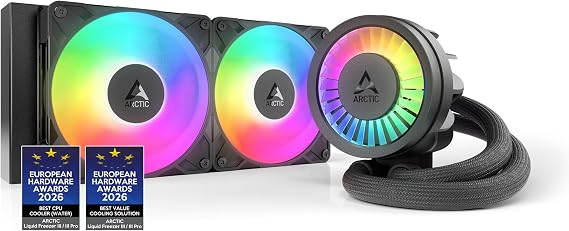
Powerful cooling in a compact 240mm size makes it well suited for users needing efficient heat dissipation in tighter cases. Performance shines with its contact frame design that targets CPU hotspots, ideal for both Intel and AMD builds. Quiet operation at low speeds adds to daily comfort.
Setup involves mounting the native offset cold plate, which aligns perfectly with the CPU’s hotspot to improve heat transfer. The included P12 PRO fan pushes more air quietly, especially at low speeds, giving you strong cooling without distracting noise. An integrated VRM fan manages voltage converter temps, supporting stable performance under load without extra adjustments.
It handles high heat loads well, with a maximum airflow of 77 cfm helping keep CPU temperatures down. Build quality feels solid, with a 4-pin power connector and a PWM-controlled VRM fan that adjusts as needed. Common praise highlights how quiet it runs, especially when idling.
A noted downside includes its maximum rotational speed listed as 1 rpm, which seems like a data error but causes some confusion.
Quiet cooling is the standout feature, providing impressive airflow without noise distractions. The integrated VRM fan helps keep power delivery components cool, contributing to reliable system performance. Confusion arises from the listed maximum speed of 1 rpm, which seems inaccurate and could mislead some when checking specs.
Great for those who want solid CPU cooling and quieter operation in mid-sized cases, especially with modern Intel and AMD CPUs. Users with very limited case space or who want a smaller 140mm radiator should consider other options due to size and mounting requirements.
Pros
- Quiet operation at low fan speeds
- Optimized cold plate placement for better heat transfer
- Integrated VRM fan for voltage converter cooling
- Compatible with latest Intel and AMD sockets
Cons
- Maximum rotational speed listed as 1 rpm, likely incorrect
- May require case space consideration for 240mm radiator
| Specification | Details |
|---|---|
| Cooling Method | Water |
| Compatible Devices | AMD, Intel |
| Voltage | 12 volts |
| Wattage | 3.96 watts |
| Air Flow Capacity | 77 cfm |
| Power Connector Type | 4-Pin |
10. Thermalright Aqua Elite 120 V3

Aluminium fins form the heart of this cooler, paired with a fourth-generation pump head to provide steady and efficient water cooling. Suitable for desktop setups that need a compact but effective 120mm solution, its standout feature is reliable heat dissipation with minimal vibration.
Setup is straightforward with a standard 120mm ARGB fan and protected water pipes that help reduce evaporation over time. The fan runs quietly at 25.6 dB while delivering decent airflow of 66.17 cfm at up to 1500 rpm. Syncing ARGB lighting with your motherboard is simple via the 5V 3-pin connector, adding style without complicating things.
It cools well enough for everyday desktop use, thanks to the black aluminium fin heat sink plate and integrated pump design. Build quality feels solid, especially the protected water pipe mesh. Most praise revolves around its quiet operation and reliable cooling.
Some users mention limited brightness in the lighting effects when syncing multiple devices.
Quiet operation combined with efficient cooling stands out clearly, while some users note the lighting brightness doesn’t always meet expectations, especially when synced with other ARGB components. The good build quality also helps ensure durability over longer periods.
Ideal for those wanting a compact AIO with decent cooling and lighting effects for standard desktops. Users needing brighter or larger cooling setups might consider alternatives with bigger fan sizes or stronger lighting options.
Pros
- Low vibration performance during operation
- Good thermal dissipation from aluminium fins
- ARGB lighting syncs with motherboard smoothly
- Quiet fan maintaining 25.6 dB noise level
Cons
- Lighting brightness can be insufficient at times
- Limited to 120mm fan size may restrict some builds
| Specification | Details |
|---|---|
| Power Connector Type | 4-Pin |
| Voltage | 12 volts |
| Wattage | 7.2 watts |
| Noise Level | 25.6 db |
| Maximum Rotational Speed | 1500 rpm |
| Air Flow Capacity | 66.17 cfm |
11. CORSAIR NAUTILUS 360 RS

Strong cooling performance and quiet operation stand out with the CORSAIR NAUTILUS 360 RS, a water cooler designed for desktop CPUs. It fits a wide range of modern AMD and Intel sockets, making it ideal for anyone who needs effective heat management without too much noise.
Setup is straightforward thanks to the daisy-chained RS120 fans that reduce cable clutter by connecting to the motherboard with a single cable. These fans use Magnetic Dome bearings to keep noise levels low while pushing good airflow and static pressure. AirGuide technology adds focus to the cooling, which you’ll appreciate in daily use where keeping your CPU temperatures down matters.
Performance-wise, it handles demanding CPU loads well with its water cooling method and high max rotational speed of 2100 rpm. The build quality feels solid, with well-made fans and a design supporting AMD AM5, AM4, and Intel LGA 1851 and LGA 1700 sockets. Most users praise how quiet it runs, though some note the 140mm size might limit compatibility in smaller cases.
Many appreciate how quiet the RS120 fans run due to the Magnetic Dome bearing, making it suitable for low-noise setups. Common complaints focus on the physical fit since the 140mm radiator might not easily fit in compact cases.
People with mid to large-sized cases and those needing wide CPU compatibility will be happy with this cooler. Users with smaller cases or who require higher RPM for extreme cooling should consider other options.
Pros
- Supports AMD AM5, AM4, Intel LGA 1851, LGA 1700 sockets
- Pre-installed RS120 fans with AirGuide technology
- Daisy-chained fans reduce cable clutter
- Quiet Magnetic Dome bearing fans
Cons
- 140mm size may not fit smaller PC cases
- Max fan speed limited to 2100 rpm
| Specification | Details |
|---|---|
| Power Connector Type | 4-Pin |
| Cooling Method | Water |
| Compatible Devices | Desktop |
| Maximum Rotational Speed | 2100 rpm |
12. MSI MAG Coreliquid A13 240

Perfect for desktop users needing a compact but efficient liquid cooler, the MSI MAG Coreliquid A13 240 stands out with its split-flow aluminium radiator and integrated pump design. It suits those who want a quiet yet powerful cooling solution that supports the latest LGA 1851 socket out of the box.
Installation feels straightforward since the pump and radiator are combined, making the setup cleaner without extra bulky components. Daily operation remains quietly effective, thanks to the pump’s ceramic bearings and speeds that balance performance and noise. The 4-pin power connector fits standard desktop headers, while the cooler maintains a low noise level of just 14.4 dB during normal use.
Cooling performance keeps the system stable, with the pump running up to 3800 RPM to manage heat efficiently. Its aluminium radiator with the split-flow system helps long-term durability and reduces vibrations.
Users often praise its quiet operation, though some mention the maximum fan speed of 5200 RPM can get a bit louder under heavy loads.
Many users appreciate how quiet the pump runs under typical conditions thanks to the ceramic bearings. At the same time, the fan noise rises noticeably when pushed to full speed, which some find distracting. The split-flow radiator promises good durability and vibration reduction, making it reliable for ongoing use.
People who want strong cooling with minimal noise in everyday tasks will find this cooler works well. Those who expect absolute silent operation at maximum load or require extreme cooling power might look for another option with higher wattage and quieter fans at top speeds.
Pros
- Quiet operation with ceramic-bearing pump
- Supports LGA 1851 out of the box
- Durable aluminium radiator with split-flow design
- Balanced pump speed for performance and noise
Cons
- Fan can be loud at max 5200 rpm speed
- Pump power consumption is low, but limits maximum output
| Specification | Details |
|---|---|
| Power Connector Type | 4-Pin |
| Voltage | 12 volts_of_direct_current |
| Wattage | 2.16 watts |
| Noise Level | 14.4 db |
| Maximum Rotational Speed | 5200 rpm |
| Air Flow Capacity | 60.78 cfm |
Best 140mm AIO Coolers Comparison Table
| Product | Cooling Method | Max RPM | Air Flow (cfm) | Noise Level |
|---|---|---|---|---|
| ARCTIC Liquid Freezer III Pro | Liquid | 2500 rpm | 110 cfm | – |
| ARCTIC Liquid Freezer III Pro | Liquid | 2500 rpm | 110 cfm | 0.08 sones |
| Thermalright Phantom Spirit 140 | Air | 2400 rpm | 120 cfm | 33.3 db |
| Noctua NH-C14S Cooler | Air | 1500 rpm | – | 24.6 db |
| ARCTIC Liquid Freezer III Pro | Water | 2500 rpm | 110 cfm | 1 sones |
| ARCTIC Liquid Freezer III Pro | Liquid | 3000 rpm | 77 cfm | – |
| ARCTIC Liquid Freezer III Pro | Water | 3000 rpm | 77 cfm | – |
| ARCTIC Liquid Freezer III Pro | liquid | 3000 rpm | 77 cfm | – |
| ARCTIC Liquid Freezer III Pro | Water | 1 rpm | 77 cfm | – |
| Thermalright Aqua Elite 120 V3 | Water | 1500 rpm | 66.17 cfm | 25.6 db |
| CORSAIR NAUTILUS 360 RS | Water | 2100 rpm | – | – |
| MSI MAG Coreliquid A13 240 | Water | 5200 rpm | 60.78 cfm | 14.4 db |
- Cooling MethodLiquid
- Max RPM2500 rpm
- Air Flow (cfm)110 cfm
- Noise Level–
- Cooling MethodLiquid
- Max RPM2500 rpm
- Air Flow (cfm)110 cfm
- Noise Level0.08 sones
- Cooling MethodAir
- Max RPM2400 rpm
- Air Flow (cfm)120 cfm
- Noise Level33.3 db
- Cooling MethodAir
- Max RPM1500 rpm
- Air Flow (cfm)–
- Noise Level24.6 db
- Cooling MethodWater
- Max RPM2500 rpm
- Air Flow (cfm)110 cfm
- Noise Level1 sones
- Cooling MethodLiquid
- Max RPM3000 rpm
- Air Flow (cfm)77 cfm
- Noise Level–
- Cooling MethodWater
- Max RPM3000 rpm
- Air Flow (cfm)77 cfm
- Noise Level–
- Cooling Methodliquid
- Max RPM3000 rpm
- Air Flow (cfm)77 cfm
- Noise Level–
- Cooling MethodWater
- Max RPM1 rpm
- Air Flow (cfm)77 cfm
- Noise Level–
- Cooling MethodWater
- Max RPM1500 rpm
- Air Flow (cfm)66.17 cfm
- Noise Level25.6 db
- Cooling MethodWater
- Max RPM2100 rpm
- Air Flow (cfm)–
- Noise Level–
- Cooling MethodWater
- Max RPM5200 rpm
- Air Flow (cfm)60.78 cfm
- Noise Level14.4 db
How to Choose the Best 140mm AIO Cooler
Consider cooling performance, noise levels, and compatibility when selecting a 140mm AIO cooler. Choosing the right size and quality components ensures efficient heat dissipation and quiet operation, preventing overheating and costly repairs. Proper selection prevents installation issues and improves overall system reliability.
Cooling Performance
Relying on a cooling system means trusting it to keep your CPU temperatures in check even during long gaming sessions or heavy workloads. A large radiator with dense fin spacing helps draw heat away more efficiently, while the pump ensures liquid moves steadily through the loop.
A pump that’s inconsistent can cause sudden temperature spikes or uneven cooling. Fans contribute too; ones with higher static pressure ratings push air through the radiator fins better, crucial when fins are tight. For typical 140mm solutions, look for radiators around 140x140mm with at least 25mm thickness, a pump speed of roughly 2500-3000 RPM, and fans providing airflow near 70 CFM and static pressure above 2 mmH2O.
Ignoring these aspects often results in unstable CPU temps and thermal throttling. A well-balanced setup feels like it’s always keeping the CPU cool without needing to crank fan speeds or worry about sudden heat spikes.
Compatibility and Size
Many people overlook how radiator size affects case compatibility until the build is halfway done. Radiators around 140mm square fit compact cases, but thickness and hose placement can block other components or restrict airflow.
It’s important to confirm if the case supports 140mm radiators in locations like front or top mounts. Mounting brackets should match your CPU’s socket type, AMD AM4, LGA 1200, for example. Hose length varies; too short and routing is a headache, too long and it pulls tight or looks untidy.
- Check case clearance for 140mm radiators, including thickness and mounting points
- Verify mount compatibility with your CPU socket and motherboard
- Choose tubing length and flexibility according to your specific build layout
Good fitment here makes installation straightforward and avoids airflow blockage that can hinder cooling.
Noise Levels
Cooling gear running at high RPMs can quickly become noisy, a problem when working late or recording audio. Fans under load may spin faster and emit noticeable whine or buzzing. A pump’s humming or vibration can add to this, especially if the unit’s mounted directly to the chassis without dampening.
Many models allow fan speed control through BIOS or software, letting users dial down RPMs during light use or enable silent modes.
Living with a setup that stays quiet means not having to use headphones to mask background noise or blind guess your PC’s temperature using software. Look for fans rated around 20-30 dB(A) at typical speeds, and pumps designed to minimize vibration for a quieter experience.
Build Quality and Materials
Over time, cheaper materials cause corrosion or leaks, turning a once reliable cooler into a maintenance chore. Radiators made from aluminum or copper hold up better against corrosion, especially when paired with matching materials to avoid galvanic reactions.
Tubing made from thick rubber or reinforced plastic resists kinks that block flow or cause leaks. Fittings should tighten well without stripping threads or allowing drips.
Having a sturdy build means fewer worries about coolant loss, unexpected shutdowns, or messy repairs. Expect thick-walled rubber tubing, copper or aluminum radiators, and metal fittings over cheap plastic to ensure longevity and secure connections.
Ease of Installation and Maintenance
Mounting a liquid cooling system isn’t always plug-and-play. Having clear instructions and straightforward mounting hardware saves time and frustration.
Some units include a fill port or reservoir inside the block for topping up coolant, which can extend the cooler’s life if used. Cleaning is easier when the radiator fins and fans can be accessed without removing the entire assembly, preventing dust buildup that clogs airflow.
Ease of installation translates into less time staring at manuals or struggling with small screws. Regular maintenance practices improve cooling performance but only if accessing parts isn’t a complicated chore. Look for kits that emphasize simple hardware and consider how easy it is to clean or refill before buying.
Optimizing Cooling Performance with a 140mm AIO Cooler
Choosing a 140mm AIO cooler offers a good balance between cooling efficiency and space requirements inside the case. These compact units fit in smaller builds where 240mm or 360mm radiators won’t fit.
Key factors that impact performance:
- Radiator thickness: Thicker radiators usually allow for better heat dissipation but require compatible case clearance.
- Fan quality and speed: High static pressure fans improve airflow through radiator fins, directly influencing cooling.
- Pump reliability: A strong pump keeps coolant flowing steadily, preventing hotspots.
Proper installation also plays a role. Ensuring tight contact between the cold plate and the CPU surface improves thermal transfer.
140mm AIOs offer effective cooling for mid-range CPUs while taking up minimal case space.
Routine Maintenance Tips for Prolonged AIO Cooler Lifespan
Maintaining a 140mm AIO cooler extends its operational life and keeps temperatures low over time. Dust buildup on radiator fins and fans is a common cause of reduced performance.
Regular maintenance includes:
- Cleaning the radiator and fans with compressed air every few months to remove dust and debris.
- Checking the pump noise for signs of wear or imminent failure.
- Verifying mounting screws remain tight to maintain good contact pressure.
Monitoring coolant leaks around fittings can prevent damage to other components. Some users find their CPU temperatures creeping up as thermal paste dries; reapplying thermal paste every couple of years can help maintain low temps.
Keeping airflow inside the case unobstructed further aids the cooling system’s efficiency.
Comparing 140mm AIO Coolers with Air and Larger Radiator Alternatives
140mm AIO coolers sit between traditional air coolers and larger radiator liquid coolers in both size and cooling capacity. Air coolers typically rely on a large heatsink and one or two fans but can be bulkier and block RAM slots.
Advantages of 140mm AIO compared to air coolers:
- Better heat dissipation efficiency, especially under heavy loads.
- Potentially quieter operation at similar cooling performance.
Compared to larger AIOs with 240mm or 360mm radiators, 140mm models are easier to install in compact cases but don’t cool as effectively under overclocked or high-TDP CPU scenarios. Larger radiators provide more surface area to dissipate heat but require more space and sometimes specific case compatibility. Selecting between these options depends largely on case size and cooling needs rather than a one-size-fits-all choice.
People Also Asked
How Do I Install a 140mm AIO Cooler Properly?
Mount the radiator securely inside your case, attach the pump block firmly to the CPU with the right thermal paste, and connect the fans and pump headers to the motherboard. Make sure tubing isn’t kinked or overly bent to maintain good coolant flow.
Is a 140mm AIO Cooler Compatible with My PC Case?
Check your case’s specifications to confirm it supports 140mm radiator mounting; many cases have dedicated spots, but not all do. Also, measure clearance around other components like GPU and RAM to ensure the radiator fits without blocking airflow.
How Long Does a 140mm AIO Cooler Typically Last?
A 140mm AIO cooler usually lasts around 3 to 5 years before pump performance or seal integrity may degrade. Regularly inspect for leaks and listen for unusual pump noise to catch early signs of wear.
What Are Common Problems with 140mm Liquid Coolers?
Common issues include pump noise, coolant leakage, or fan failure. Bias the airflow setup to avoid dust buildup, and periodically clean the radiator fins to keep temperatures stable.
Can a 140mm AIO Cooler Fit on All CPU Sockets?
Most 140mm AIO coolers come with mounting hardware that fits a wide range of Intel and AMD sockets, but confirm compatibility with your specific CPU socket model listed by the manufacturer. Some older or less common sockets may require additional brackets.
Conclusion
Choosing the right 140mm AIO cooler comes down to cooling performance, noise levels, and build quality. Look for solid radiator and pump design since these affect longevity and efficiency. Also consider fan speed and noise, as quiet operation can be important for daily use.
Check your PC case space to make sure the cooler fits, and factor in your budget along with how often you’ll push your system. The comparison table above covers these points to help you decide which option aligns with your setup and needs.

I’m Grant Mitchell, a firearms and hunting writer with years of experience at the range and in the field. I write about rifles, shotguns, handguns, optics, safe storage, cleaning, and responsible ownership, along with practical hunting tips. My goal is to share accurate, safety-first information that helps you choose the right firearm, maintain it properly, and become a more confident shooter.


