Top 12 Best Handheld Radio You Can’t Live Without Today
Dropping a handheld radio during a noisy outdoor event or in wet conditions often reveals how frustrating a poor-quality model can be. The best handheld radio handles drops, weather, and interference without losing connection or clarity.
Many radios fail at crucial moments because their signal range is too short or the build quality can’t withstand rough use.
Durability is key for the best handheld radio, typically meaning an impact-resistant casing rated to at least IP67 for water and dust resistance. Battery life also matters; you want something that can last at least 12 hours on a single charge. Transmit power generally ranges from 1 to 5 watts, with more watts offering longer range but draining batteries faster.
A comfortable size and easy-to-use controls add to the overall practicality when you’re using it hands-free or while on the move.
Need a Quick Check?
| Image | Product | Price |
|---|---|---|
Our Top Picks 1  | Baofeng UV-5R Radio | Check Price |
Our Top Picks 2  | Cobra HH50WXST CB Radio | Check Price |
Our Top Picks 3  | Portable Bluetooth Shortwave Radio | Check Price |
Our Selected Top 12 Handheld Radio for Different Needs
This list features a variety of handheld radios designed for different uses and environments. Each review covers performance details, user suitability, and highlights both strengths and limitations to help identify which model fits specific needs.
1. Baofeng UV-5R Dual Band Handheld Radio
Compact and lightweight, the Baofeng UV-5R fits easily in a pocket and suits anyone needing a reliable handheld radio for outdoor or emergency use. Its biggest strength lies in supporting both VHF and UHF bands, making communication flexible across a wide frequency range.
Setting up involves selecting from 128 channels and programming the dual-band display to keep track of two frequencies at once. Day-to-day use benefits from the dual standby mode, letting you monitor both channels independently.
The keypad lock prevents accidental changes, and you can pick between high and low transmit power depending on your range needs.
Communications come through clearly within a maximum range of 5 kilometers, handling both VHF and UHF frequencies without trouble. The build feels solid but is not water resistant, so it requires some care in wet conditions.
High praise often goes to how many channels and tones it supports, while common complaints mention the lack of water resistance as a drawback.
Strong points include a broad frequency range and multiple channels helping you stay connected in varied environments. Most users note the device performs well for voice communication but caution that it cannot handle rain or wet conditions due to no water resistance.
People who need flexible frequency options and reliable battery life will appreciate it. Those working or adventuring in harsh or wet environments might want to look for a model with water resistance instead.
Pros
- Supports dual-band VHF and UHF frequencies
- Long battery life of 72 hours
- Dual standby and independent A/B operation
- Keypad lock prevents accidental input
Cons
- Not water resistant
- Limited maximum talking range of 5 kilometers
| Specification | Details |
|---|---|
| Frequency Range | 144-148MHz, 420-450MHz |
| Number of Channels | 128 |
| Battery Average Life | 72 hours |
| Voltage | 4 volts |
| Maximum Talking Range | 5 kilometer |
2. Cobra HH50WXST Handheld CB Radio
Great choice for anyone needing a reliable handheld CB radio with impressive noise reduction. Ideal for drivers and outdoor enthusiasts looking to stay connected and updated on weather and emergencies. Its standout feature is the Soundtracker System, cutting through static for clearer communication.
Setup involves simple programming of channels and loading 9 AA batteries, which fit securely. The Dual Watch lets you keep tabs on two channels at once, useful when tracking conversations and weather alerts on the NOAA system.
Carrying it on trips is easy, and the weather-resistant design helps when conditions get wet or dusty.
Communication comes through clearly thanks to the Soundtracker System filtering out about 90% of noise. The radio performs well up to 20 miles under good conditions. Built solidly with water resistance, it feels like it can take some rough handling.
The most common gripe involves the need for frequent battery replacement using AA batteries.
Sound clarity is a big advantage, making conversations easier even in busy airwaves. Most users note the battery life as a drawback, needing frequent replacement during extended use. Carrying and operating it daily feels secure thanks to its rugged, water-resistant design. It’s not for those needing ultra-long range or low battery maintenance.
People who want dependable, noise-reduced CB chats with weather updates will appreciate this radio. Those who need longer battery life or extended communication range might want to explore alternatives with rechargeable power packs or higher transmission power.
Pros
- Filters 90% of noise for clearer reception
- Built-in NOAA Weather Radio for alerts
- Dual Watch monitors two channels at once
- Water resistant for outdoor use
Cons
- Requires nine AA batteries, which consume power quickly
- Range limited to about 20 miles in ideal conditions
| Specification | Details |
|---|---|
| Number of Channels | 40 |
| Talking Range Maximum | 20 mile |
| Water Resistance Level | Water Resistant |
| Voltage | 12 volts |
| Number of Batteries | 9 AA batteries required |
3. Portable Bluetooth AM FM Shortwave Radio
Compact plastic casing makes it easy to carry anywhere, suited for people who need reliable radio access outdoors or during emergencies. Its standout feature is the ability to pick up a wide range of frequencies clearly, including NOAA weather alerts for timely updates.
Setup is straightforward thanks to the digital tuner and Bluetooth connectivity. Battery power comes from included 2 LR44 batteries, keeping it running without fuss. Switching between FM, AM, SW, and WB bands is quick, and the built-in flashlight adds practical value during nighttime use.
Sound quality remains clear across all four bands, with the advanced DSP chip catching faint signals that many other radios miss. The plastic body feels durable for everyday handling.
A common complaint involves the battery life being limited, requiring frequent replacements or recharging. The built-in flashlight is handy but not very bright.
Many users appreciate the clear reception and fast switching between bands, which makes listening enjoyable in various conditions. At the same time, frequent battery changes are needed, which can be inconvenient during extended use away from power sources.
People who need basic but diverse radio coverage with weather alerts will find this a reliable tool. Those who require longer battery endurance or brighter flashlights might want to consider other options.
Pros
- Clear reception on all four bands
- NOAA weather alerts for safety
- Bluetooth allows wireless audio
- Compact and easy to carry around
Cons
- Battery life often needs attention
- Flashlight brightness could be improved
| Specification | Details |
|---|---|
| Radio Bands Supported | 4-Band |
| Tuner Type | AM, FM, SW, WB |
| Additional Features | NOAA Weather Alert, Rechargeable, Built-In Flashlight, Bluetooth, Digital Tuner, Portable |
| Connectivity Technology | Bluetooth |
| Number of Batteries | 2 LR44 batteries required. (included) |
| Display Type | digital |
4. Uniden PRO401HH 40 Channel Handheld CB Radio

Long-range communication stands out most with the Uniden PRO401HH, a handheld CB radio suited for road warriors and outdoor enthusiasts. Its ability to switch between low and high power settings makes it ideal when you need to balance battery life with an extended range of up to 8 miles.
Getting started involves powering it with 9 AA batteries or connecting to a 12V DC source, commonly found in vehicles. Day-to-day use is straightforward thanks to its 40 legal CB channels, letting you stay connected whether hiking or driving. Adjusting power modes conserves battery when close by or boosts signal when distance matters.
The digital tuner reliably locks onto channels with clear audio around 30 dB noise level. Its solid build works well for mobile use but lacks water resistance, so caution is needed in wet conditions.
High praise comes from dependable long-range communication, though some find the battery requirement slightly inconvenient.
The radio delivers dependable communication over long distances, praised for its effective high-power mode. Commonly noted is the inconvenience of needing 9 AA batteries and the lack of water resistance, which might limit outdoor usage in rain or harsh weather.
This model suits those frequently in vehicles or dry outdoor settings who need solid CB coverage. Users seeking waterproof durability or fewer battery demands might look for alternative handheld radios with those features.
Pros
- High and low power settings for battery management
- Operates on the full 40 authorized CB channels
- Compatible with 12V DC power sources in vehicles
- Clear audio with low ambient noise
Cons
- Not water resistant, unsuitable for wet environments
- Requires 9 AA batteries, which may be bulky and frequent to replace
| Specification | Details |
|---|---|
| Number of Channels | 40 |
| Talking Range Maximum | 8 mile |
| Voltage | 12 volts_of_direct_current |
| Number of Batteries | 9 AA batteries required |
| Audible Noise | 30 db |
5. Portable AM FM Transistor Radio

Great for those who want clear AM/FM radio reception without fuss, this portable radio shines with its powerful DSP anti-jamming chip. It’s ideal for anyone needing solid signal picking up a wide range of frequencies, especially where reception can be tricky. Its biggest strength is reliable, noise-free playback.
Setup is straightforward since it runs on batteries, making it ready wherever you go. Adjusting stations feels smooth thanks to the 360-degree rotatable telescopic antenna, which helps grab signals well around you.
Day to day, you can switch with ease between AM and FM bands, enjoy sound through the built-in stereo speakers, or plug in headphones using the 3.5mm jack for private listening.
Sound comes through clearly with little interference, supporting both talk shows and music nicely across FM and AM. The build feels compact and portable, though it’s not water resistant, so it’s best kept dry. Many users praise how well the antenna picks up distant stations, but some note it lacks water protection and the display is basic.
Strongest praise is for the DSP chip combined with the long antenna that effectively improves radio sensitivity and signal clarity. Common complaint centers around the lack of water resistance and the simple display technology which limits visibility in certain lighting. The radio reliably picks up a wide range of AM and FM frequencies with clear audio output.
Those needing a portable radio that performs well indoors or in fair weather will find this model suits their needs. People looking for a rugged or outdoor-focused radio should consider one with water resistance and a more advanced display for easier tuning under bright sunlight or rain.
Pros
- Clear AM/FM signal with DSP anti-jamming chip
- Long, rotatable 16.5-inch antenna
- High quality large stereo speakers
- 3.5mm headphone jack for private listening
Cons
- Not water resistant
- Basic LCD or LED display
| Specification | Details |
|---|---|
| Connectivity Technology | Auxiliary |
| Tuner Type | AM, FM |
| Power Source | Battery Powered |
| Radio Bands Supported | AM/FM |
| Audio Output Mode | Stereo |
| Hardware Interface | 3.5mm Audio |
6. Midland GXT1000VP4 GMRS Two-Way Radios 2 Pack

Staying connected across large outdoor areas like campgrounds or job sites can be tough when phone signals drop. Midland GXT1000VP4 radios suit adults needing reliable two-way communication with a long talk range, making groups reachable even when spread out. Its standout feature is the extensive 50-channel setup combined with 142 privacy codes for clear group conversations.
Setting up these radios is straightforward; both units come charged and ready alongside rechargeable battery packs and a desktop charger. Day-to-day use benefits from the hands-free eVOX voice activation, letting you talk without pressing buttons while driving or working.
The dual power mode lets you switch to AA batteries when rechargeable power runs out, making sure the radios stay powered all day during family outings or sports trips.
These radios deliver well with up to 36 miles of maximum talking range under ideal conditions and a solid water-resistant build suitable for outdoor use. The NOAA weather alert feature keeps users informed about severe conditions quickly.
Reviews often praise the clear sound quality and range, while the most common issue involves the radios feeling a bit bulky for some users.
Clear voice communication over long distances earns high marks, with users appreciating the NOAA weather alerts and dual power flexibility. The bulkier design and limited 10-hour battery life are the main complaints that appear consistently.
Anyone needing dependable two-way radios for outdoor activities or work will find these reliable and easy to maintain. People seeking something more compact or longer-lasting battery life might want to explore other options.
Pros
- Long 36-mile talking range
- Hands-free voice activation (eVOX)
- Built-in NOAA weather alerts
- Comes with rechargeable and AA battery options
Cons
- Feels bulky for some users
- Battery life lasts around 10 hours
| Specification | Details |
|---|---|
| Number of Channels | 50 |
| Talking Range Maximum | 36 mile |
| Battery Average Life | 10 hours |
| Water Resistance Level | Water Resistant |
| Number of Batteries | 8 AA batteries required (included) |
7. PRUNUS J-555 Pocket AM FM Radio

Charging versatility stands out with the PRUNUS J-555 Pocket AM FM Radio offering both AAA battery and USB-C power options. Perfect for outdoor lovers and emergency preppers, it removes worry about running out of juice during a trip or power outage.
Setup is straightforward; grab a AAA battery for outdoor adventures or plug in the USB-C cable for daily use. Its lightweight design and built-in flashlight add convenience for camping or power failures.
Headphones can connect for private listening without disturbing others nearby.
Reception on AM and FM bands is clear enough for casual listening while the stereo audio output adds some depth. The compact build feels durable but not water resistant, so care is needed around moisture.
Reviews praise its dual power source highly while some note the lack of waterproofing as a drawback.
The standout feature is its dual power capability with AAA batteries and USB-C charging, allowing use during long trips and power outages. Common feedback highlights appreciation for portability but mentions it is not water resistant and requires dry conditions.
Those who spend much time outdoors or want a reliable emergency radio will find this very useful. Users needing a waterproof or fully rugged radio should look for alternatives better suited to harsh conditions.
Pros
- Dual power options with USB-C and AAA battery
- Built-in flashlight for emergencies
- Lightweight and easy to carry everywhere
- Compatible with headphones for private listening
Cons
- Not water resistant, needs dry conditions
- AAA batteries not included, must supply separately
| Specification | Details |
|---|---|
| Connectivity Technology | USB |
| Tuner Type | AM/FM |
| Power Source | Battery and Corded Electric |
| Radio Bands Supported | AM/FM |
| Audio Output Mode | Stereo |
| Hardware Interface | USB Type C |
8. Portable AM FM Transistor Radio

People who want a simple, reliable handheld radio for AM, FM, and shortwave listening will appreciate this portable model. Its biggest strength lies in picking up stations clearly over a wide range, thanks to a DSP anti-jamming chip and telescopic antenna. Ideal for checking news, music, or talk shows on various frequency bands.
Charging the included lithium-ion battery through USB is straightforward, making it ready to go without fuss. The display combines LED and LCD for easy tuning across AM (530-1710 kHz), FM (88-108 MHz), and shortwave (2.8-22 MHz) bands.
Its compact size makes carrying it convenient for daily use, whether at home or on the move, with the power button and tuning knobs within easy reach.
Reception is sharp across all supported bands, helped by the DSP chip cutting through interference well. The 5W speaker outputs sound clearly loud enough for casual listening.
The radio feels solid with a practical design, though it’s not water resistant and so needs some care outdoors. A common point raised is that the antenna can be a bit fragile if handled roughly.
Reception quality stands out as the best feature, thanks to the DSP anti-jamming chip and telescopic antenna that handle multiple bands well. Many appreciate the clear, loud speaker. Common feedback points to the antenna’s delicate nature, requiring careful handling to avoid damage.
This radio suits anyone looking for a straightforward, portable device to catch a wide range of stations with decent sound. Those needing a rugged, weatherproof unit for rough outdoor situations might want to explore other options better suited to those conditions.
Pros
- Clear reception across AM, FM, and shortwave bands
- Rechargeable battery included with USB charging
- Easy-to-read LED/LCD display for tuning
- Compact and lightweight for portability
Cons
- Antenna can be fragile when extended
- Not water resistant for outdoor use
| Specification | Details |
|---|---|
| Power Source | Battery Powered |
| Number of Batteries | 1 Lithium Ion batteries required. (included) |
| Connectivity Technology | USB |
| Tuner Type | AM FM SW1 SW2 |
| Display Type | LED or LCD |
| Radio Bands Supported | 4-Band |
9. PRUNUS J-166 Portable AM FM Radio

Small enough to fit in one hand, this portable AM FM radio suits anyone who wants a lightweight option for outdoor use or emergencies. Its biggest strength is how easy it is to carry around thanks to the back clip and lanyard, making it simple to keep it on you during walks or workouts.
Setting it up just means popping in two AA batteries and tuning to your favorite station with the dial. Day-to-day use is straightforward, with no complicated menus or screens. It supports both AM and FM bands, and you can plug in headphones through the 3.5mm jack for private listening while out and about.
The radio pulls in signals clearly enough for casual listening, with decent sound through built-in speaker or headphones. It’s solidly built and impressively light at just 4.2oz without batteries. The main praise revolves around its portability and simple design.
A common downside mentioned is that it’s not water resistant, so keep it away from moisture.
Portability and ease of use are highlighted as strong points, with many appreciating how convenient the clip and lanyard make it to take anywhere. The lack of water resistance is the most frequently noted drawback, limiting use in wet conditions.
This radio will suit those looking for a simple, lightweight device for casual listening outdoors or in emergency kits. Anyone needing a waterproof radio or rechargeable power might want to look at other options.
Pros
- Compact size close to iPhone 7
- Lightweight for easy carrying
- Back clip and lanyard included
- Supports headphones via 3.5mm jack
Cons
- Not water resistant
- Requires batteries, no rechargeable option
| Specification | Details |
|---|---|
| Dimensions | 2.7* 5* 1.1 inch |
| Weight | 4.2oz (without batteries) |
| Radio Bands Supported | 2-Band (AM/FM) |
| Power Source | 2 AA batteries required |
| Hardware Interface | 3.5mm Audio |
10. XHDATA D220 Portable AM FM Shortwave Radio
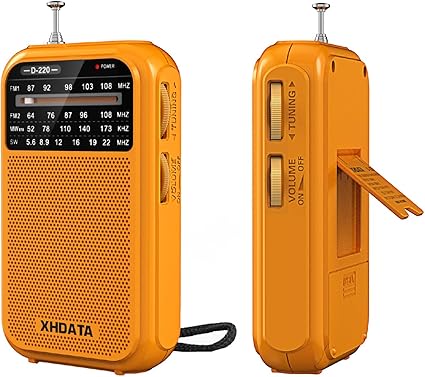
XHDATA D220 Portable AM FM Shortwave Radio is perfect for those who want access to AM, FM, and shortwave bands in a compact, lightweight device. Its main strength lies in excellent signal reception combined with portability, making it suited for travelers and radio enthusiasts who prefer a straightforward, easy-to-carry radio.
Turning it on requires just a twist of the volume/power switch button and selecting the band with a single switch. The tuning knob feels precise, allowing quick access to stations. It runs on AA batteries which keep it going for long periods without plugging in.
Holding it in one hand or slipping it in a pocket works well thanks to its small size and light weight.
Signal reception stands out across AM, FM, and shortwave frequencies, capturing stations clearly even in challenging locations. The casing feels sturdy and resists dust and minor shocks, useful when on the move. Some users note that despite its simplicity, the volume control could offer finer adjustment, and the absence of water resistance means extra care near moisture.
The radio’s strong signal reception delivers good clarity across multiple bands, appreciated for its portability and simple controls. The most noted drawback is the lack of water resistance, which requires careful handling to avoid damage from spills or rain.
People who want a lightweight, battery-powered radio for casual or travel use will find this model suitable. Those needing digital displays, finer volume control, or waterproof features should consider other options.
Pros
- Compact size fits easily in pockets or bags
- Clear reception across AM, FM, and shortwave bands
- Easy-to-use volume and tuning controls
- Lightweight and shockproof design
Cons
- No water resistance, not safe near moisture
- Volume control lacks fine tuning options
| Specification | Details |
|---|---|
| Radio Bands Supported | 3-Band, FM, AM, SW |
| Power Source | Battery Powered (AA batteries required) |
| Audio Output Mode | Stereo |
| Frequency Coverage | FM: 64-108 MHz, AM: 520-1730 KHz, SW: 5.6-22.0 MHz |
| Weight | 125g without batteries |
| Display Technology | Non-digital |
11. TIDRADIO TD-H9 GMRS Handheld Radio

Handling communication on the move feels surprisingly clear and versatile with the TIDRADIO TD-H9 GMRS handheld radio. Great for outdoor enthusiasts or anyone needing reliable range and multiple features, it stands out for its solid connectivity options and user-friendly interface. The blend of GPS, Bluetooth, and customizable buttons makes daily use feel intuitive and practical.
Setting up the radio involves straightforward pairing via Bluetooth, which allows connection to headphones or speakers without extra hassle. The dual PTT buttons, including a customizable side key, make switching channels or initiating calls quick during busy use.
Text messaging and APRS tracking keep communication flexible beyond regular voice. The USB-C port simplifies programming and updates, matching what advanced users want in a single handheld device.
Sound quality remains crisp over its maximum 10-kilometer range, handling outdoor conditions thanks to its IP54 water-resistant rating. The rugged body proves durable against rough handling while weight remains manageable for long outings. Most appreciate the combination of noise reduction and NOAA weather alerts, but some find the menu system slightly complex for quick adjustments in demanding situations.
Positive feedback highlights the device’s clear sound and long-range communication, alongside its ruggedness and useful additional features like GPS and Bluetooth. The main negative is the complexity of its menu, which some find challenging under pressure or in fast-paced settings.
Anyone needing advanced communication tools with easy Bluetooth setup and strong weather resistance will find this radio suitable. Those wanting a simpler, more streamlined interface might look elsewhere to avoid the menu learning curve.
Pros
- Long battery life of 72 hours for extended use
- Customizable dual PTT buttons give users better control
- Bluetooth connectivity for headphones and speakers
- Includes weather alerts and noise reduction features
Cons
- Menues can be complicated when quick changes are needed
- Single 9V battery usage may limit power options
| Specification | Details |
|---|---|
| Number of Channels | 199 |
| Water Resistance Level | Water Resistant (IP54) |
| Talking Range Maximum | 10 kilometer |
| Battery Average Life | 72 hours |
| Voltage | 7.4 volts of direct current |
12. Midland 75-822 AM/FM Handheld CB Radio

Compact and versatile, this CB radio works well for anyone needing both handheld and mobile options. Its biggest strength lies in switching between AM for traditional CB talk and FM for clearer audio with less static, fitting a variety of communication needs on the road or at worksites.
Setup is straightforward with the included mobile adapter for vehicle use, allowing easy connection to external antennas and 12V power. Carrying it around means relying on six AA batteries, which makes it easy to replace power anytime.
Switching between AM and FM channels, plus NOAA weather alerts, keeps you connected and informed no matter where you are.
Communication range reaches up to about one mile under normal conditions, delivering clear signals on all 40 CB channels. The automatic squelch helps reduce background noise, making conversations easier to hear.
The radio lacks water resistance, which is a downside in wet environments. Construction feels durable for regular use, though the bulky battery setup can make it a bit heavy to carry all day.
Clear audio on FM channels and handy NOAA alerts stand out as key benefits. Many users mention the absence of water resistance as a limitation during outdoor activities.
Ideal for those needing flexible use between handheld and vehicle setups, especially in dry conditions. Anyone frequently exposed to rain or looking for a lighter option may want to consider alternatives.
Pros
- AM/FM capability on all 40 channels
- Includes mobile adapter for vehicle use
- Automatic squelch reduces background noise
- 10 NOAA weather channels with alerts
Cons
- Not water resistant for outdoor use
- Uses six AA batteries, adding weight
| Specification | Details |
|---|---|
| Number of Channels | 40 |
| Frequency Range | 26.965 MHz – 27.405 MHz |
| Talking Range Maximum | 1 mile |
| Voltage | 0.01 volts |
| Number of Batteries | 6 AA batteries required |
Comparison of Top Handheld Radios Reviewed
| Product | Channels | Range | Power Source | Water Resistance |
|---|---|---|---|---|
| Baofeng UV-5R Radio | 128 | 5 kilometer | 1 Lithium Metal battery | Not Water Resistant |
| Cobra HH50WXST CB Radio | 40 | 20 mile | 9 AA batteries | Water Resistant |
| Portable Bluetooth Shortwave Radio | – | – | Rechargeable battery | – |
| Uniden PRO401HH CB Radio | 40 | 8 mile | 9 AA batteries | Not Water Resistant |
| Classic Portable AM FM Radio | – | – | Battery Powered | – |
| Midland GXT1000VP4 Radios | 50 | 36 mile | 8 AA batteries | Water Resistant |
| PRUNUS J-555 Pocket Radio | – | – | Rechargeable USB | – |
| Compact AM FM Transistor Radio | – | – | 1 Lithium Ion battery | – |
| PRUNUS J-166 AM FM Radio | – | – | 2 AA batteries | Not Water Resistant |
| XHDATA D220 Shortwave Radio | – | – | Battery Powered | Dust Resistant |
| TIDRADIO TD-H9 GMRS Radio | 199 | 10 kilometer | Rechargeable battery | IP54 Rated |
| Midland 75-822 CB Radio | 40 | 1 mile | 6 AA batteries | Not Water Resistant |
- Channels128
- Range5 kilometer
- Power Source1 Lithium Metal battery
- Water ResistanceNot Water Resistant
- Channels40
- Range20 mile
- Power Source9 AA batteries
- Water ResistanceWater Resistant
- Channels–
- Range–
- Power SourceRechargeable battery
- Water Resistance–
- Channels40
- Range8 mile
- Power Source9 AA batteries
- Water ResistanceNot Water Resistant
- Channels–
- Range–
- Power SourceBattery Powered
- Water Resistance–
- Channels50
- Range36 mile
- Power Source8 AA batteries
- Water ResistanceWater Resistant
- Channels–
- Range–
- Power SourceRechargeable USB
- Water Resistance–
- Channels–
- Range–
- Power Source1 Lithium Ion battery
- Water Resistance–
- Channels–
- Range–
- Power Source2 AA batteries
- Water ResistanceNot Water Resistant
- Channels–
- Range–
- Power SourceBattery Powered
- Water ResistanceDust Resistant
- Channels199
- Range10 kilometer
- Power SourceRechargeable battery
- Water ResistanceIP54 Rated
- Channels40
- Range1 mile
- Power Source6 AA batteries
- Water ResistanceNot Water Resistant
How to Choose the Best Handheld Radio
Choosing the best handheld radio involves considering range, battery life, durability, and ease of use. Prioritizing these factors ensures reliable communication and longer device lifespan, helping you avoid frequent replacements or failures during critical moments. Getting these right saves both money and hassle.
Range and Signal Quality
Trying to communicate over long distances with a device that frequently loses signal or has garbled audio can be frustrating. Radios vary widely in maximum range depending on terrain, weather, and obstructions. Models claiming several miles on paper often deliver much less in urban or wooded areas.
A reliable device maintains a clear audio connection up to at least a mile in challenging conditions and beyond five miles in open spaces.
Choosing radios that support both VHF and UHF frequency bands provides flexibility for different environments and uses. Having access to a good number of channels, typically 16 or more, helps avoid crowded frequencies, reducing interference and improving call quality.
Radios that offer frequency scanning can help find the best channel in noisy environments without manual switching.
Battery Life and Power Options
Running out of power during a critical moment is a common annoyance with handheld radios. Device battery life affects daily reliability, with many models lasting between 8 and 12 hours on a single charge during active use. Using devices that accept rechargeable battery packs is preferable for regular use since disposable batteries can get expensive and add weight when carried as backups.
Power-saving features like auto shut-off or low transmission power extend battery life in standby or low-demand settings. Radios with quick charging options allow for usable talk time after just 1 to 2 hours of charging, which is valuable in tight schedules.
Some devices also support charging via common USB cables, making recharging more convenient in the field.
Durability and Build Quality
Dropping radios or exposing them to rain or dust is common outdoor use, so rugged construction is essential. Many models come with an IP67 or IP68 rating, meaning they resist water immersion and dust intrusion, which keeps them working after accidental drops in puddles or dusty work sites.
The housing is usually built from dense ABS plastic or rubber-coated materials that absorb shock, and buttons often have firm tactile feedback to prevent accidental presses. Internal components need protection from impacts and vibration, so units that meet military-grade standards or offer reinforced internal mountings tend to last longer without malfunctioning.
User Interface and Ease of Use
Trying to operate a handheld radio with tiny, unlabeled buttons or a cramped menu system can be a hassle, especially in dark or cold conditions. Models with a backlit display or simple, well-spaced buttons make switching channels and adjusting volume easier without fumbling. Clear, legible displays that show channel numbers and battery status help prevent surprises during use.
Programming favorite channels in advance or through simple menus saves time in the field. Volume control that allows for quick adjustment helps stay in touch even in loud environments. Audio clarity is critical; radios with noise-canceling microphones or adjustable speaker volume prevent messages from getting lost amid background noise.
Compatibility and Additional Features
Devices supporting industry-standard frequencies ensure compatibility with other brands and emergency services, important for work or outdoor groups relying on cross-communication. Radios that can connect with popular headsets or external antennas expand usability, whether for hands-free operation or improved signal strength in fringe areas.
Additional features like emergency alert buttons that send distress signals, weather channels that provide real-time updates, and scanning modes to monitor multiple channels save effort and increase user safety. Features like these add practical value beyond basic communication and are worth considering depending on specific needs.
Optimizing Signal Range: Tips for Maximizing Your Handheld Radio’s Performance
Clear communication depends on a strong radio signal and proper antenna use. Positioning the radio higher, away from obstructions like buildings or dense trees, often improves reception.
Carrying the radio with the antenna fully extended prevents signal degradation. The quality and type of antenna also play a role; some handheld radios support aftermarket antennas suited for longer ranges.
Battery health impacts signal strength too. A low battery can reduce broadcast power, so replacing or recharging batteries regularly helps maintain consistent performance.
Tips for better signal:
- Hold the radio upright with the antenna vertical.
- Keep the antenna extended and avoid covering it with your hand.
- Avoid physical obstacles when possible or move to higher ground.
- Use the radio’s power boost settings when transmitting, if available.
Applying these simple steps can noticeably improve the effective range of handheld radios in everyday use.
Essential Maintenance Practices to Extend the Lifespan of Your Handheld Radio
Regular cleaning and proper storage significantly affect how long a handheld radio remains functional. Dirt, dust, and moisture can build up in buttons, ports, and antenna connections, leading to performance issues or failure.
After outdoor use, wiping the radio with a dry, soft cloth removes grime. Avoid using solvents or immersion in liquids. When the unit gets wet, dry it thoroughly as soon as possible.
Store the radio in a cool, dry place away from direct sunlight to prevent battery damage.
Key maintenance points include:
- Check and clean battery contacts periodically.
- Inspect the antenna for damage and replace if necessary.
- Test buttons and knobs regularly to ensure responsiveness.
- Keep firmware updated if the model supports it.
Following these practices helps avoid common issues and extends the life span of your handheld radio.
Comparing Handheld Radios with Mobile and Base Station Units: When to Choose Each
Handheld radios offer portability and are convenient for short-range communication, making them suitable for on-the-go use, outdoor activities, and quick coordination tasks. Mobile units are typically installed in vehicles, providing more power and better antennas for extended range while staying connected on the move.
Base station radios have higher power output, larger antennas, and more features for fixed locations like offices or emergency centers. They support longer communication distances and multiple users simultaneously.
How to choose:
- Pick handheld radios for flexibility and ease of carrying.
- Use mobile radios when a vehicle is your main base and you need wider coverage while driving.
- Choose base stations for permanent setups with the highest power needs and advanced features.
The decision depends on mobility requirements, range expectations, and intended communication environments.
People Also Asked
How Long Does a Handheld Radio Battery Typically Last on a Single Charge?
Battery life on a handheld radio usually ranges from 8 to 12 hours with moderate use. Keeping the radio on standby mode instead of full transmission can extend battery life during long trips or shifts.
What Are Common Safety Precautions When Using a Handheld Radio?
Avoid operating the radio near water unless it is waterproof, and keep it away from explosive environments. Maintaining a secure grip and using a clip or case prevents drops and damage while in use.
Will This Handheld Radio Work with My Existing Communication System?
This depends on the radio’s frequency range and coding capabilities; most standard handheld radios work on common frequencies like FRS or GMRS. Matching the channel and privacy codes with your system ensures clear, secure communication.
How Do I Properly Care for and Clean a Handheld Radio?
Use a soft cloth to wipe the radio clean, avoiding harsh chemicals which can damage the plastic. Regularly check the battery contacts for corrosion and keep the charging port free of debris to maintain connection quality.
What Size Handheld Radio Is Easiest to Carry During Outdoor Activities?
Compact models weighing less than 8 ounces are the easiest to carry and handle outdoors. Choose a radio with an ergonomic design that fits comfortably in your hand or pocket without adding bulk.
Conclusion
Choosing the right handheld radio depends mostly on range, battery life, and durability. It’s important to consider how far you need to communicate, how long the radio should last on a charge, and whether it can handle outdoor conditions if that’s where you’ll be using it. These factors will affect how well the radio performs for your needs.
Think about how often and where you’ll use the radio to decide which features and price range make sense. Take another look at the comparison table and product details above to see which model fits best with your specific requirements and budget. Matching the radio to your daily use will save time and money in the long run.

I’m Grant Mitchell, a firearms and hunting writer with years of experience at the range and in the field. I write about rifles, shotguns, handguns, optics, safe storage, cleaning, and responsible ownership, along with practical hunting tips. My goal is to share accurate, safety-first information that helps you choose the right firearm, maintain it properly, and become a more confident shooter.